

EC Website Creation for Kitchen Knife Sales
Building a fast, multilingual e-commerce site for a Sakai-based kitchen knife store, boosting traffic and international sales through Shopify and Webflow integration.


Expanding into Japan represents a significant opportunity, but also one of the most culturally and operationally demanding moves a business can make. While Japan is a global leader in innovation, consumer sophistication, and economic strength, it’s also a market where trust, nuance, and precision define success.
Localization is not simply a matter of translating content—it’s a full-spectrum strategy. From adapting product features to aligning customer service and refining your brand voice, successful Japanese localization means creating a presence that feels native, relevant, and trustworthy.
This article serves as your in-depth guide to understanding what localization in Japan truly entails. Whether you're launching a product, building a service model, or entering Japan’s digital marketing ecosystem, we'll break down the critical components—from market readiness and product adaptation to cultural messaging and platform-specific promotion.
Before you begin the localization process, it’s essential to take a step back and ask the most critical question: Should you even enter the Japanese market?
Localization is a powerful tool, but without product-market fit, no amount of translation, transcreation, or adaptation can compensate for poor alignment. Japan is a lucrative and advanced economy, but it is also highly regulated, culturally distinct, and demanding in terms of quality and service.
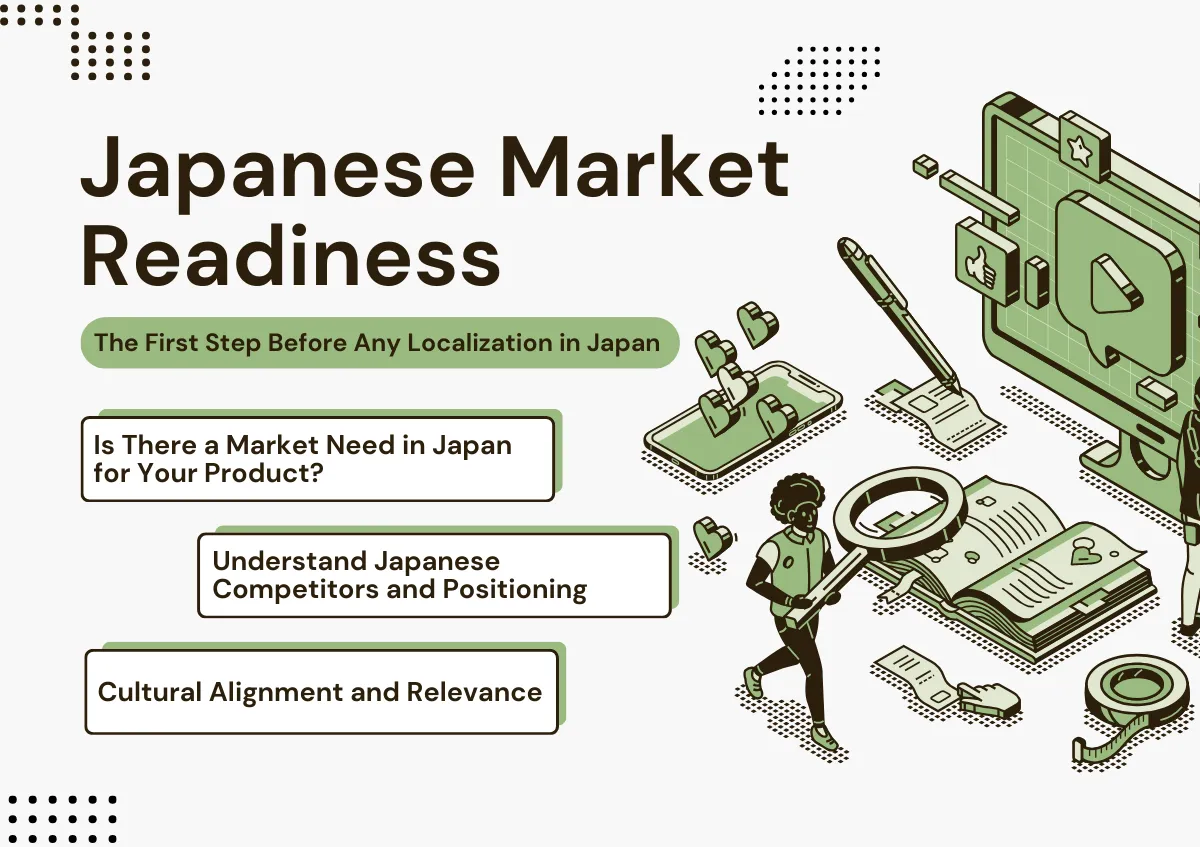
This section will help you evaluate your readiness by breaking down three fundamental areas: market demand, competitive positioning, and cultural alignment.
Before any localization in Japan, your first step is to assess whether the product or service you're offering is actually wanted—and needed—in the Japanese market.
Start by asking:
For instance, a dietary supplement that’s successful in the U.S. might face two major issues in Japan:
Even if your product has been successful in Western markets, that success does not automatically translate to Japan. Investing in market validation—through consumer testing, focus groups, or even cross-border eCommerce pilots—can prevent costly missteps later.


After confirming demand, the next critical step is understanding the competitive landscape in Japan. Localization means very little if you're entering a saturated market or if you can’t position your product clearly against local alternatives.
Ask yourself:
Example:
If you're selling a skincare product tailored to anti-aging, you’ll be up against entrenched Japanese brands like Shiseido or Fancl. These companies not only dominate distribution channels but also benefit from deep cultural trust and marketing tailored to Japanese values (e.g., subtlety, safety, ritual). Simply translating your ad campaign and adjusting packaging won’t be enough. You’ll need to define whether you’re offering something truly differentiated—maybe more natural, more tech-forward, or better suited for niche skin types.
At this stage, conducting a SWOT analysis or benchmarking exercise is incredibly useful. Many global companies falter not because they lack a good product, but because they don’t know how to position it effectively within the Japanese market context.
Even if your product passes the demand and competition checks, it must still resonate culturally with Japanese consumers. Cultural fit is often the most overlooked barrier in localization for Japan, and it can be the hardest to fix once you're already in the market.
Consider:
For example, a haircare brand designed for thick, curly hair textures may be irrelevant in Japan, where most consumers have straight or fine hair and seek entirely different performance characteristics. The base product itself, not just the packaging or instructions, would need to be re-engineered to gain traction.
Likewise, products that rely on bold, edgy, or confrontational branding often need to be softened or reimagined entirely. Japanese consumers tend to appreciate polished, respectful, and understated communication.
Understanding this cultural dynamic is critical not just for your marketing team but for product developers, designers, and executive leadership. It will shape how your brand is perceived and whether or not it will be accepted into everyday Japanese life.
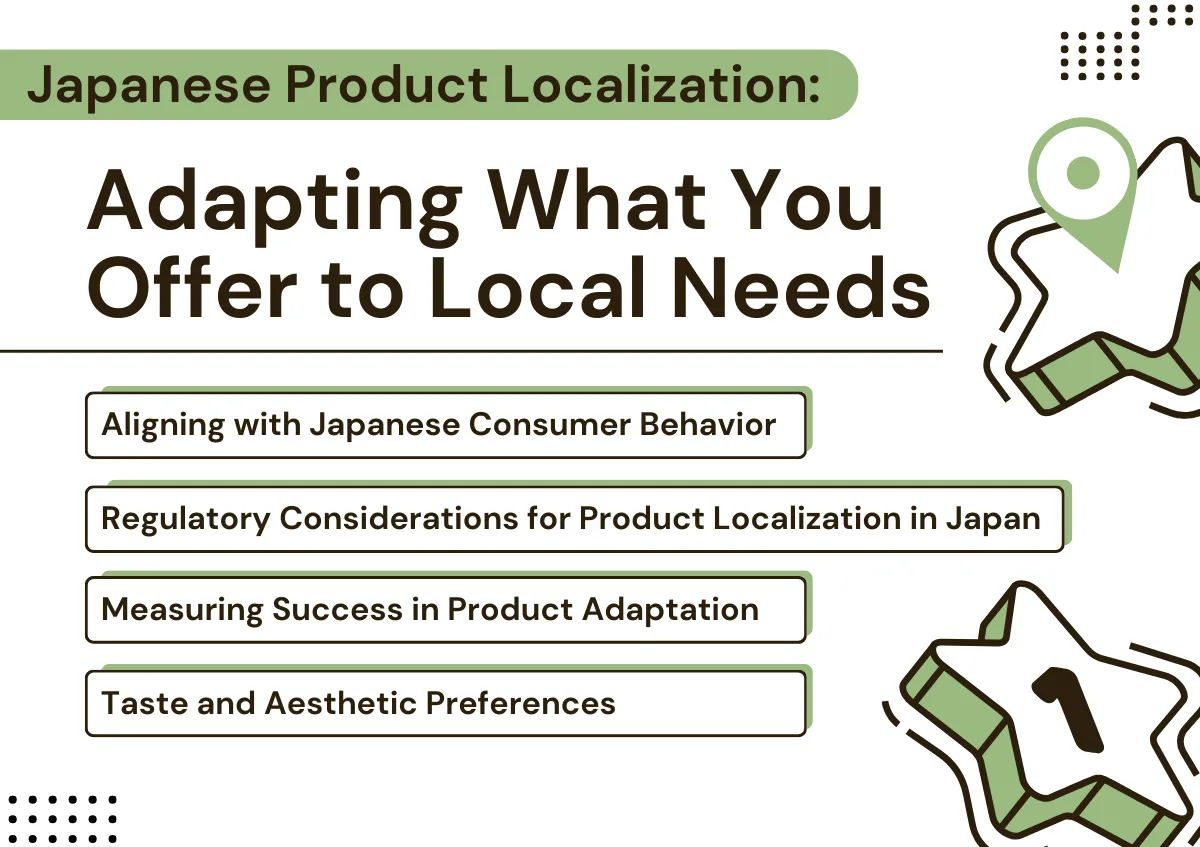
Japanese consumers expect quality, precision, and usability, and they rarely compromise on any of these. Successfully localizing a product for Japan means more than just translating a manual or adjusting packaging. It often requires rethinking the form factor, features, aesthetics, branding, and even ingredients to meet the expectations of one of the most discerning consumer markets in the world.
Let’s explore the key areas where product adaptation is essential and what best practices can help ensure success.
Japanese consumers are known for their high attention to detail and demand for polish in both physical and digital products. From software interfaces to kitchen appliances, the standard is clear: everything must be intuitive, cleanly designed, and function flawlessly.
What this means for localization:
Example:
TechPro Innovations, a North American smart home company, miniaturized their devices and enhanced energy efficiency for Japan’s compact urban homes. They also developed a localized app with culturally familiar icons and full Japanese support. The result? 200% YoY growth and recognition as “Best Localized Smart Home Product” in Japan.
Japan has a well-deserved reputation for being heavily regulated, especially in product categories that impact public health or safety. These laws are enforced strictly, and non-compliance can result in product bans, fines, or reputational damage.
Which industries need to be extra cautious?
Example:
A U.S. energy drink brand promoting “fat-burning” or “mental sharpness” may face immediate rejection or legal issues in Japan unless it rewords its claims and provides scientific evidence that meets local standards.
Before launching, companies should consult a local regulatory expert or legal advisor to conduct a pre-market review. Failing to do so could derail even the most promising localization efforts.
Even if a product works perfectly and passes all legal hurdles, it must still look, feel, and taste “Japanese.” Cultural aesthetics are deeply ingrained in the buying decision, and a poor fit here can mean rejection at first glance.
What this means for localization:
Example: A skincare brand that uses bold neon colors and edgy fonts in its Western packaging may struggle in Japan, where consumers equate subtle tones and calming design with safety, purity, and quality.

To know whether your localized product is resonating in Japan, you need to track more than just sales. Success is tied to perception, feedback, and strategic growth in the local context.
Key metrics to monitor:
Product localization in Japan is multi-dimensional. It’s not just about language—it’s about taste, texture, design, regulation, and even emotional resonance. Successful companies treat localization as an opportunity to innovate, developing Japan-exclusive variants, packaging tailored for gifting, and campaigns that celebrate cultural alignment.
Adapt with intent, test with local users, and collaborate with Japanese experts. The payoff? A stronger foothold in one of the world’s most brand-loyal and quality-focused markets.
Great products fail in Japan without excellent service—expectations are high.
In Japan, outstanding service isn’t a competitive advantage—it’s the standard. This expectation extends beyond in-store hospitality into every aspect of after-sales support, delivery, and customer interaction.
At the heart of Japanese service culture is the concept of Omotenashi—a deep-rooted philosophy of hospitality that emphasizes anticipating customer needs and delivering exceptional experiences without expecting anything in return. For foreign companies, this means localizing service operations just as thoroughly as products and marketing. Here’s how.
In Japan, language proficiency is directly tied to brand trust. A support agent who’s not completely fluent, or customer service that feels "foreign" risks undermining the consumer’s confidence in your product, no matter how good it is.
What it requires:
Example:
If a customer reaches out via phone and encounters a non-native speaker with 80% fluency, it can immediately diminish your credibility, even if the information provided is technically correct. The Japanese consumer may interpret this as a lack of seriousness or professionalism, resulting in dissatisfaction or churn.
Best practices:
Japan sets the gold standard for logistics. From same-day delivery in Tokyo to precisely timed courier drop-offs, punctuality and precision are non-negotiable. Poor fulfillment erodes customer trust faster than in many other markets.
What Japanese customers expect:
Example:
In the U.S., a one-day shipping delay might be frustrating. In Japan, the same delay can spark negative reviews, returned orders, or even platform penalties (especially on Rakuten and Amazon). Japanese consumers interpret missed timelines as a failure to uphold the service promise.
Fulfillment best practices:

Beyond customer conversations, your support infrastructure—policies, processes, and guarantees—must feel localized. Japanese consumers look for transparency, fairness, and formality in after-sales policies.
What to localize:
Best practices:
Service localization in Japan goes far deeper than call center hours or chatbot scripts. It is about earning long-term trust through respect, clarity, precision, and cultural sensitivity. Japanese customers don’t just want a helpful answer—they want it delivered with the right tone, at the right time, by the right person, and wrapped in politeness.
By investing in native-level support, flawless logistics, and localized after-sales care, your company signals that it takes Japan seriously, not just as a market, but as a culture.
Marketing in Japan requires precision, subtlety, and the right platforms.
Japanese consumers are highly discerning and culturally sensitive, and they expect brand communication to reflect those values. Whether B2C or B2B, success in the Japanese market depends on your ability to earn trust, adapt your tone, and connect through local channels. Translation is only the starting point—effective marketing in Japan requires deep localization of both message and method.
In Japan, success in marketing often hinges on utilizing the right communication tools. Foreign businesses that assume global platforms like WhatsApp or Facebook Messenger will suffice risk missing a significant portion of their target audience.
Key platforms in Japan:
Example:
Many Japanese businesses run LINE-exclusive campaigns, such as member coupons, seasonal offers, and chat-based customer support. A brand’s absence from LINE could make it seem unfamiliar or inaccessible to local consumers.
Best practices:
Transcreation—the art of rewriting content for a different cultural context—is critical in Japan. A direct translation of your Western campaign may miss the mark entirely, either failing to resonate or causing unintended offense.
Cultural dynamics to consider:
Example:
A U.S. ad campaign built around the theme of “freedom” may not perform well in Japan, where themes like “belonging,” “trust,” or “effort” are more emotionally powerful. Instead, the same message might be adapted to emphasize working together, inner strength, or community success.
Case in point: KitKat’s success in Japan was significantly boosted by a transcreation that turned its name into a good-luck pun ("Kitto Katsu"), connecting it to exam season gift-giving culture. That local emotional hook helped the brand dominate Japan’s chocolate market.
Tips for transcreation:
In Japan, how you say something matters just as much—if not more—than what you're saying. Marketing messages should be formal, polished, and emotionally appropriate. Even minor missteps in tone or formality can significantly damage brand perception.
Avoid:
Embrace:
Example:
In B2B, trust and credibility are paramount. Campaigns should focus on long-term value, consistency, and respect, rather than short-term pricing advantages. For consumer brands, tone down exaggerated claims and focus on storytelling, tradition, and connection.
Visuals also matter. Consider cultural symbols, color psychology (e.g., red and gold for celebration, white for cleanliness), and seasonal design motifs. Brands like Coca-Cola and McDonald’s Japan excel here, with limited-edition cherry blossom packaging in spring and seasonal flavors like sakura mochi pie.

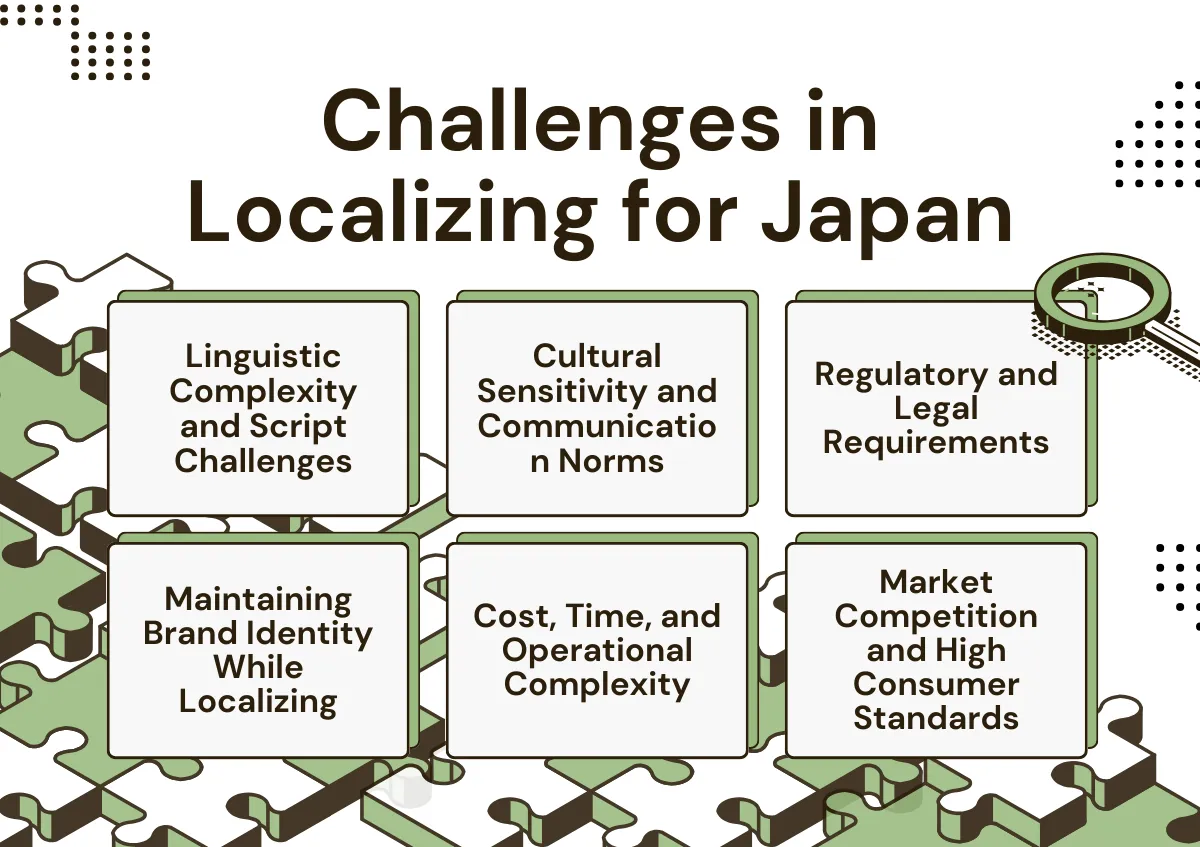
Japan is one of the most attractive yet complex markets for global companies. While its economy is large, stable, and highly developed, localizing for Japan is uniquely challenging. Success requires more than linguistic accuracy—it demands deep cultural understanding, strategic investment, and adaptation at every level, from software to packaging, from UI design to brand messaging.
Let’s explore the key localization challenges businesses face when entering the Japanese market.
Japanese is one of the most challenging languages to localize accurately. It employs three different writing systems—kanji, hiragana, and katakana—each with specific use cases, formality levels, and visual implications.
Key issues include:
Solution:
Employ professional translators and native linguists who specialize in transcreation and industry-specific terminology, and conduct UX testing with Japanese users.
Japanese culture is characterized as high-context, formal, and deeply nuanced. Localization efforts must extend far beyond language to align with cultural expectations and communication styles.
Challenges include:
Solution:
Conduct thorough cultural reviews of all assets, work with local experts, and consider regional segmentation in your marketing or sales strategy.
Japan has strict laws and compliance standards, particularly in areas like health, tech, e-commerce, and data privacy.
Key challenges:
Solution:
Partner with local legal advisors and regulatory consultants to ensure all your content, processes, and products comply with Japanese law.
One of the most significant strategic hurdles is preserving your brand’s global essence while localizing enough to feel authentically Japanese.
Tensions include:
Solution:
Create a Japan-specific brand strategy that defines how global values translate into local messaging. Use flexible brand guidelines that allow for adaptation without fragmentation.
Effective localization for Japan demands substantial investment in time, resources, and strategic planning.
Challenges include:
Solution:
Prioritize localization efforts based on market potential and ROI, and consider a phased rollout of product lines or services. Use a local partner network to reduce internal overhead.
The Japanese market is saturated with high-quality domestic and foreign brands. Consumers are loyal, but extremely discerning, and they expect excellence in every detail, from grammar to customer service tone.
Other complications:
Solution:
Invest in local hiring, consumer research, and long-term trust-building strategies. Don’t rely on brand novelty alone—demonstrate reliability and cultural fluency.
Succeeding in Japan is not about quick wins or simple adaptation. It’s about deep alignment with one of the world’s most culturally rich and customer-focused markets. Businesses that thrive here understand that localization is a strategic commitment, not a checkbox. They invest in language accuracy, emotional relevance, regulatory readiness, and consumer empathy.
Localization isn’t about changing who you are—it’s about respectfully evolving your brand to fit into Japan’s cultural fabric without losing your core identity. And when that’s done well, the reward is lasting: brand equity, loyal customers, and sustainable growth in a region that values depth over hype.

At IGNITE, we don’t just help you translate—we help you thrive.
As a team of multilingual Japanese and foreign digital marketing specialists based in Osaka, we serve as your local marketing division, not an agency you outsource to, but a partner you integrate with. From market research and strategy to translation, content creation, advertising, and full-scale digital campaigns, we help you localize, scale, and succeed.
We specialize in:
Whether you're just entering the Japanese market or ready to scale, IGNITE is here to bridge the language, cultural, and strategic gaps—with speed, quality, and clarity.
Let’s IGNITE your brand in Japan.
Contact us for a consultation and market localization strategy tailored to your business.
EN-JA bilingual project manager with experience leading Japanese translation and localization projects. Oversees SEO-focused content quality, production, and coordination.

Building a fast, multilingual e-commerce site for a Sakai-based kitchen knife store, boosting traffic and international sales through Shopify and Webflow integration.
Localizing over 1,100 sake and shochu listings into English, driving a 148% increase in inquiries through SEO-focused translation and website optimization.

Delivering accurate Japanese-English localization for a pet product website, optimizing industry-specific vocabulary to support international marketing expansion.

Providing high-quality multilingual translations for a pet supplies brand’s brochures and website, ensuring global appeal at international exhibitions.

Translating YouTube content into four languages to help a Japanese fitness creator grow global views by 132% through SEO-optimized subtitles, tags, and descriptions.

Providing comprehensive translation services, we supported a global food delivery app in translating over 30,000 restaurant menus into English with speed, accuracy, and scalability.
Find the right service to grow your business in Japan.