Japan’s business landscape demands more than just competitive products—it requires exceptional customer service rooted in its unique cultural values. This guide shows international SMEs how to master Japan customer service, avoid common pitfalls, and build trust with discerning consumers. With practical strategies and cultural insights, it offers a roadmap to achieving loyalty, reputation, and long-term growth in one of the world’s most demanding markets.
Expanding into Japan offers international businesses immense potential, but success depends on more than product quality or competitive pricing. In Japan, customer service is not just an operational function but a reflection of values such as respect, attentiveness, and harmony. For small and medium-sized enterprises (SMEs), the bar for service is often higher than in many Western markets, which can feel daunting at first.
This guide explores what makes Japanese customer service unique, the common mistakes foreign businesses should avoid, and practical strategies SMEs can use to thrive. By learning how to deliver the kind of experience Japanese consumers expect, you can unlock loyalty, protect your reputation, and build a sustainable presence in one of the world’s most discerning markets.
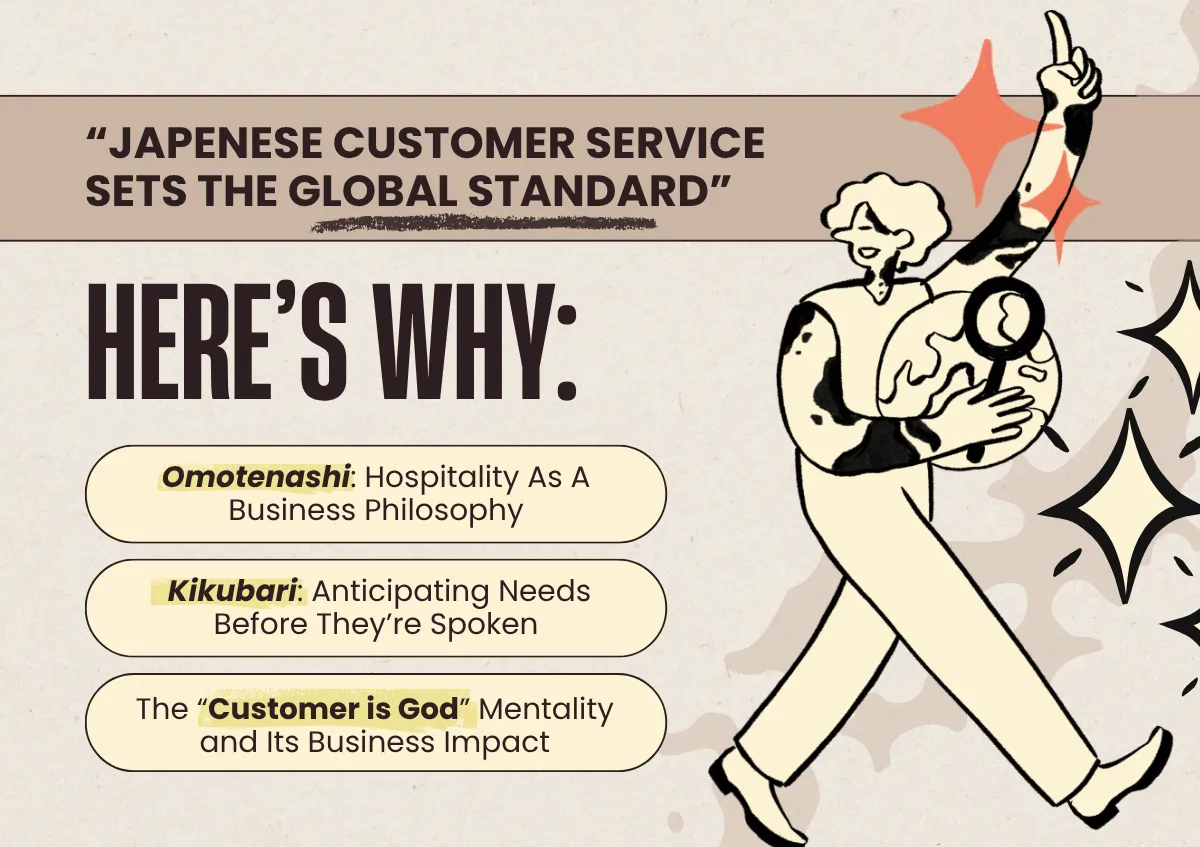
Why Japanese Customer Service Sets the Global Standard
Customer service in Japan is more than a business function; it’s a reflection of cultural values, social harmony, and centuries-old traditions of hospitality. While many countries pride themselves on friendly or efficient service, Japan’s approach is distinctive in its consistency and depth. From the neighborhood convenience store to five-star hotels, customers encounter the same high standards of respect, attentiveness, and care.
For international businesses, particularly small and medium-sized enterprises (SMEs), understanding these expectations is crucial. What might be considered “above and beyond” in the United States is often seen as the baseline in Japan. This section examines three cornerstones of Japanese customer service: omotenashi, kikubari, and the “customer is God” mentality, and compares them with Western practices.
Omotenashi: Hospitality As A Business Philosophy
The foundation of Japanese customer service lies in omotenashi, a philosophy of hospitality that emphasizes sincerity, humility, and care for others without expecting anything in return. Its roots go back to cultural practices like the tea ceremony and traditional inns (ryokan), where hosts anticipated every guest’s need, from room temperature to tea refills, often without the guest saying a word.
For modern businesses, omotenashi translates into meticulous attention to detail. Small gestures, such as bowing upon entry, neatly wrapping even low-cost items, or following up after a purchase, all reflect a mindset that every customer deserves respect and appreciation.
Contrast with the U.S.
In America, customer service is often framed around friendliness, efficiency, and the idea that “the customer is always right.” While these principles can lead to excellent experiences, they’re also inconsistent. Some interactions feel warm and proactive, while others feel transactional or rushed. By comparison, Japanese service aims for consistency: every customer should receive the same level of care, regardless of the price point or circumstance.
Takeaway for SMEs
You don’t need to mimic Japanese rituals, but adopting the omotenashi mindset of treating every interaction as an opportunity to delight can immediately differentiate your brand in Japan.
Kikubari: Anticipating Needs Before They’re Spoken
Kikubari (literally “to spread one’s attention”) is the art of noticing and responding to unspoken needs. It goes beyond politeness; it’s about being so attuned to your customers that you solve problems before they arise.
For example, in a Japanese café, staff may quietly bring a glass of water when they notice you’ve been sitting for a while, or in a retail store, a clerk may discreetly offer a basket the moment your hands are full. These gestures are not grand, but they communicate attentiveness and empathy.
Cultural Difference
In the U.S., customers are generally expected to voice their needs. If you want more water, you ask. If a product is out of stock, you inquire. Americans value directness, so service providers are often reactive rather than anticipatory. In Japan, by contrast, waiting for the customer to ask may already be seen as a service failure.
Anecdote (Illustrative of Cultural Gap)
An American living in Japan recalled being reprimanded at work for the sound of his shoes disturbing colleagues. To him, this was a minor, personal issue; but to his Japanese coworkers, not noticing the impact on others reflected a lack of kikubari. What seems small or invisible in one culture can carry enormous weight in another.
Takeaway for SMEs
Training staff in kikubari doesn’t require them to “act Japanese.” Instead, the focus should be on observing carefully, anticipating simple needs such as extra explanation, reassurance, or a timely follow-up, and responding with care and consideration. This level of attentiveness quickly builds trust with Japanese consumers who have come to expect proactive service.
The “Customer is God” Mentality and Its Business Impact
A phrase often heard in Japan is “Okyakusama wa kamisama (the customer is God).” While meant metaphorically, it reflects how deeply businesses prioritize customer satisfaction. Employees are trained to apologize sincerely for even minor inconveniences, keep promises diligently, and resolve issues without excuses.
Comparison to the U.S.
American businesses often rely on goodwill gestures (discounts, replacements, store credits) to manage complaints. But apologies may feel perfunctory, and policies sometimes emphasize protecting the business first. In Japan, the apology itself carries enormous cultural significance, often outweighing the value of compensation. Customers expect humility, accountability, and visible effort to restore trust.
Risks for Foreign Businesses
For international companies, especially SMEs, failing to grasp the mentality of the customer being “God” can backfire. Even if your product is excellent, poor handling of a complaint (delayed response, inadequate apology, or defensive explanation) can erode brand reputation quickly. Japanese consumers rarely complain directly; instead, dissatisfaction circulates quietly through word-of-mouth or online reviews.
Takeaway for SMEs
You don’t need to worship customers, but you must demonstrate genuine accountability. Practical, low-cost actions include:
Always apologizing first, even if the issue isn’t technically your fault.
Keeping promises and following up when you say you will.
Training staff to use respectful, formal language when addressing concerns.
Done consistently, these small efforts signal respect, which is the true meaning behind the “customer is God” ethos.
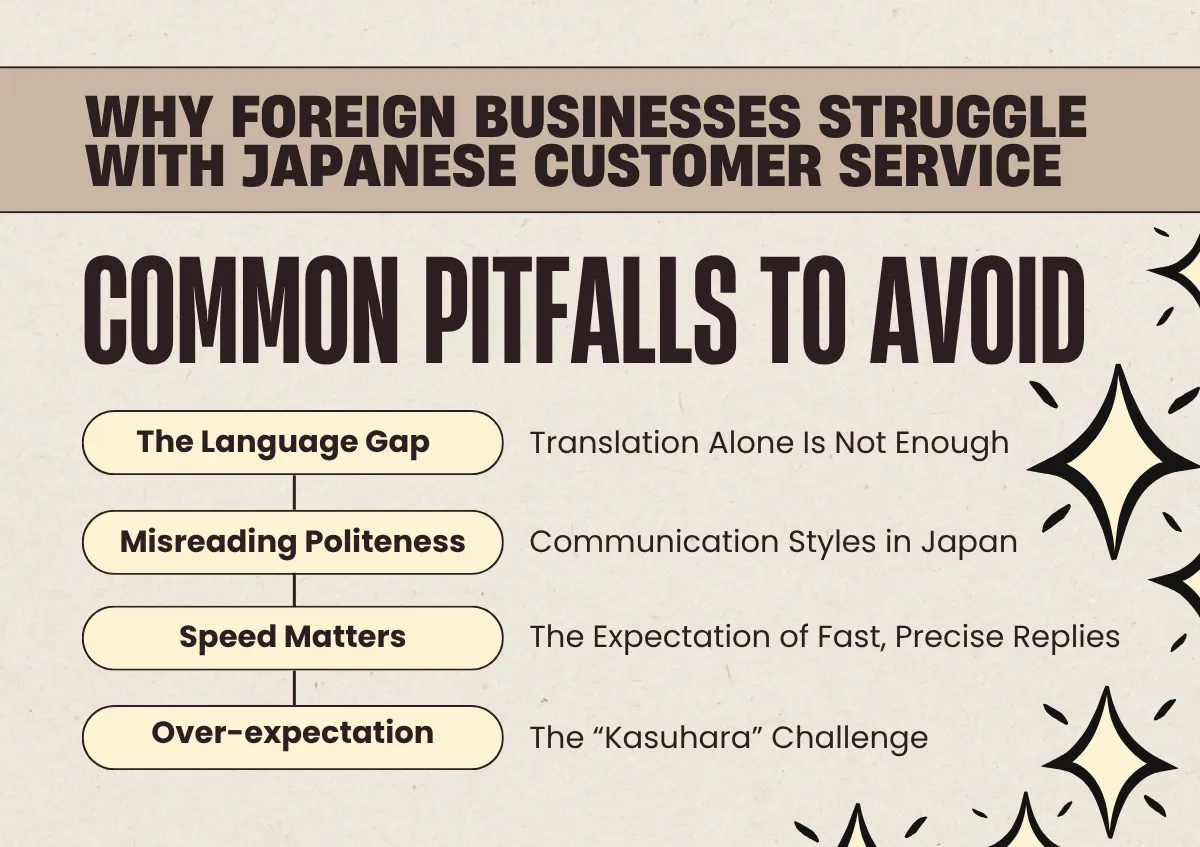
Why Foreign Businesses Struggle with Japanese Customer Service: Common Pitfalls to Avoid
Even companies with excellent customer service reputations in their home markets often stumble in Japan. The challenge is not a lack of effort, but a gap in cultural expectations. Japanese consumers hold service providers to unusually high standards of attentiveness, politeness, and speed. What is considered acceptable in the United States or Europe may come across as careless or even disrespectful in Japan.
This section highlights the most common pitfalls that international businesses face and provides guidance on how to avoid them.
The Language Gap: Why Translation Alone Is Not Enough
Beyond Word-for-Word Translation
Many foreign companies believe hiring a translation agency or relying on bilingual staff is sufficient. However, Japanese communication is deeply nuanced. Choosing the wrong word or level of politeness (keigo) can unintentionally alienate customers. For example, “ごめんなさい” (gomen nasai) may sound casual, while “すみません” (sumimasen) is more professional in customer service contexts.
Japanese uses three writing systems (kanji, hiragana, katakana), each with different connotations. Even a simple word like “I” can be written as 私, わたし, or ワタシ, with each carrying different tones (formal, soft, casual). A machine translation or a non-native writer may choose a version that clashes with the brand’s image.
Comparison with the U.S.
In the U.S., tone matters, but customers are generally forgiving if the message is clear and concise. A casual “Sorry about that” in customer service may suffice. In Japan, the wrong choice of wording signals carelessness and can erode trust.
Misreading Politeness: Communication Styles in Japan
Indirectness and Non-Confrontation
Japanese customers rarely complain directly. Instead, they may simply stop using your service, or quietly spread negative feedback within their networks. What feels like “no complaints” to a Western company may actually indicate dissatisfaction.
The Role of Apologies and Humility
In Japan, a sincere apology often matters more than compensation. A company that takes responsibility immediately is seen as trustworthy. In the U.S., however, customer service usually emphasizes problem-solving first, with an apology added as a courtesy.
Comparison with the U.S.
Americans value clear, direct communication. Customers often state their frustrations openly and expect fast, pragmatic solutions. Japanese customers, by contrast, may avoid confrontation altogether, requiring staff to pick up on subtle cues and respond preemptively.
Takeaway for SMEs
Train staff to interpret silence or polite language as potential signs of dissatisfaction. A proactive follow-up email or call in Japanese can prevent customer churn.
Speed Matters: The Expectation of Fast, Precise Replies
The Standard of Promptness
In Japan, even minor delays in response times can harm a company’s reputation. Customers expect quick acknowledgment of their inquiries, even outside of standard business hours. Response speed is often viewed as a reflection of reliability.
Precision and Detail
Japanese customers also expect answers to be accurate and complete. A vague or partial response can frustrate them more than waiting a little longer for a complete solution.
Comparison with the U.S.
American consumers value speed, but they often accept automated responses or chatbots if these solutions efficiently resolve the problem. In Japan, customers still prefer the human touch, although automation is slowly gaining ground.
Takeaway for SMEs
Establish Japanese-language support channels with dedicated staff. Even if full 24/7 support is not possible, ensure quick acknowledgment with a culturally appropriate response.
When Expectations Go Too Far: The “Kasuhara” Challenge
Understanding Kasu-Hara
“Kasu-Hara” (short for “customer harassment”) refers to situations where customers exploit the “customer is always right” mentality, making unreasonable demands or treating staff in an abusive manner. The issue has become more pronounced in recent years as customer expectations continue to rise, making it essential for businesses to protect staff with clear policies and support systems.
The TraditionalChallenge
Historically, businesses in Japan have tolerated demanding or even abusive customer behavior, often prioritizing customer satisfaction over employee well-being. As labor shortages intensify, however, more companies are drawing clear boundaries through anti-harassment policies and structured escalation protocols.
Comparison with the U.S.
In the U.S., companies often have clear policies against abusive customer behavior, allowing them to terminate accounts or refuse service. Japanese businesses have only recently begun to adopt similar measures.
Takeaway for SMEs
Protect your Japanese staff by setting clear internal guidelines for handling abusive customers. A balance between respecting customers and safeguarding employees will be increasingly crucial for building sustainable operations in Japan.
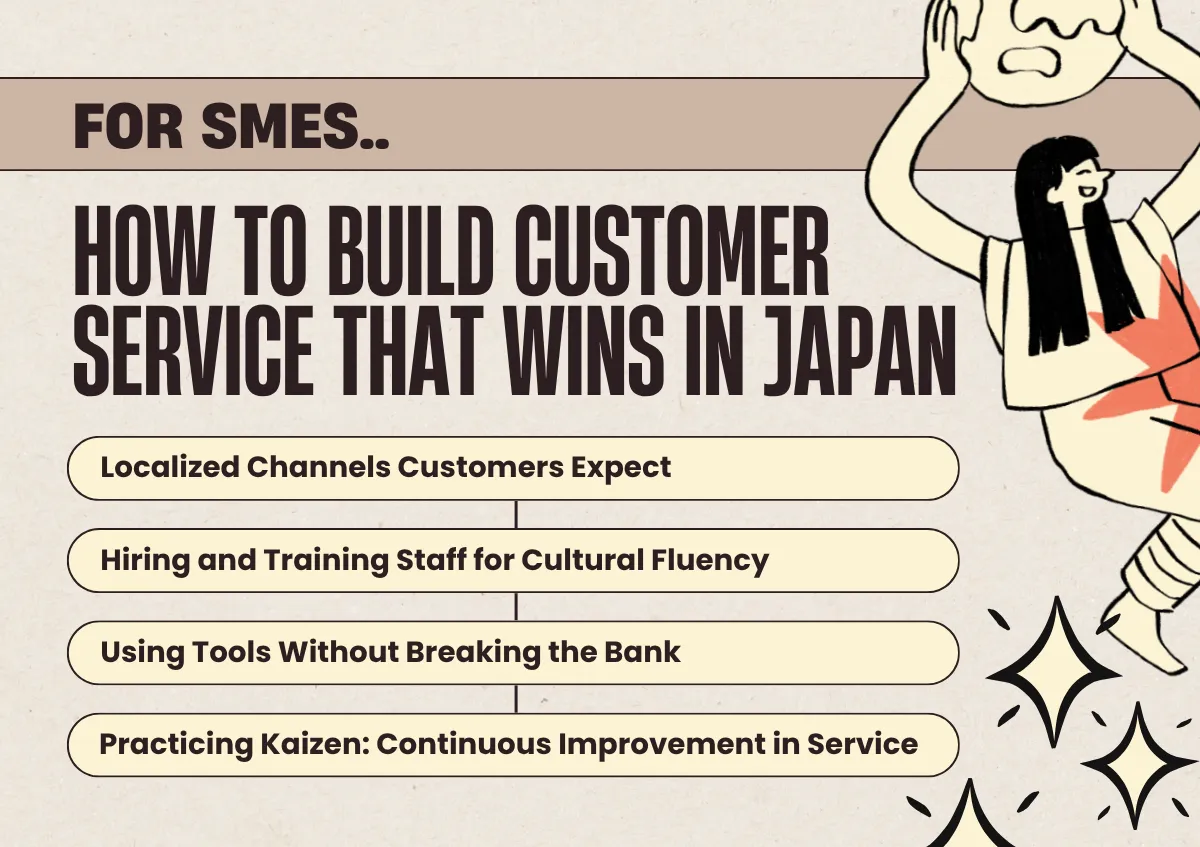
How SMEs Can Build Customer Service That Wins in Japan
Small and medium-sized businesses often assume that only large corporations can afford the type of customer service Japanese consumers expect. In reality, even with limited resources, SMEs can build a service culture that earns loyalty and trust. The key lies in adapting to Japanese preferences, training staff to go beyond language fluency, utilizing technology effectively, and committing to ongoing improvement.
Localized Channels Customers Expect
Japanese consumers expect to reach businesses through familiar, trusted channels. Unlike in the U.S., where phone and email still dominate for many SMEs, Japanese customers often prefer messaging platforms and mobile-first solutions.
Despite the rise of digital channels, phone support remains a non-negotiable option for Japanese customers. Clear communication, active listening, and a polite tone are essential for effective interactions. In the U.S., customers often accept shorter, more transactional phone calls. In Japan, calls may run longer as staff are expected to listen carefully and provide thorough responses.
LINE: Japan’s Messaging Standard
Whereas U.S. businesses often rely on Facebook Messenger or SMS for quick customer interactions, in Japan, LINE is the dominant messaging app. Offering customer service through LINE is often seen as a baseline expectation rather than an innovation. SMEs that adopt LINE for order updates, inquiries, and promotions demonstrate their commitment to serving the Japanese market.
Email and Chat: The Importance of Polished Replies
Japanese consumers expect well-structured, polite, and detailed responses in email. Unlike in the U.S., where short and casual replies are acceptable, Japanese emails often follow strict etiquette and formatting rules. Live chat is also gaining popularity, but it must strike a balance between speed and formality.
Hiring and Training Staff for Cultural Fluency
Language skills alone are not enough to succeed in Japanese customer service. Staff must understand the cultural expectations, communication styles, and nuances of politeness that shape customer interactions.
Beyond Bilingualism
U.S. companies expanding to Japan often prioritize bilingual staff, but focusing too heavily on language skills can limit the available talent pool. Cultural fluency is usually more valuable. A native Japanese employee who thoroughly understands service expectations will often outperform a bilingual hire who lacks cultural awareness.
Communication Training
In the U.S., service training often emphasizes friendliness and efficiency. In Japan, training must include keigo (honorific language), active listening, and appropriate forms of apology. For example, “sumimasen” is often more suitable than “gomen nasai” in business contexts, a nuance that foreign staff must be taught.
Hiring Differences: U.S. vs. Japan
U.S. hiring often rewards individuality, past achievements, and proactive personalities.
Japanese hiring values group harmony, respect for hierarchy, and long-term loyalty.
For SMEs, emphasizing teamwork and patience during hiring can be more effective than seeking purely “go-getter” profiles.
Using Tools Without Breaking the Bank
SMEs do not need enterprise-scale budgets to provide high-quality service. The right mix of affordable tools can help bridge the gap between limited staff capacity and high customer expectations.
CRM Systems for SMEs
While U.S. businesses often adopt large-scale platforms like Salesforce, Japanese SMEs may benefit from lightweight, affordable CRMs that integrate with LINE or email. Options like Zoho or HubSpot Starter plans allow SMEs to manage inquiries and track customer history without overwhelming costs.
Chatbots and Automation
In the U.S., chatbots are widely used to replace human interaction for basic inquiries. In Japan, automation should enhance, not replace, the human element. A chatbot that handles initial questions but quickly routes complex issues to a human agent can improve efficiency while maintaining trust.
Technology Adoption Rates
U.S.: Rapid adoption of AI-driven support tools with a focus on efficiency.
Japan: Slower adoption, with emphasis on maintaining empathy and human touch. SMEs must adapt tools in a way that aligns with Japanese cultural expectations, rather than simply importing U.S. practices.
Practicing Kaizen: Continuous Improvement in Service
Customer service in Japan is not a “set it and forget it” function. Success requires constant refinement, a principle rooted in the philosophy of kaizen.
What Kaizen Means for Customer Service
Kaizen, or continuous improvement, encourages small, consistent changes that compound over time. SMEs are responsible for:
Reviewing customer feedback weekly and adjusting processes.
Holding regular staff discussions on service challenges.
Empowering frontline employees to suggest improvements.
The PDCA Cycle in Action
Many Japanese businesses apply the Plan-Do-Check-Act (PDCA) cycle to their service operations. For example:
Plan: Propose a new script for handling complaints.
Do: Test it with customers.
Check: Gather feedback and measure satisfaction.
Act: Standardize the best approach.
Comparison with the U.S. Approach
In the U.S., service improvements are often driven by quarterly KPIs or customer satisfaction surveys. In Japan, the focus is more incremental and employee-driven, with every staff member encouraged to look for ways to enhance the customer experience.
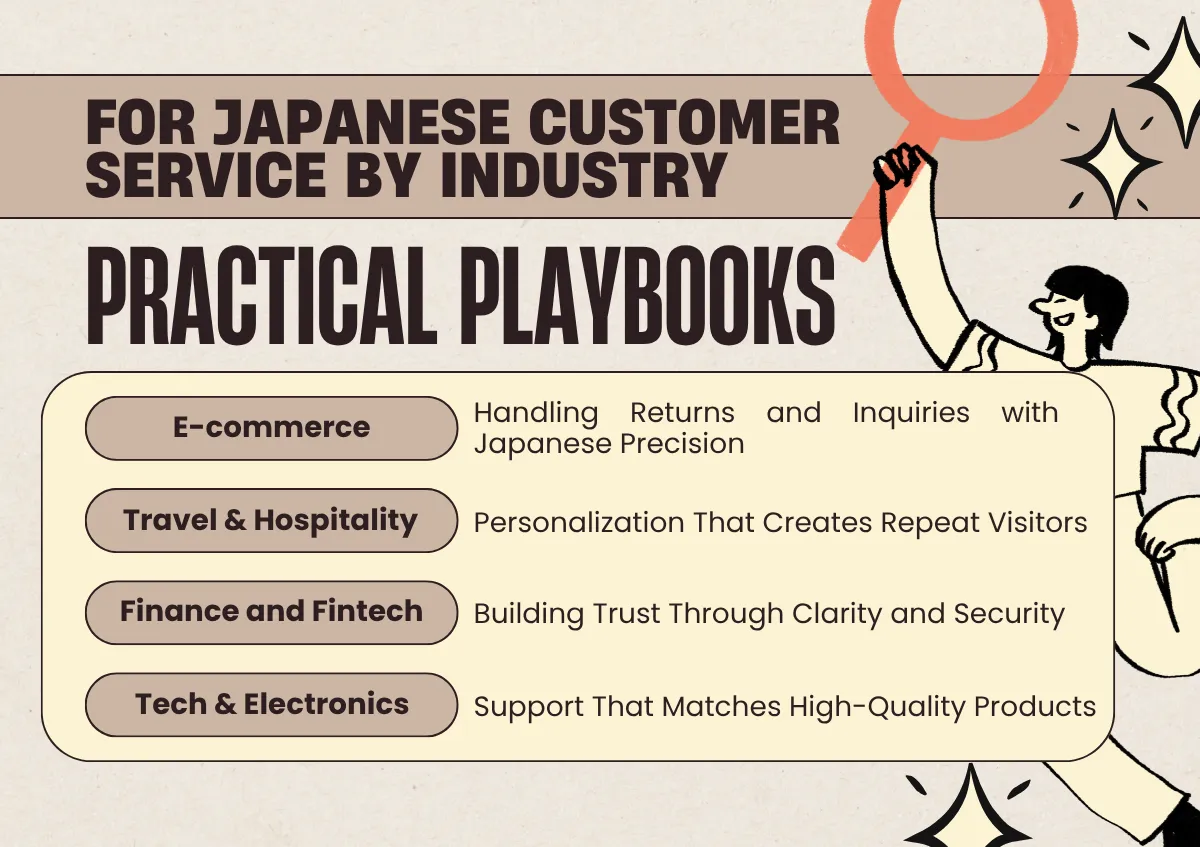
Practical Playbooks for Japanese Customer Service by Industry
Japanese customer service expectations vary depending on the industry, but the underlying principle of omotenashi, anticipating customer needs with care and sincerity, remains consistent. For foreign SMEs entering Japan, tailoring service strategies by sector is essential. Below are practical approaches to help businesses align with Japanese standards while drawing useful contrasts with service models in the U.S.
E-commerce: Handling Returns and Inquiries with Japanese Precision
In the U.S., customers often accept return windows of 14–30 days, with return shipping costs sometimes passed on to the buyer. In Japan, the expectation is more generous: businesses are often expected to provide hassle-free returns with minimal burden on the customer. Even small e-commerce brands are expected to handle exchanges quickly and politely.
Clear Communication on Orders
Japanese customers value proactive updates. A delay email that includes a detailed apology and a revised delivery timeline reassures customers far more than a generic “your order is delayed.” In the U.S., customers typically focus on speed and tracking updates, while in Japan, the tone, formality, and apology carry equal importance.
Personalization in Recommendations
Where U.S. e-commerce companies often rely on broad algorithm-driven suggestions, Japanese consumers respond well to curated, precise recommendations that show care. For example, suggesting a complementary product based on past purchases is often seen as thoughtful rather than intrusive.
Travel and Hospitality: Personalization That Creates Repeat Visitors
Japan’s hospitality industry is renowned worldwide, with omotenashi at its heart. For SMEs in this sector, every interaction with a guest is an opportunity to build loyalty. Small gestures, from personalized greetings to proactive problem-solving, often make the difference between a one-time visitor and a repeat customer.
Anticipating Guest Needs
In the U.S., hospitality often emphasizes convenience, such as self-check-in kiosks or mobile app services. In Japan, although these technologies exist, human touch is still highly valued. Greeting a guest by name, offering slippers upon arrival, or noting dietary restrictions from a previous visit can turn a one-time guest into a repeat visitor.
Thoughtful Gestures
Examples include welcome gifts, handwritten notes, or small surprises on birthdays. While U.S. hotels may focus on loyalty programs and point systems, Japanese hospitality places a strong emphasis on creating memorable, personalized moments that demonstrate genuine care.
The Power of Apologies and Follow-ups
If something goes wrong during a stay, a sincere apology, sometimes accompanied by a small gift or service recovery measure, goes a long way. In the U.S., compensation (like a voucher or discount) is often the main approach, whereas in Japan, tone and sincerity matter just as much as material restitution.
Finance and Fintech: Building Trust Through Clarity and Security
The financial sector in Japan faces a particular challenge: customers tend to be conservative and risk-averse, making trust the most critical factor.
Clarity in Communication
Unlike in the U.S., where fintech apps often use casual, friendly language, Japanese consumers expect formal, precise explanations. Overly casual communication can erode trust in a sector where credibility is everything.
Security and Transparency
Japanese consumers scrutinize financial security more closely than many U.S. customers. Providing detailed information on data protection, fraud prevention, and dispute handling is essential. SME fintechs can differentiate themselves by clearly and respectfully communicating safety measures in plain Japanese.
Building Human Touch Into Digital Services
In the U.S., fintech often prides itself on minimizing human interaction. In Japan, accessible human support alongside digital tools reassures customers. For example, offering a helpline with polite, culturally fluent staff can significantly boost confidence in a new app.
Tech and Electronics: Support That Matches High-Quality Products
Japan’s tech and electronics markets are highly competitive and driven by quality. For SMEs selling or supporting technology, the customer service must match the quality of the product.
Detailed Documentation and Guides
Where U.S. users may expect quick-start manuals and short video tutorials, Japanese consumers prefer in-depth, step-by-step guides that cover multiple scenarios. Clarity and thoroughness are valued over brevity.
Multilingual and Around-the-Clock Support
With Japan’s large base of both domestic and foreign tech users, companies offering multilingual support and 24/7 access stand out. In the U.S., 24/7 support is often an enterprise-level offering, but in Japan, even SMEs are increasingly expected to provide it, or at least appear highly responsive.
Remote support is highly valued in Japan, where consumers expect swift and precise resolutions without needing to return products unless absolutely necessary. In the U.S., customers may be more tolerant of mailing faulty products for repair or replacement. By contrast, Japanese consumers often see that process as an unnecessary inconvenience that undermines brand reliability.
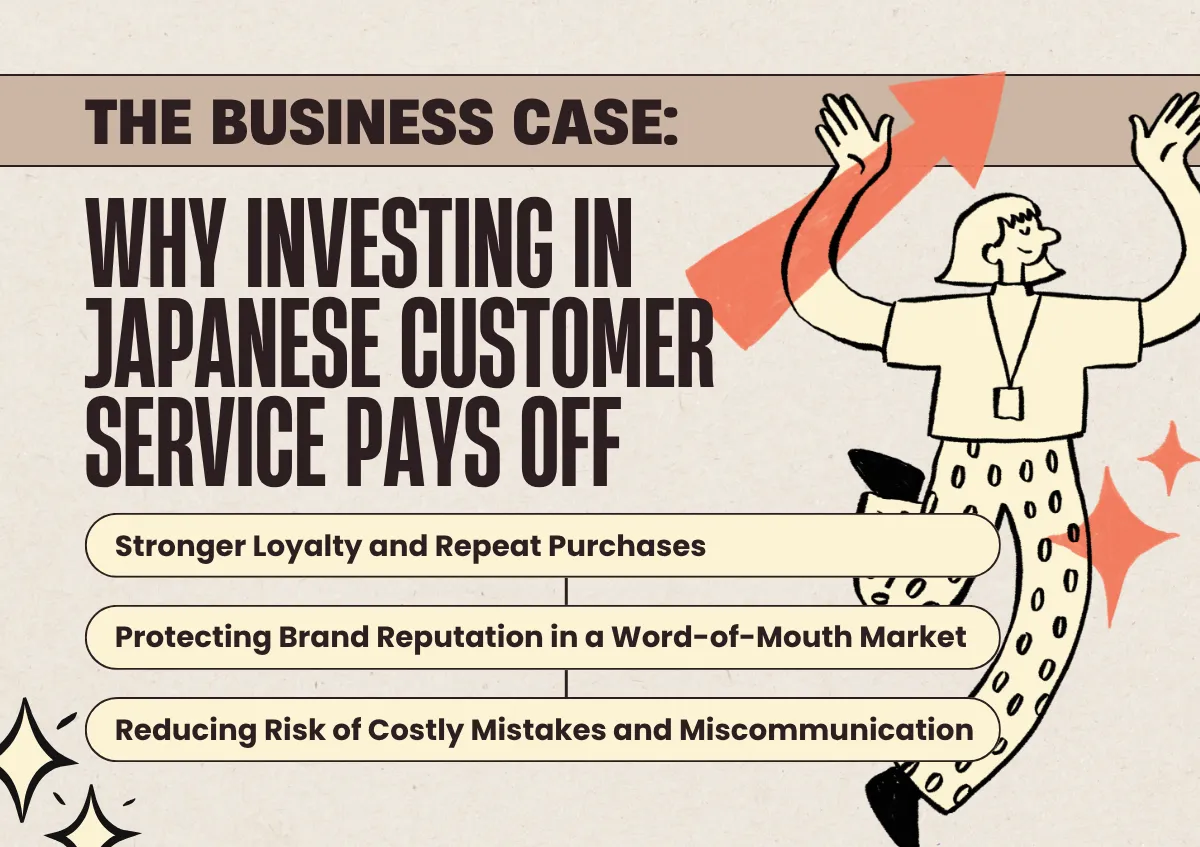
Why Investing in Japanese Customer Service Pays Off: The Business Case
For many international businesses, Japan is perceived as a challenging market due to its high standards. However, those very standards make investment in customer service one of the highest-return-on-investment (ROI) strategies available. Unlike in the US, where price competitiveness or product innovation often dominate, Japanese consumers consistently reward brands that deliver care, clarity, and reliability. This section explores why dedicating resources to service is not simply a cost, but a growth multiplier in Japan.
Stronger Loyalty and Repeat Purchases
Customer service in Japan has a direct impact on loyalty that often surprises foreign businesses.
The Lifetime Value Difference
In the US, loyalty programs and discounts often drive repeat purchases. In Japan, however, loyalty is earned through trust, reliability, and attentiveness. A customer who feels “looked after” is not only more likely to buy again but will often remain loyal to a brand for years, even when cheaper alternatives exist.
Example: From Trial to Habit
A global skincare brand discovered that Japanese customers who interacted with their local customer support team were 40% more likely to make repeat purchases than those who only shopped online. Polite follow-up emails, transparent return processes, and product guidance built a trust loop that converted one-time buyers into lifetime fans.
Protecting Brand Reputation in a Word-of-Mouth Market
In Japan, word of mouth carries outsized influence, both online and offline. Unlike in the US, where reviews can be polarized but also quickly drowned out by volume, Japanese consumers tend to give weight to personal recommendations and detailed reviews.
Negative Feedback Has Longer Consequences
A single unresolved issue can ripple across social media, comparison blogs, and forums. Because Japanese customers expect flawless service, a visible misstep is harder to recover from than in the US. Proactive problem resolution is not only damage control; it is brand insurance.
The Amplifying Effect of Praise
Positive experiences can be just as influential as negative ones. Customers who feel genuinely respected often share their stories with family, friends, or community groups. In Japan’s tightly connected consumer networks, such advocacy carries more weight than traditional advertising and can significantly enhance a brand’s reputation.
Reducing Risk of Costly Mistakes and Miscommunication
Customer service in Japan is not only about delight; it is also about risk management. Misunderstandings that might be forgiven elsewhere are less tolerated in Japan, where details matter and precision is expected.
Consider fintech or healthcare sectors: misunderstandings around terms, fees, or procedures can escalate quickly. A dedicated Japanese support team helps foreign businesses avoid costly errors, regulatory penalties, or PR crises.
Conclusion: Building Long-Term Success in Japan Through Customer Service
Winning in Japan does not require SMEs to mimic every Japanese business practice, but it does require a genuine commitment to meeting customers where they are. By investing in cultural understanding, localized communication, and continuous improvement, even smaller businesses can achieve service levels that impress Japanese consumers.
The payoff is significant: loyal customers who stay for years, a brand reputation that attracts organic growth, and fewer risks of missteps in a market that values precision and sincerity. Japan’s high standards may appear intimidating at first, but for businesses willing to adapt, they also serve as a roadmap to sustainable success.
Key Takeaways: Japan Customer Service Strategy
Customer service in Japan is a cultural phenomenon, not just a transactional one. Concepts like omotenashi (sincere hospitality), kikubari (anticipating unspoken needs), and the “customer is God” mentality establish a standard of care that surpasses what many international businesses are accustomed to. Even small gestures, when delivered consistently, can differentiate your brand.
Language and nuance matter as much as the product itself. Translation alone is not enough. Customers notice word choice, tone, and levels of politeness. Hiring native speakers, using appropriate keigo (honorific language), and localizing brand voice are critical steps in building credibility.
Politeness often hides dissatisfaction. Unlike in the U.S., Japanese customers rarely complain directly. Silence or overly polite feedback may signal a problem. Proactive follow-ups and careful attention to subtle cues are crucial in preventing customer churn.
Speed and accuracy are non-negotiable. Customers expect immediate acknowledgment and detailed, precise answers. While U.S. consumers may tolerate automated responses or partial solutions, Japanese consumers value the combination of responsiveness and thoroughness.
High expectations can lead to “kasuhara.” Some customers may take advantage of the service-first culture with unreasonable demands. Protecting your staff with clear escalation protocols and anti-harassment guidelines is just as important as serving customers.
Hospitality: Small, thoughtful gestures matter more than loyalty points or apps.
Finance and Fintech: Formal clarity, security transparency, and access to human support build trust.
Tech and Electronics: Thorough documentation, multilingual support, and remote troubleshooting are expected.
Even SMEs can compete by adapting smartly. You don’t need enterprise-level budgets. Offering LINE support, investing in lightweight CRM tools, and training staff in cultural fluency can create a significant impact without overwhelming resources.
Continuous improvement is an integral part of our culture. The Japanese principle of kaizen means service should constantly evolve. Regularly reviewing feedback, empowering staff to suggest changes, and refining processes signal to customers that you care about progress as much as they do.
The ROI is real. Strong service leads to long-term loyalty, protects your brand in a word-of-mouth-driven market, and reduces costly mistakes caused by miscommunication. In Japan, service excellence is not just a cost center; it is a competitive advantage and a key driver of growth.
IGNITE Your Business in Japan!
Ready to bring your customer service strategy up to Japan’s world-class standards? At IGNITE, we specialize in helping international businesses localize their operations for the Japanese market. From setting up LINE support channels to training staff in cultural fluency and omotenashi, we provide the tools and expertise you need to exceed customer expectations without enterprise-level budgets.
Partner with us to avoid costly missteps, accelerate your market entry, and build lasting trust with Japanese customers.
EN-JA bilingual project manager with experience leading Japanese translation and localization projects. Oversees SEO-focused content quality, production, and coordination.