Thinking of launching a business in Japan? This comprehensive guide breaks down everything foreign entrepreneurs need to know—from choosing the right business structure and securing a visa to understanding cultural expectations and legal requirements. With Japan’s innovation-friendly economy and increasing support for startups, now is the perfect time to enter the market—armed with the right strategy and insights.
Japan, the world’s 4th largest economy and the 2nd strongest in Asia, offers a dynamic and innovation-driven environment for foreign entrepreneurs. With world-class infrastructure, advanced research and development, and strong government initiatives promoting startup growth, Japan is steadily becoming one of the most attractive destinations for international businesses looking to expand into Asia.
Once considered a market dominated by large, traditional corporations, Japan has evolved in the past decade to welcome entrepreneurial ventures, particularly in sectors like technology, advanced manufacturing, biotech, e-commerce, and renewable energy. The country presents significant opportunities for those with the right strategy and preparation.
However, success in Japan requires more than ambition. Success in Japan demands cultural adaptability, regulatory compliance, and a well-researched business plan. A detailed business plan is essential for establishing your market positioning and operational strategy and a requirement for securing a business visa.
This guide walks you through every step, from selecting the right business structure (like a Kabushiki Kaisha or Gōdō Kaisha) to navigating visa options, banking hurdles, and compliance obligations. Whether you’re comparing Japan to other global markets like the U.S. or ready to begin the incorporation process, this blog will equip you with the clarity and direction needed to launch successfully in Japan.
When starting a business in Japan as a foreigner, one of the first and most important decisions you’ll make is choosing the proper company structure. Your choice will determine how you’re taxed, how much flexibility you have, the level of credibility your business carries, and even how easily you can open a bank account or secure a visa.
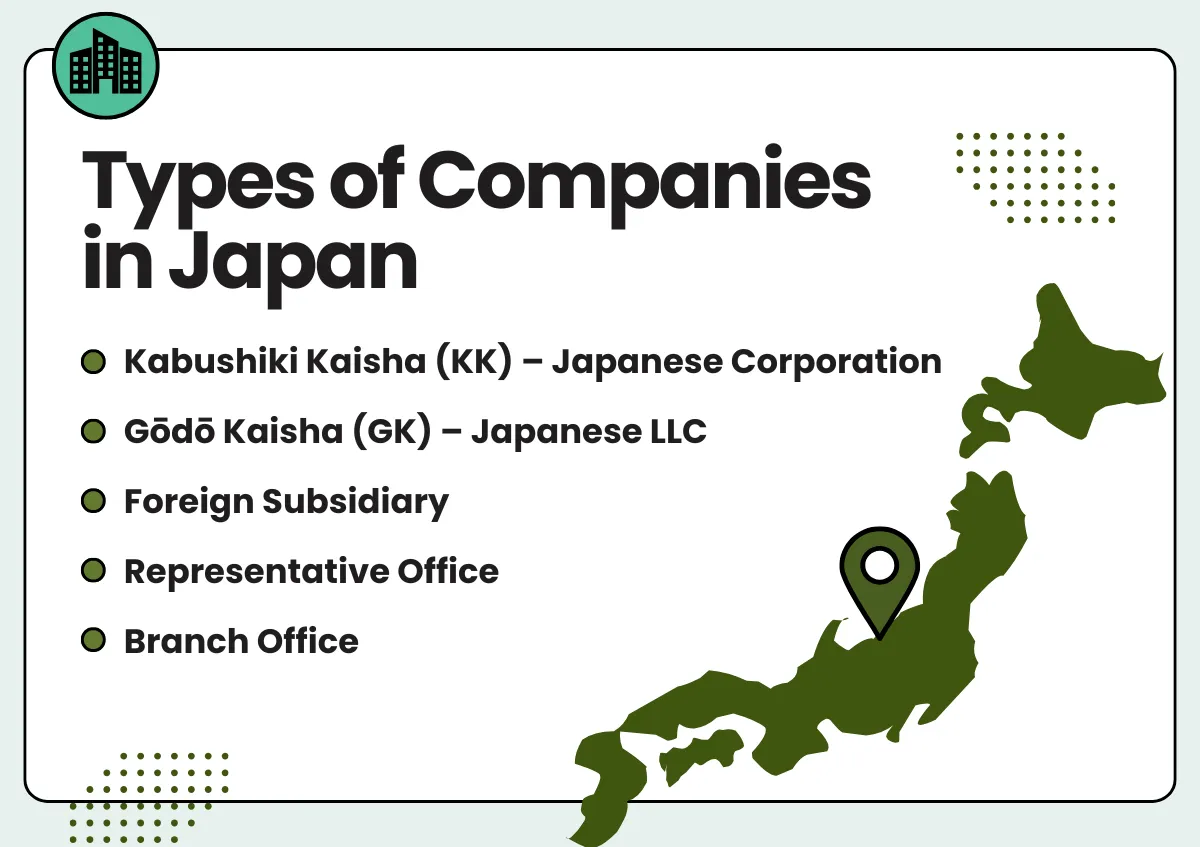
Foreign entrepreneurs in Japan generally choose from five main company types, each with its own pros and cons depending on your goals, risk tolerance, and long-term strategy.
Kabushiki Kaisha (KK) – Japanese Corporation
The Kabushiki Kaisha (KK) is Japan's most well-known and respected company type. It is equivalent to a U.S. C-Corporation or a UK Public Limited Company (PLC).
Category
Details
Best For
Mid- to large-sized businesses; foreign companies seeking high credibility
Legal Status
Independent legal entity
Setup Time
4–6 weeks
Capital
No minimum (5M yen recommended for visas)
Governance
Shareholders + Board of Directors
Key Features
Requires notarized Articles, annual financial disclosures, and a trusted structure
Pros
High trust, full commercial rights, strong bank & partner access
Cons
Higher costs (200K–400K yen), more paperwork, slower setup
Opt for a Kabushiki Kaisha (KK) if your goal is long-term growth in Japan, building strong credibility, or attracting investors.
Gōdō Kaisha (GK) – Japanese LLC
The Gōdō Kaisha (GK) is a limited liability company, similar to a U.S. LLC or a UK Ltd. It offers operational flexibility and a more straightforward setup process, making it attractive for startups and small businesses.
Category
Details
Best For
Startups, entrepreneurs, and small businesses
Legal Status
Independent legal entity
Setup Time
2–4 weeks
Capital
No minimum (5M yen recommended for visas)
Governance
Members manage directly
Key Features
No notarization; flexible profit-sharing; no financial disclosure required
Pros
Low cost, fast setup, easy internal management
Cons
Lower credibility may face issues with conservative partners or banks/td>
Choose a Gōdō Kaisha (GK) if you prefer a faster, more cost-effective setup with flexible management.
Foreign Subsidiary
A subsidiary is a wholly owned KK or GK that operates as an independent legal entity in Japan but is controlled by a foreign parent company. It combines the benefits of a Japanese business structure with foreign ownership.
Category
Details
Best For
Foreign corporations seeking long-term control in Japan
Legal Status
Independent entity (KK or GK) owned by a foreign parent
Setup Time
Same as KK or GK
Capital
Follows KK or GK requirements
Governance
Matches chosen entity type
Key Features
Full liability, taxed independently, eligible for subsidies
Pros
Legal and tax separation, retains full ownership, local autonomy
Cons
Complex setup, governance must align with the chosen entity
Establish a Subsidiary when you need legal and operational separation between your Japanese entity and the overseas headquarters.
Branch Office
A branch office directly extends a foreign parent company, with operations managed from headquarters abroad. It does not form a separate legal entity in Japan.
Category
Details
Best For
Foreign companies testing the market or operating with a limited presence
Legal Status
Not separate from the foreign parent company
Setup Time
1–2 weeks
Capital
No minimum; funds remitted by the parent
Governance
Managed directly from HQ; local rep required
Key Features
Can do business; taxed as part of the parent company
Pros
Quick setup, can employ staff, and sign contracts
Cons
Lower trust, limited autonomy, and harder to open bank accounts
Consider a Branch Office if you want to enter the market quickly and validate your business model while remaining under the foreign parent company’s structure.
Representative Office
A representative office allows a foreign company to conduct non-commercial activities in Japan, such as market research, hiring, or liaising with clients. It cannot engage in profit-generating business or sign contracts.
Category
Details
Best For
Market research or pre-market presence without business activity
Legal Status
Not a legal entity
Setup Time
~1 week
Capital
Not required
Governance
No formal structure
Key Features
Cannot sign contracts or generate revenue
Pros
Easiest and cheapest to establish, no tax or compliance burden
Cons
Cannot do business, hire staff, or open bank accounts
Use a Representative Office strictly for non-commercial activities such as market research, local hiring, or preliminary setup tasks.
Legal Requirements for Opening a Business in Japan
Before officially registering and operating a business in Japan, you must fulfill several essential legal and procedural requirements. These are often prerequisites for securing a business visa and establishing credibility with banks and government authorities. Missing any of these steps can result in registration delays, visa rejection, or banking issues.
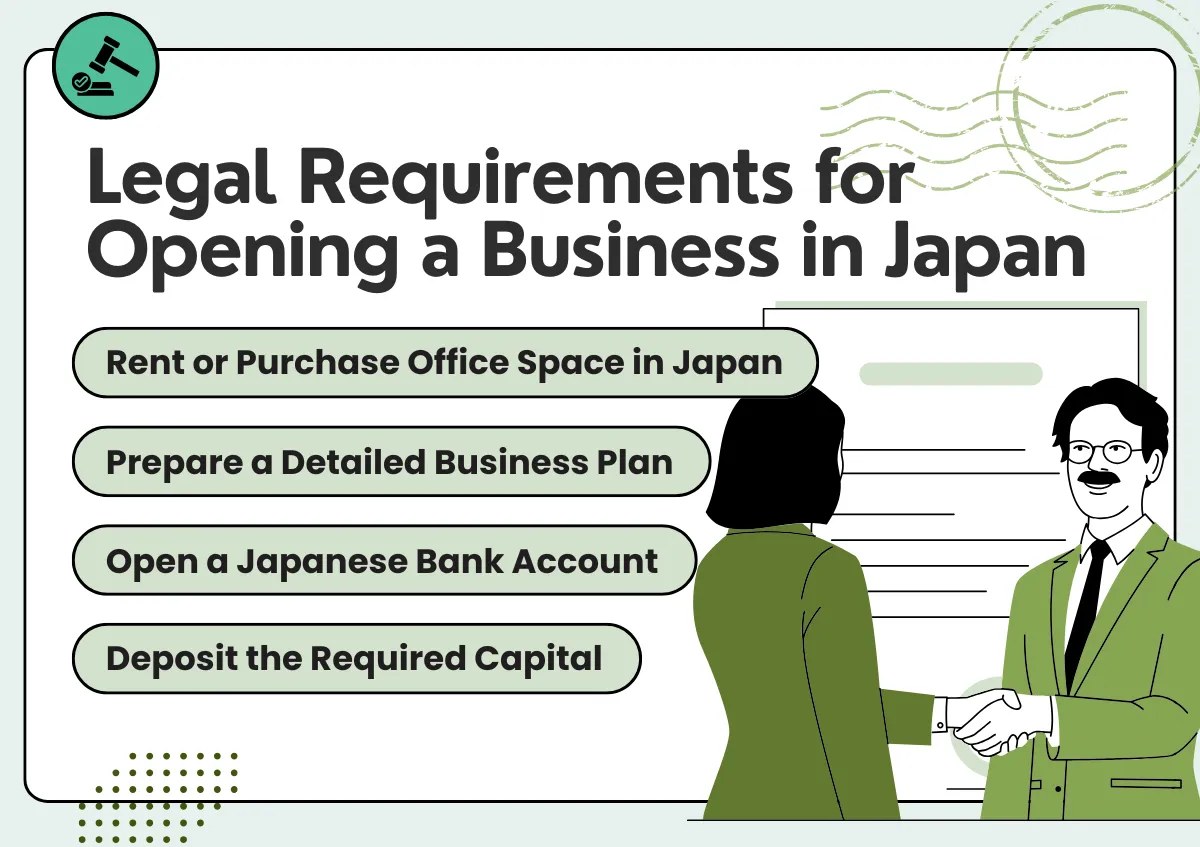
Here are the four core requirements for opening a business in Japan as a foreign entrepreneur:
Rent or Purchase Office Space in Japan
A physical office address is required to register a company legally in Japan. Virtual offices are no longer sufficient for most official procedures, including corporate bank account applications, receiving legal mail (書留 kakitome), and establishing trust with authorities or clients.
Acceptable options include:
Serviced Offices (Short-Term Leases): These are fully furnished and ideal for newly registered businesses needing a quick setup. Serviced offices typically include internet, reception services, meeting rooms, and basic amenities. They're commonly leased on a monthly basis and require less upfront paperwork, making them popular among foreign entrepreneurs.
Shared Offices / Co-working Spaces: Perfect for startups and solo founders, shared offices offer an affordable and collaborative working environment. They provide desks, Wi-Fi, printers, and access to shared meeting rooms and often allow for month-to-month flexibility. However, some may not qualify as acceptable business addresses for registration or visa applications, so check carefully before committing.
Furnished/Unfurnished Long-Term Offices: These traditional offices require 1–2 year lease agreements, governed by Japan’s Land and Building Lease Law. Furnished offices reduce setup time, while unfurnished spaces provide more flexibility in design and layout. This option is best for businesses looking to establish a lasting presence in Japan.
Owned Commercial Property: Typically reserved for larger, well-capitalized companies, buying commercial property offers the highest level of control and permanence. However, it requires navigating complex real estate laws and a higher initial investment.
Rent costs can vary widely by district. Tokyo’s central wards (Minato, Chiyoda, Shibuya) command higher prices, while suburban or regional areas offer more affordable options, sometimes with extra government incentives for foreign entrepreneurs.
Prepare a Detailed Business Plan
A detailed business plan is essential for both company registration and visa approval. Japanese immigration officials and financial institutions often request this document to assess your operational credibility.
Your business plan should clearly outline:
The nature and goals of your business
Market opportunity and customer acquisition strategies
Financial projections and profit expectations
Growth roadmap and operational plan
Funding strategy, including whether you’ll rely on personal capital, loans, or investors
Keep the plan practical and aligned with Japanese law. If you're submitting this to a government body or bank, consider consulting a bilingual advisor to ensure clarity and compliance.
Opening a bank account is a legal and operational necessity when starting a business in Japan. It is required at multiple stages—from establishing your company to managing its day-to-day finances.
When Bank Accounts Are Needed for Business Operations in Japan
There are two key stages where bank accounts play a critical role:
1. Before Incorporation
A personal bank account under the name of the representative founder (with a valid visa) is used to:
Deposit initial capital
Submit proof of capital for company registration
2. After Incorporation
A corporate bank account is needed to:
Receive payments from clients
Pay suppliers and employees
Track and manage company cash flow
Handle taxes and regulatory payments
Even if capital is paid into the representative’s account pre-incorporation, it is typically transferred to the corporate account once the company is established.
Why It’s Difficult for Foreigners to Open a Corporate Bank Account
Opening a corporate bank account in Japan as a foreigner is challenging due to strict screening procedures and additional documentation requirements.
Typical challenges include:
Lack of Japanese language skills
No prior business track record in Japan
Virtual office address (often rejected by major banks)
No resident representative in Japan
Common requirements for corporate account opening:
Valid residence card
Japanese contact information
Detailed business activity documentation or website
Inkan (registered seal) and seal certificate
Company registration documents:
Certificate of Registered Matters (履歴事項全部証明書)
Corporate Seal Certificate (印鑑証明書)
Identification of the representative director (passport, My Number Card, or driver’s license)
In some cases, licenses or permits based on your business type
Alternative Banking Options for Foreign Entrepreneurs
If megabanks reject your application, consider these alternatives:
1. Internet banks (e.g., GMO Aozora, Rakuten Bank)
*Online banks allow account opening entirely online, though they may offer fewer services or limitations on wire transfers.
2. Credit unions (Shinkin banks)
3. Japan Post Bank (Yucho Bank)
4. Regional banks
5. City banks (e.g., MUFG, SMBC)
*Ease of Access (Highest → Lowest)
Note that account approvals for foreigners usually take 2–3 weeks, but delays are common if:
Additional documents are required
There are any discrepancies in your application
The business nature raises questions during screening
Many banks prefer (or require) the company’s representative director to reside in Japan and hold a valid residence card. Appointing a local co-founder or trusted individual as a director can significantly improve your chances of success when applying for a corporate bank account.
Deposit the Required Capital
To establish your company, you’ll need proof of invested capital. While there’s no strict minimum for a KK or GK, having at least 5 million yen (approx. USD $32,000) is highly recommended, especially for those applying for a Business Manager Visa.
Here’s how the capital process works:
First, open a personal bank account under your name (requires a visa and residence card)
Deposit the capital amount into this account
Request a bank book copy or a deposit certificate
Submit that document during company registration at the Legal Affairs Bureau
Failing to provide proof of capital investment can delay your registration or invalidate your visa application.
Types of Visas for Starting a Business in Japan
Understanding the correct visa is one of the most critical steps in starting a business in Japan as a foreign entrepreneur. Japan offers several business-related visa categories tailored to different stages of business development. Choosing the correct visa early on will not only determine your legal ability to live and work in Japan but also influence your company’s ability to open bank accounts, lease office space, and build credibility.
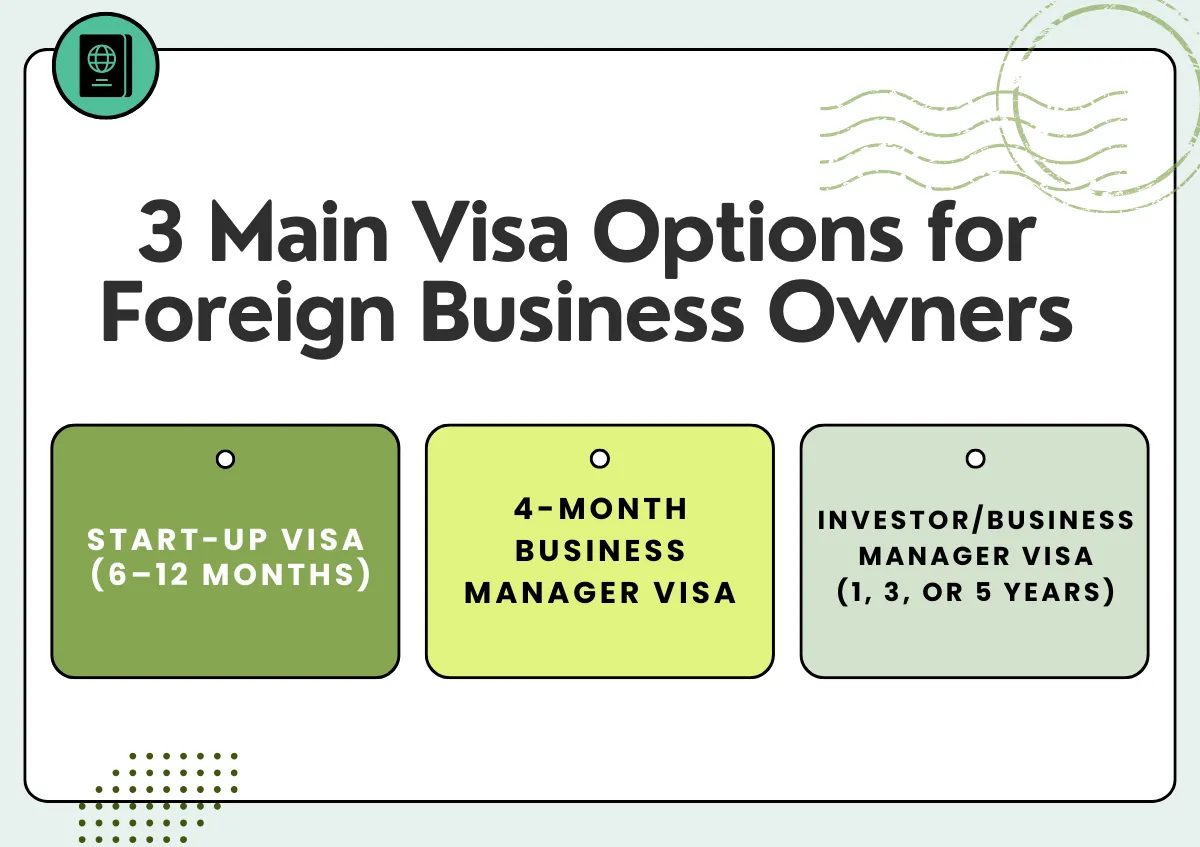
The three main visa options for foreign business owners are:
Start-up Visa (6–12 Months)
4-Month Business Manager Visa
Investor/Business Manager Visa (1, 3, or 5 Years)
Each visa has distinct requirements, limitations, and use cases. Let’s explore them below.
Start-up Visa (6–12 Months)
The Start-up Visa is designed to help foreign entrepreneurs enter Japan before fully establishing a company. This visa grants between 6 and 12 months of residency and is primarily intended for preparatory activities such as:
Securing an office
Drafting a business plan
Opening a personal bank account
Registering the company
Gathering the capital required for longer-term visas
This visa is particularly appealing because it does not initially require a registered company or proof of capital, making it ideal for early-stage founders. However, it is only available in select municipalities such as Tokyo, Fukuoka, Sendai, Hiroshima, Imabari, and Niigata. Each city operates its version of the program and sets specific conditions.
To apply, you must:
Submit a Japanese-language business plan
Obtain an endorsement from the local government
Show intent and capacity to transition into a longer-term visa
This type of visa is best for early-stage entrepreneurs who have yet to incorporate or secure funding and are planning to set up in a Start-up visa–friendly city.
4-Month Business Manager Visa
The 4-Month Business Manager Visa is a short-term option that allows foreign nationals to stay in Japan for 120 days to finalize their company’s registration and complete other administrative tasks. It is a transitional step between entering the country and applying for a longer-term visa (such as the 1-year Business Manager Visa).
Unlike the Start-up Visa, the 4-Month Business Manager Visa requires that you have registered your company in Japan. Still, it allows time to complete the other required steps for full residency.
To qualify, you must:
Complete company registration at the Legal Affairs Bureau
Have a physical office address
Open or be in the process of opening a Japanese bank account
The challenge is that you’ll need a visa to get a residence card, but you also need that card to open a bank account, making the 4-Month Visa a crucial workaround in this "chicken-and-egg" scenario.
This type of visa is perfect for entrepreneurs who’ve started the registration process but need time inside Japan to finalize bank accounts, funding, or other requirements.
Investor/Business Manager Visa (1, 3, or 5 Years)
The Investor/Business Manager Visa—commonly referred to simply as the “Business Manager Visa”—is the most comprehensive long-term visa for foreign entrepreneurs running a company in Japan. It is typically granted for 1, 3, or 5 years, depending on the performance and credibility of the business.
To qualify, you must:
Have a registered company in Japan
Show at least 5 million yen in invested capital, or
Employ two or more full-time Japanese residents
Secure a physical office location
Play an active management role (not just a passive investor)
In many cases, applicants first enter Japan with either a Start-up Visa or a 4-Month Business Manager Visa and then transition to the Investor Visa once all business setup steps are complete.
Immigration authorities also assess the long-term sustainability and economic contribution of your business when deciding the duration of your visa. Most first-time approvals are for one year, with longer durations available after successful renewal.
This type of visa is best suited for fully registered and operational businesses with clear investment or staffing commitments.
Business Setup in Japan for Foreigners: Step-by-Step Instructions
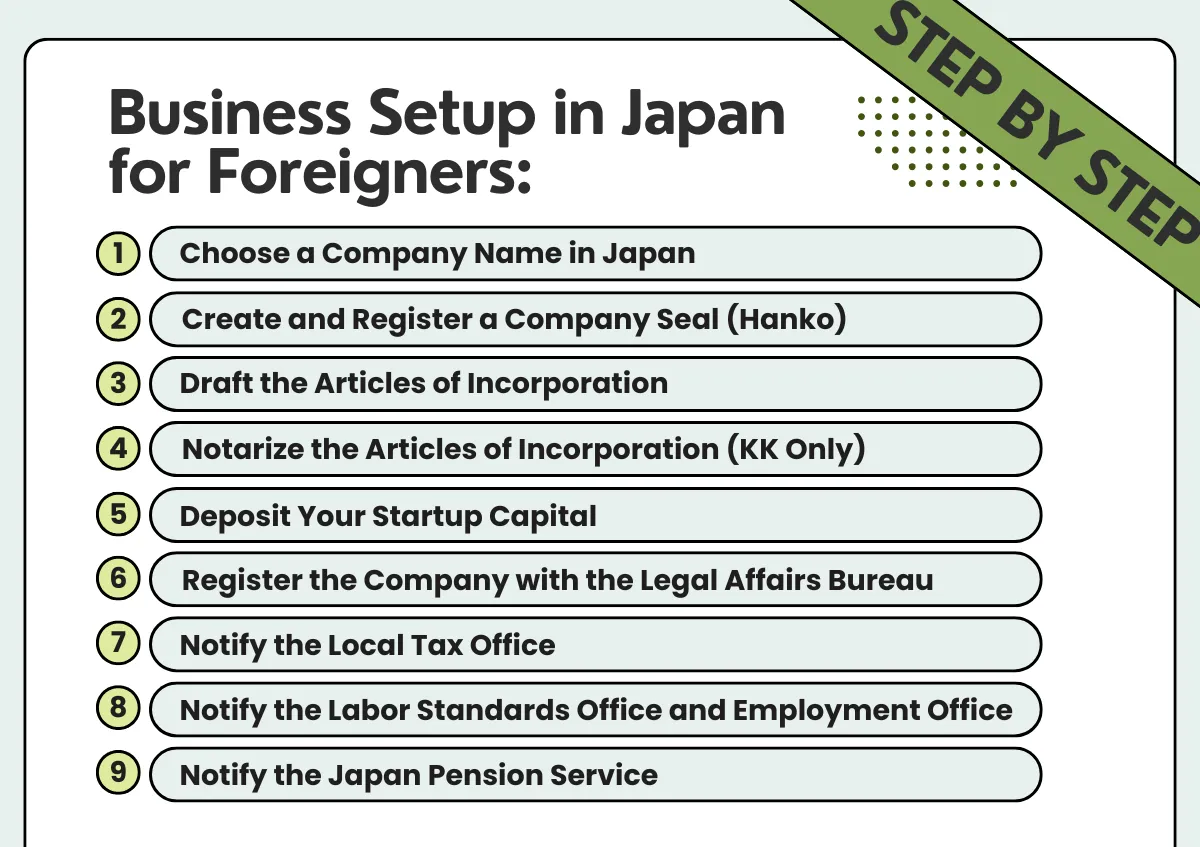
Once you’ve chosen your business structure and understood the basic legal and visa requirements, it’s time to move through the step-by-step process of officially setting up your business in Japan. This section breaks down the key bureaucratic milestones, many of which are required for visa applications, tax registration, and opening bank accounts.
Each step must be completed sequentially to ensure legal compliance and operational readiness. Let’s walk through the process.
1. Choose a Company Name in Japan
Start by choosing a unique name for your company. Japan allows company names to include both Japanese and Roman (English) characters. However, the name must be distinguishable from existing registered businesses.
Avoid special symbols or characters that may be rejected
Use the Japanese Ministry of Justice’s online database to check for name availability (Japanese only)
Consider reserving domain names and registering trademarks to protect your brand
2. Create and Register a Company Seal (Hanko)
Before registration, your company must have a seal (印鑑 or hanko), your legal signature for contracts and official filings.
Machine-carved seals typically cost around 10,000 yen
Hand-carved seals can cost 20,000 yen or more and are considered more traditional
Every company director may also need their own personal seal
Once created, your seal must be registered at the Legal Affairs Bureau to obtain an official certificate of authenticity. You’ll use this for all future administrative and legal procedures.
3. Draft the Articles of Incorporation
The Articles of Incorporation (定款) are your company's founding document and must be written in Japanese. They should include:
Company name and physical address
Business objectives and incorporation date
Initial capital investment
Names and addresses of directors/founders
Share structure (for KKs)
Templates are available on the Legal Affairs Bureau’s website, and working with a judicial scrivener is highly recommended for non-Japanese speakers.
4. Notarize the Articles of Incorporation (KK Only)
If you’re establishing a Kabushiki Kaisha (KK), a licensed Japanese notary must notarize your Articles of Incorporation. This step is not required for a Gōdō Kaisha (GK).
Bring 3 signed copies of the Articles
Have all directors present or submit powers of attorney
Expect to pay approximately 50,000–100,000 yen in fees
Online notarization is now available via services like Marunouchi Notary Office, which reduces paperwork and avoids stamp taxes
5. Deposit Your Startup Capital
You must deposit your company’s initial capital into a Japanese personal bank account (usually under the name of the representative director).
Open the account after receiving your visa and residence card
Deposit the funds and retain a copy of your bank book or deposit certificate
This proof will be submitted during registration
There is no legal minimum capital requirement, but 5 million yen is recommended for visa credibility and operational stability.
6. Register the Company with the Legal Affairs Bureau
Once you have deposited your capital and prepared your paperwork, submit your company registration to the Legal Affairs Bureau in the area where your office is located.
You’ll need:
Notarized Articles of Incorporation (KK only)
Capital deposit certificate
Application to Do Business (登記申請書)
Seal notification form (印鑑届出書)
Director’s consent letter (就任承諾書)
Director’s seal registration certificate (印鑑証明書)
Founder’s written decision (if the address is not in the Articles)
Auditor’s appointment letter (if applicable)
Registration fees:
Kabushiki Kaisha (KK): Minimum 150,000 yen
Gōdō Kaisha (GK): Minimum 60,000 yen
Once approved, you’ll receive your Certificate of Incorporation (登記事項証明書)—officially establishing your business in Japan
7. Notify the Local Tax Office
After registration, you are legally required to notify the local tax authority. This includes submitting:
Incorporation Notification (法人設立届出書)
Application for Blue Tax Returns (青色申告承認申請書)
Application for Withholding Tax Exemption Approval (源泉所得税の納期の特例の承認に関する申請書)
Notification of Payroll Office Establishment (給与支払事務所等の開設届出書)
These documents ensure your business is registered for consumption tax, corporate tax, and payroll obligations.
8. Notify the Labor Standards Office and Employment Office (If hiring staff)
If you plan to employ staff, you must notify both the Labor Standards Inspection Office and the Public Employment Security Office. Required documents include:
Labor Insurance Affiliation Report (労働保険関係成立届)
Estimated Premium Declaration for Labor Insurance (労働保険概算保険料申告書)
Even if you have only one employee, this step is mandatory.
9. Notify the Japan Pension Service
All companies in Japan are legally obligated to enroll their staff—including founders and directors—in the national health insurance and pension systems, even if they don’t yet have employees.
You’ll need to submit:
Health Insurance and Pension Eligibility Notification (健康保険・厚生年金保険被保険者資格取得届)
Insurance Application Form (健康保険・厚生年金保険新規適用届)
Dependent Notification (健康保険被扶養者届), if applicable
This step ensures compliance with Japan’s social welfare system and supports visa renewal or upgrade applications.
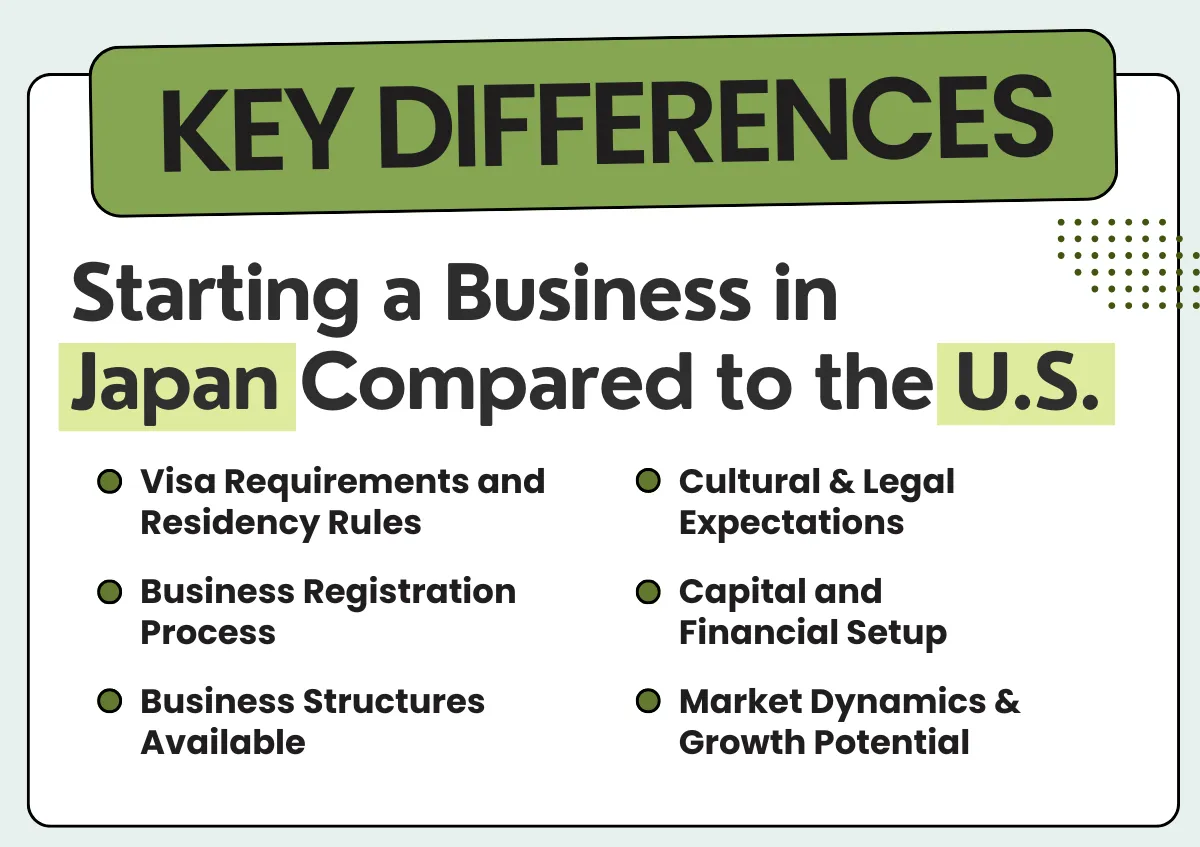
Key Differences in Starting a Business in Japan Compared to the U.S.
Foreign companies looking to enter the Japanese market often assume that starting a business in Japan is similar to doing so in the U.S. However, the two countries differ significantly in legal procedures, visa requirements, cultural norms, and startup conditions. While both offer business-friendly environments, understanding the contrasts is critical for successful market entry and long-term growth.
One of the most overlooked—but critical—differences lies in marketing. What works in the U.S. or Europe often falls flat in Japan, where trust, subtlety, and long-term brand positioning are key. This extends to digital strategies like SEO and link building. In Japan, authority is built through curated relationships, industry-specific directories, and content partnerships rather than aggressive outreach or high-volume tactics. To succeed, your marketing must be as localized as your legal and operational setup. Partnering with experts who understand Japan’s unique digital landscape can make all the difference.
Here’s how Japan compares to the United States in several key areas:
Visa Requirements and Residency Rules
Category
Japan
United States
Visa for Founders
Required (e.g., Business Manager Visa or Start-up Visa)
Not required to incorporate; only needed to reside or work
Minimum Capital for Visa
Often requires 5 million yen for a Business Manager Visa
EB-5 Visa is available, but not required for business formation
Visa-Free Ownership
No – residency needed to manage operations
Yes – foreigners can own businesses without residency
In Japan, foreign entrepreneurs must obtain a visa to live in the country and actively manage their business. In contrast, the U.S. allows foreigners to register a company remotely without needing a visa, unless they plan to live or work within the U.S.
Business Registration Process
Category
Japan
United States
Registration Agency
Legal Affairs Bureau (法務局)
State governments
Required Documents
Business plan, Articles of Incorporation, inkan, capital proof, etc.
Business name registration, EIN, incorporation documents
Time to Register
2–6 weeks (GK or KK)
1–7 business days (varies by state)
Use of Personal Seal
Required for many filings (inkan/hanko)
Not applicable
Starting a business in Japan involves more steps and paperwork, including creating a business seal, notarizing documents (for KKs), and working with the Legal Affairs Bureau. The U.S. registration process is generally simpler and faster and handled at the state level.
Business Structures Available
Category
Japan
United States
Registration Agency
Legal Affairs Bureau (法務局)
State governments
Required Documents
Business plan, Articles of Incorporation, inkan, capital proof, etc.
Business name registration, EIN, incorporation documents
Time to Register
2–6 weeks (GK or KK)
1–7 business days (varies by state)
Use of Personal Seal
Required for many filings (inkan/hanko)
Not applicable
Both countries offer flexible structures, but the KK is more formal and credible in Japan, while the LLC is a popular, low-maintenance choice in the U.S.
Formal and bureaucratic; reliant on in-person stamps and seals
Digital-friendly and more standardized
Relationship Building
Essential for long-term success
Important, but often secondary to contracts
Cultural understanding is critical in Japan, where relationship-building and etiquette often outweigh written agreements. In the U.S., business transactions are more transactional and fast-paced, with fewer linguistic or procedural barriers.
Capital and Financial Setup
Category
Japan
United States
Capital Requirement
None legally, but 5 million yen recommended for visa eligibility
Varies; often no minimum for LLCs
Banking Access
Difficult for foreign founders; strict documentation required
Easier, especially with a U.S. address/ID
Corporate Account Setup Time
2–4 weeks (longer if the representative is not in Japan)
Often same-day to a few days
Foreign Ownership
Allowed, but practical barriers exist
Fully permitted without restrictions
In Japan, corporate banking is one of the most challenging steps for foreign founders, especially without a Japanese address or local representative. In contrast, U.S. banking is far more accessible and often allows remote setup with minimal hurdles.
Market Dynamics & Growth Potential
Category
Japan
United States
Market Size
Smaller domestic market; aging population
Large, diverse, and high-growth market
Market Stability
Stable and well-regulated
Competitive, high risk/reward
Competitive Landscape
Conservative, saturated industries
Open to new entrants and innovation
Government Support
Available (esp. for foreign startups and innovation sectors)
Available, but varies by state and industry
Japan offers a mature and stable business environment, ideal for companies with localized strategies and long-term objectives. The U.S. presents higher potential for scale, but with a faster pace, more competition, and fewer regulatory barriers.
What Foreign Companies Should Consider
Key Considerations
Japan
United States
Ideal For
Long-term commitment, cultural integration, and B2B business
Varies, but credibility can be built quickly through performance
Risk vs. Reward
Lower risk, moderate reward, long-term payoff
Higher risk, higher reward
Foreign companies looking to build a trusted local presence in Japan should be prepared for longer setup times, stricter requirements, and cultural adaptation, but they will benefit from a stable and sophisticated business environment. Meanwhile, those seeking speed and flexibility may find the U.S. a faster path to entry and scale.
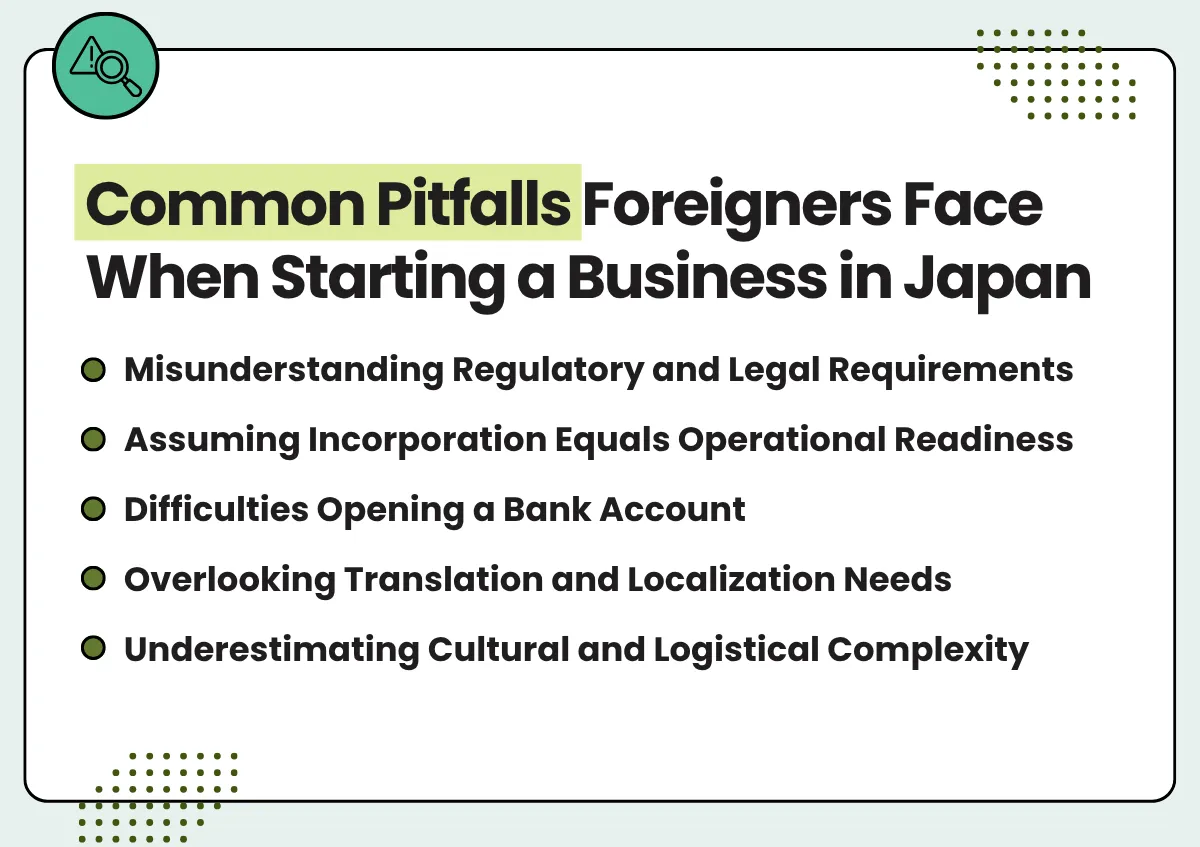
Common Pitfalls Foreigners Face When Starting a Business in Japan
Entering the Japanese market as a small or medium-sized foreign company presents unique opportunities and challenges that differ from those in more familiar business environments like the U.S. or EU. While Japan offers a structured and supportive business ecosystem, foreign entrepreneurs often stumble on avoidable issues due to unfamiliarity with local practices, laws, and expectations.
Here are the most common mistakes and hidden pitfalls to be aware of before and after setting up your business in Japan:
Misunderstanding Regulatory and Legal Requirements
Japan’s regulatory landscape is strict and highly detail-oriented. Failing to comply—intentionally or not—can stall your business before it begins.
Common Issues:
Vague or poorly defined business activities in the Articles of Incorporation
Skipping product certifications or labeling compliance
Confusion around which permits are necessary for your sector
Tip: Consult with a legal expert or JETRO (which we will discuss later in this blog) before filing anything. Always have your business scope clearly defined in Japanese.
Some companies believe that they're ready to operate once they’ve registered their KK or GK. In reality, incorporation is just one of several required steps.
What’s Often Missed:
Notifications to the tax office, pension office, and labor bureau
Opening a corporate bank account (which often requires a separate timeline)
Notarization requirements for KKs
Tip: Create a post-incorporation checklist and plan for a 60–90 day runway post-registration before full operation.
Difficulties Opening a Bank Account
Japanese banks are cautious and risk-averse. Foreign-owned startups without a local representative often face rejections even with full documentation.
What Banks Look For:
A physical (not virtual) office address
A resident representative director with a valid Japanese visa and address
A clear, lawful business model with supporting documents
Tip: Start with an online bank (e.g., GMO Aozora) and appoint a local co-director, if possible.
Overlooking Translation and Localization Needs
A major early-stage pitfall is underestimating the importance of not just translating—but properly localizing—your legal, operational, and customer-facing materials. Professional Japanese translation is essential for documentation submitted to banks, immigration, and government agencies. But when it comes to brand messaging, direct translation isn't enough. Effective Japanese copywriting is its own discipline, requiring cultural fluency, tone sensitivity, and an understanding of local consumer psychology.
Impact:
Delays in registration filings
Rejected visa or bank applications
Miscommunication with local partners
Tip: Allocate budget for certified document translation and a bilingual advisor early in the planning stage.
Underestimating Cultural and Logistical Complexity
Japan’s business customs and logistics systems have unique characteristics that can cause unexpected friction.
Examples:
Overlooking Japan’s strict punctuality and gift-giving etiquette in supply chain relationships
Expecting Japanese clients to respond quickly or casually
Choosing the wrong fulfillment model due to a lack of local partnerships
Tip: Partner with local logistics providers and spend time understanding the unspoken cultural norms of doing business in Japan.
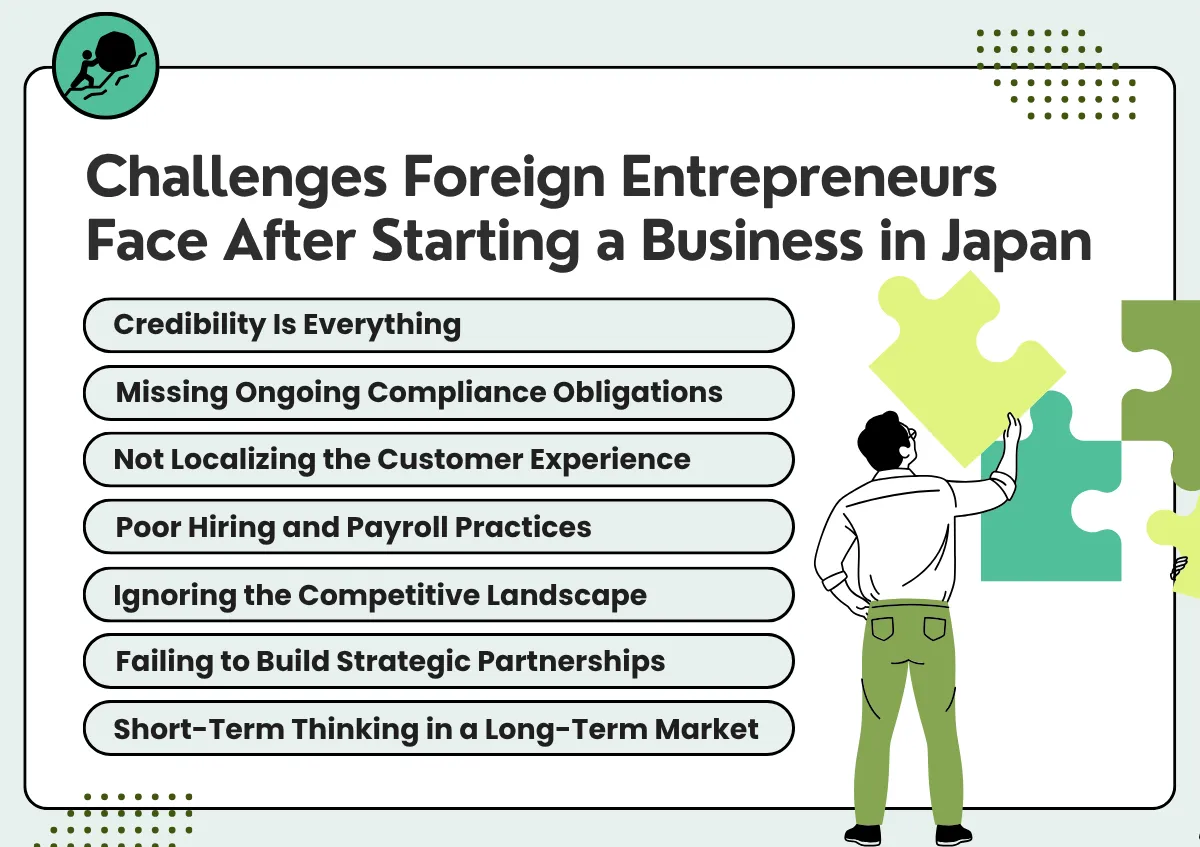
Challenges Foreign Entrepreneurs Face After Starting a Business in Japan
Once the business is up and running, new issues that weren’t obvious during the setup phase often emerge. These post-launch pitfalls are just as important to avoid, especially for smaller companies without large support teams.
Credibility Is Everything—And Foreigners Often Start from a Minus
In Japan, trust and reputation are foundational to doing business. Building that credibility takes time for foreign entrepreneurs, and it often starts at a disadvantage. Even Japanese nationals face hurdles establishing trust when starting from scratch; for foreigners, the barriers are even steeper due to language gaps, unfamiliarity with local customs, and perceived risk.
What this means:
Banks, landlords, and clients may hesitate to engage with new foreign-led businesses until a track record is established.
A Kabushiki Kaisha (KK) is often favored for its formal structure and perceived legitimacy.
A Japanese co-founder, advisor, or representative director can significantly boost your company's trustworthiness.
Tip: Consider early investments in trust-building, such as securing a long-term office, publishing bilingual materials, or actively engaging in local business communities.
Missing Ongoing Compliance Obligations
Even after you’re operational, Japan has recurring filing, tax, and governance requirements that must be met.
Key Obligations:
Annual General Meetings (KKs only)
Financial statements submitted to the Legal Affairs Bureau
Social insurance enrollment and payroll reporting
Business registration updates for any changes
Tip: Use a bilingual accountant or outsource to a payroll/legal firm to avoid monthly and annual deadlines.
Not Localizing the Customer Experience
After launch, many foreign companies struggle to gain traction with Japanese customers because they don’t localize beyond language.
Not offering local payment methods like PayPay or convenience store payments
Tip: Treat localization as an ongoing strategy, not a one-time task. Keep updating your digital presence to match evolving local preferences.
Poor Hiring and Payroll Practices
Hiring staff in Japan isn’t as simple as issuing contracts. Labor law compliance is strict, and violations—even unintentional ones—can lead to severe penalties.
Common Pitfalls:
Using English-only employment contracts
Failing to register employees for pension and health insurance
Incorrect tax withholding and payroll reporting
Tip: Work with a local labor attorney or outsourced payroll service. Ensure employment contracts meet Japanese Labor Standards Law.
Ignoring the Competitive Landscape
Once in the market, foreign companies often find it challenging to stand out or scale due to the strength of existing players and customer loyalty.
Risks:
Offering a product or service too similar to entrenched competitors
Not conducting deep competitive research before launching
Misjudging the value of Japanese brand trust and consistency
Tip: Position your company based on clear differentiation—better service, more personalized support, or superior quality, not just price or novelty.
Failing to Build Strategic Partnerships
Sustainable growth in Japan often depends on local alliances—yet many foreign founders delay or overlook this step.
Tip: Don’t wait until sales slow down to start building strategic alliances. Start as soon as your product-market fit is confirmed.
Short-Term Thinking in a Long-Term Market
Japan is a slow-and-steady market, where quick wins rarely result in long-term success. Foreign companies that fail to invest in long-term brand-building often fade out after initial hype.
Why It Happens:
Western founders expecting fast ROI
Budgeting for 6–12 months instead of 3–5 years
Prioritizing disruption over integration
Tip: Focus on building trust, not just gaining attention. In the Japanese business environment, longevity and commitment resonate far more than fast growth.
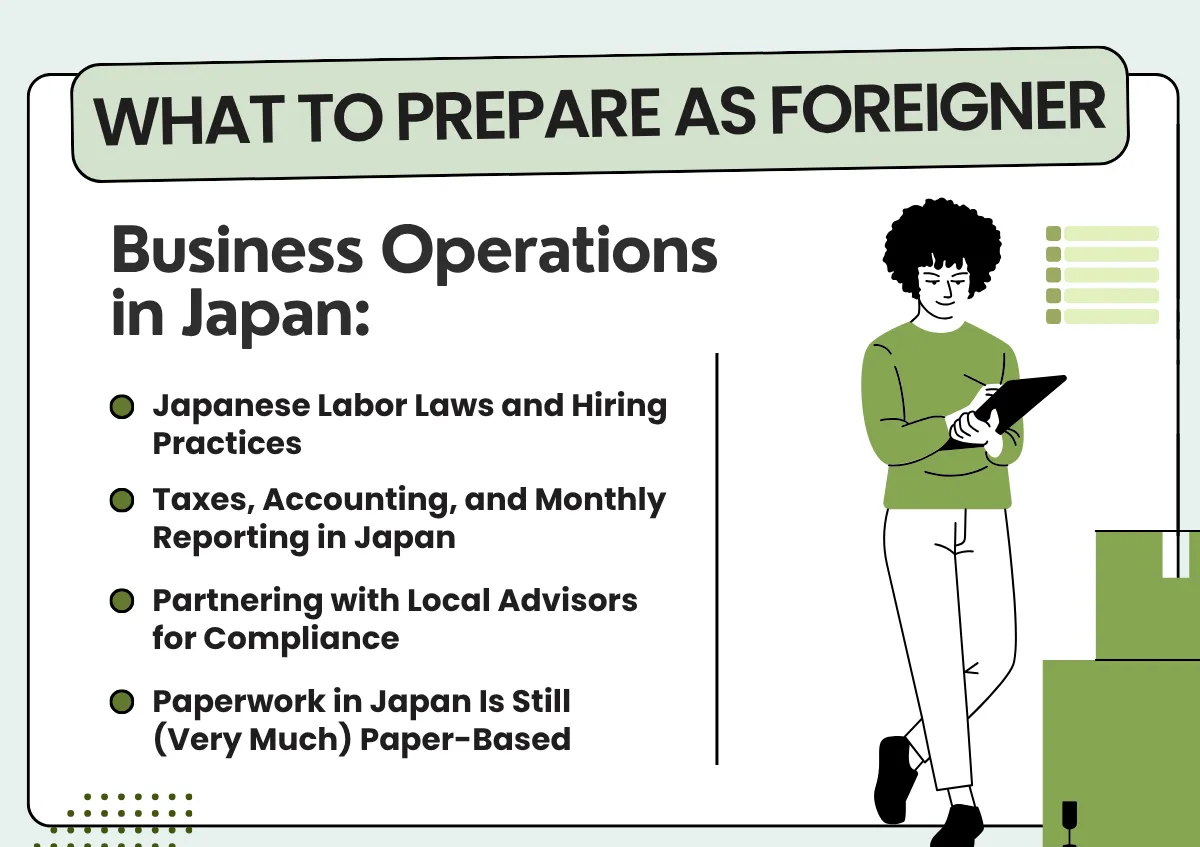
Business Operations in Japan: What Foreigners Should Prepare For
Once you’ve understood the common pitfalls and your company is registered and operational in Japan, daily business activities are subject to local laws and regulations that may differ significantly from what foreign entrepreneurs are used to. Smooth business operations in Japan rely on compliance, accurate reporting, and local expertise, especially for small and medium-sized businesses unfamiliar with the country’s legal landscape.
Japanese Labor Laws and Hiring Practices
Hiring employees in Japan comes with strict labor law obligations, even for small teams. Foreign-owned businesses must comply with contracts, payroll, and social insurance rules.
Key points to prepare for:
Written employment contracts are legally required and must be detailed (wages, hours, benefits). They should be translated into Japanese and aligned with the Labor Standards Act.
All employees must have social insurance enrollment (health, pension, unemployment).
Payroll systems must support monthly salary payments and accurate tax filings. Local payroll software or outsourcing is highly recommended.
Compliance with labor law is essential—Japan enforces rules on working hours, overtime, paid leave, and termination procedures.
Many foreign companies simplify this process by outsourcing payroll and HR administration to local service providers.
Taxes, Accounting, and Monthly Reporting in Japan
All companies operating in Japan—regardless of profitability—must meet tax and financial filing obligations. These requirements are especially strict for Kabushiki Kaisha (KK) but also apply to Gōdō Kaisha (GK).
Your business will need to:
Submit annual tax returns, including corporate income tax, local tax, and consumption tax
Hold and document an Annual General Meeting (AGM) if operating as a KK
Prepare and submit financial statements to the Legal Affairs Bureau annually
Report payroll and social insurance data monthly or quarterly
Failure to meet these requirements can result in penalties, delays in visa renewals, or reputational harm.
Partnering with Local Advisors for Compliance
Japan’s regulatory environment is highly structured, and not always friendly to DIY approaches. For most foreign entrepreneurs, hiring local advisors is essential.
Advisors that can help:
Certified tax accountants (zeirishi) for bookkeeping, tax filings, and audits
Social insurance consultants (shakai hoken rōmushi) for employee-related filings
Legal advisors or judicial scriveners for business registration updates and contract compliance
Many foreign businesses rely on bilingual firms or Professional Employer Organizations (PEOs) that handle payroll, HR, and back-office compliance under one roof.
Paperwork in Japan Is Still (Very Much) Paper-Based
Despite Japan’s reputation as a tech-forward nation, much of its administrative and business operations are still deeply reliant on paper. Foreign entrepreneurs are often surprised that many procedures—company registration, tax filings, and even invoice exchanges—require printed forms, physical stamps, and in-person submissions.
There are a few cultural and systemic reasons for this:
Habitual Paper Checking: Many Japanese professionals still prefer to review documents on paper. It’s a habit formed from school and reinforced through workplace norms.
Client and Vendor Expectations: Even if your company is digital-first, you may still need to print or receive documents for clients or external partners who haven’t adopted paperless workflows.
Legal Perception of Original Documents: Japanese businesses often view the “original” as the paper version. Even when documents are scanned, companies frequently retain the physical version in storage due to legal uncertainty and risk aversion.
While laws like the e-Document Law and Electronic Books Preservation Act technically allow for digitized records, the interpretation and application of these rules are complex—even for legal professionals. As a result, many companies default to dual record-keeping: paper and digital, increasing operational overhead.
When starting a business in Japan, expect to integrate with some paper-based workflows. Build buffer time into your processes, and consider working with local experts who understand how to navigate these requirements smoothly.
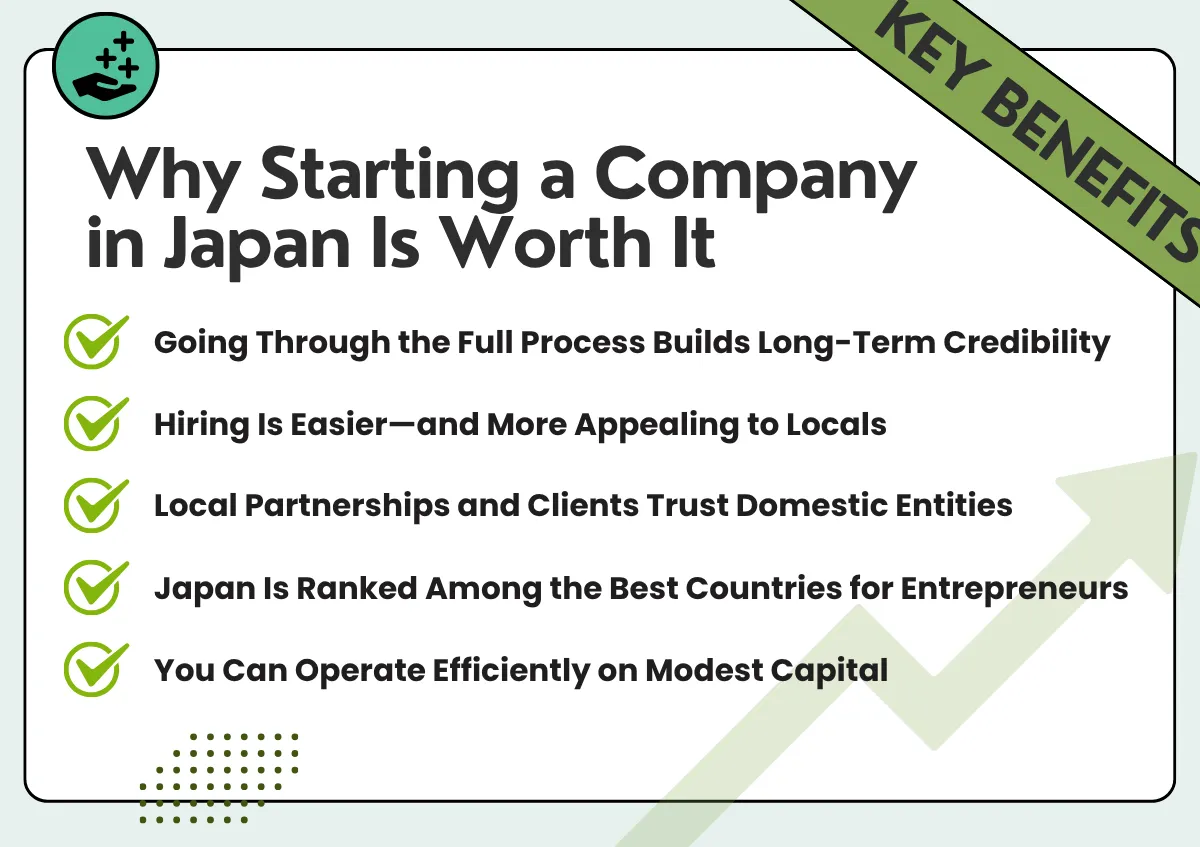
Why Starting a Company in Japan Is Worth It: Key Benefits Beyond Market Entry
While the process of starting a business in Japan may seem bureaucratic and time-intensive, going through the full company registration process has clear, lasting benefits—especially if you're serious about long-term success in the Japanese market. Japan is not just a place to sell; it's a place to establish, hire, and grow a sustainable operation.
Going Through the Full Process Builds Long-Term Credibility
Launching a fully registered company—rather than just testing the waters with an informal presence—offers a significant credibility boost. Japanese consumers, employees, clients, and even landlords are highly risk-averse. Operating as a registered Japanese entity (KK or GK) shows commitment, compliance, and professionalism.
Even for Japanese nationals, starting a business comes with credibility challenges. Foreigners often begin from a credibility disadvantage, making it even more crucial to show you're here for the long run. A legally registered company helps remove doubts about payment reliability and regulatory adherence.
While freelance contracts and remote partnerships may work abroad, Japanese talent often prefers working for domestic companies. Why?
Japanese firms can offer shakai hoken (social insurance) and pension contributions, which are highly valued for long-term security.
Local hires also trust that Japanese entities will follow labor laws and pay on time.
Many talented individuals with entrepreneurial drive work at startups or venture-backed firms instead of founding their own. This means you can access a pool of high-performing professionals, especially if your business is correctly registered in Japan.
Local Partnerships and Clients Trust Domestic Entities
In Japan’s relationship-driven economy, the structure of your business matters. Clients and partners are more willing to work with registered Japanese companies, especially regarding contracts, B2B payments, or long-term collaborations. A foreign unregistered entity often raises compliance red flags or logistical challenges (e.g., invoicing, tax receipts, regulatory checks).
If you're serious about integrating into Japanese business networks, a domestic business entity gives you the structure and legitimacy.
Japan Is Ranked Among the Best Countries for Entrepreneurs
Surprisingly to many, Japan ranks #2 globally as one of the best countries for entrepreneurs (per a joint study by UPenn Wharton and Y&R). While it may lack the startup "buzz" of places like Silicon Valley or Tel Aviv, Japan’s business landscape offers quiet advantages:
Access to talented individuals who aren’t ready to start their own business but are eager to innovate.
Less competitive pressure in early-stage sectors compared to saturated startup ecosystems.
Opportunities to build a presence with relatively lower real estate costs compared to global cities like Hong Kong, London, or New York.
You Can Operate Efficiently on Modest Capital
Compared to other major metropolitan markets, office rents in Tokyo and Osaka are relatively affordable given the infrastructure, safety, and convenience offered. This allows startups to control burn rates while maintaining a strong base of operations.
According to a JLL global office rent report, Tokyo’s central districts are nearly 50% more affordable than equivalent spaces in Hong Kong or London.
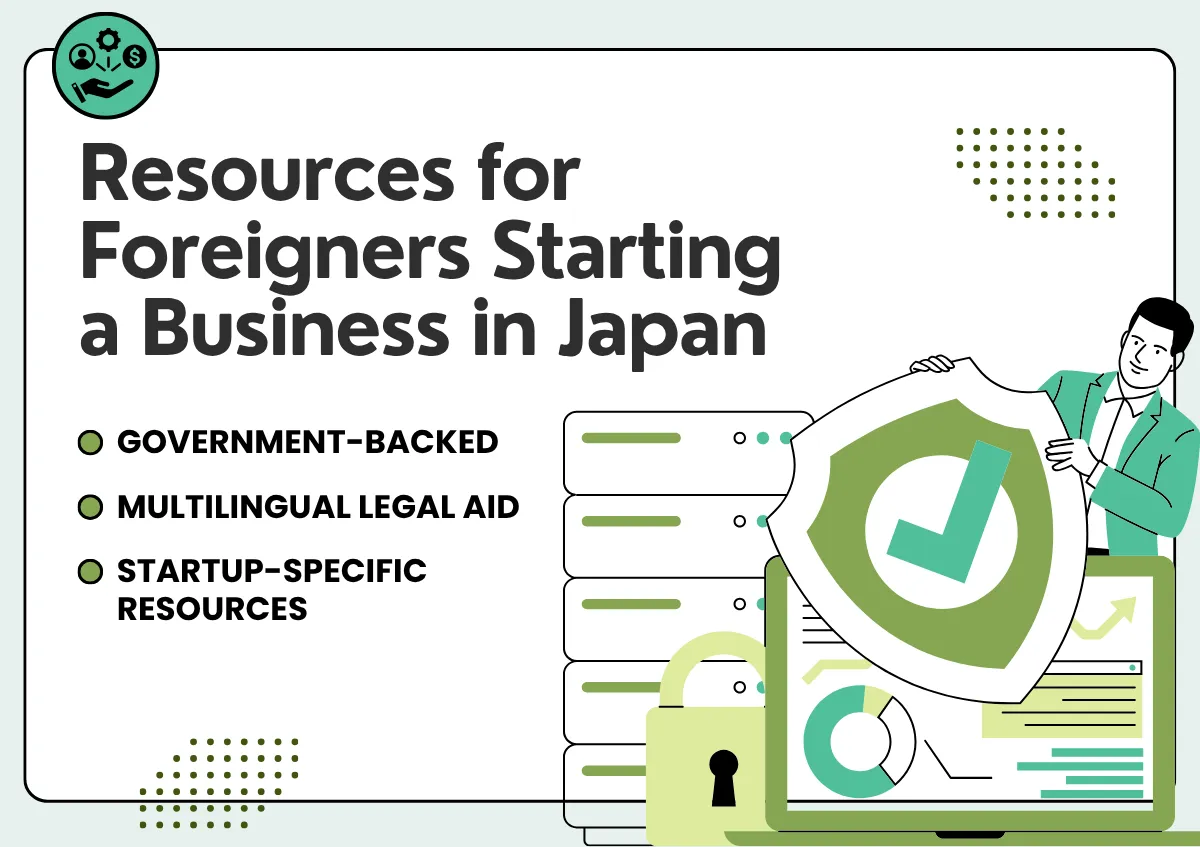
Resources for Foreigners Starting a Business in Japan For
Starting a business in Japan can feel overwhelming, especially for foreign entrepreneurs who must navigate legal procedures, compliance, and cultural expectations. Fortunately, Japan offers a strong support infrastructure for foreign businesses, including government-backed advisory services, multilingual legal aid, and startup-specific resources.
Below are key organizations and platforms that can help you get started correctly.
Government and Institutional Support Resources
Organization
What It Offers
Who It's For
JETRO (Japan External Trade Organization)
Market research, setup guides, legal/tax expert introductions, and subsidy information
Foreign startups and expanding businesses
TOSBEC (Tokyo One-Stop Business Establishment Center)
Company registration, tax and visa processing, social insurance support—all in one location
Foreign entrepreneurs setting up in Tokyo
Local Chambers of Commerce (e.g., JCCI)
Networking events, regional business insights, and local partner introductions
Businesses needing regional support and community access
Where to Get English-Speaking Legal and Tax Help
Service
Description
Best For
Houterasu (Japan Legal Support Center)
Legal consultation services with interpreter support in multiple languages
General legal matters, contract disputes, and local legal advice
Japan Federation of Bar Associations (Nichibenren)
Lawyer search tool with foreign language support filters
Finding English-speaking legal professionals
JETRO Professional Directory
Lists of bilingual tax advisors, CPAs, and legal professionals
Legal & financial services tailored for foreign businesses
Financial Services Agency (FSA)
Directory of regulated financial professionals familiar with fintech and compliance
Businesses in finance, crypto, or investment sectors
Frequently Asked Questions About Starting a Business in Japan
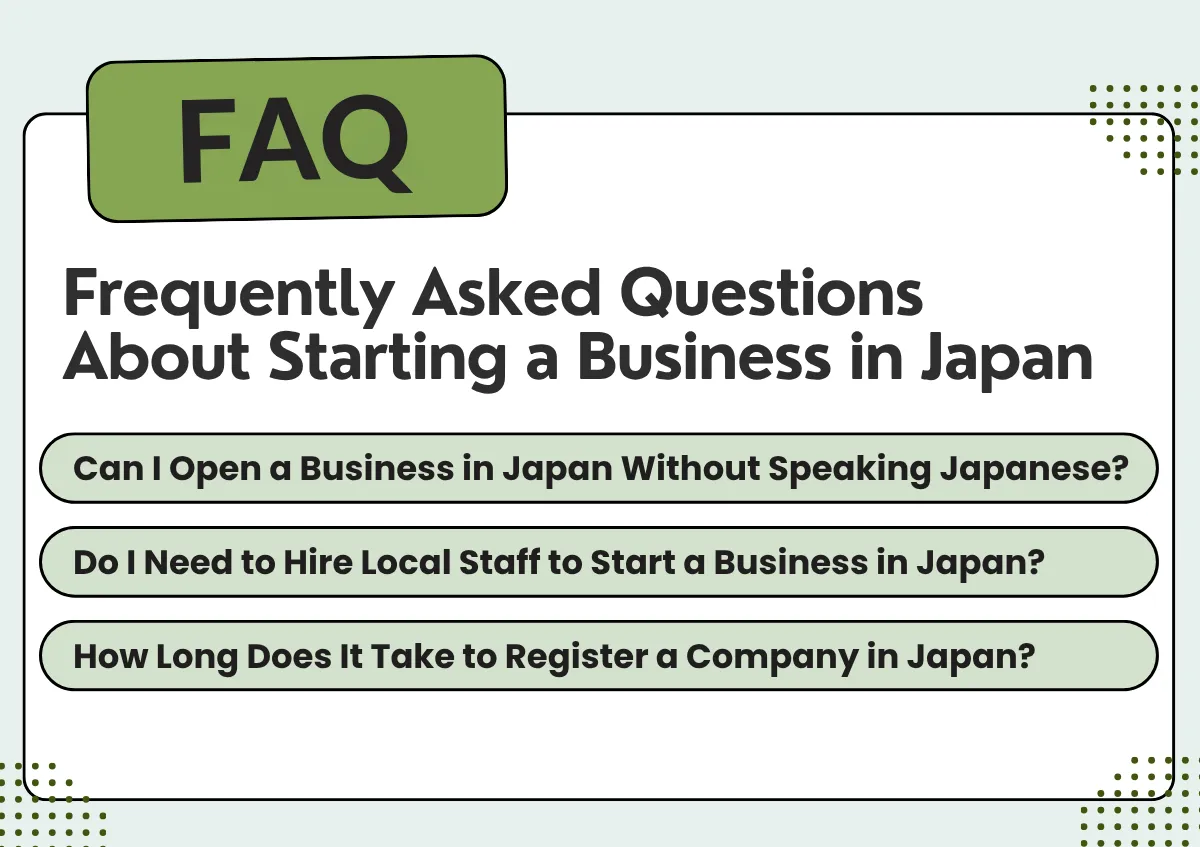
Curious about starting a business in Japan? This FAQ section addresses three common questions that foreign entrepreneurs have. Learn if foreigners can open a business in Japan without speaking the language, if they need to hire local staff to start a business, and how long it takes to register a company in Japan. These answers provide essential insights into legal requirements and necessary preparations, helping you confidently navigate the process. Whether you plan to establish a company or explore business opportunities in Japan, understanding these fundamentals is paramount for a successful start-up journey.
Can I Open a Business in Japan Without Speaking Japanese?
Yes, it’s possible, but it’s crucial that you either have a solid understanding of Japanese yourself or work with bilingual professionals. Many legal documents must be submitted in Japanese, including the Articles of Incorporation. Partnering with a judicial or administrative scrivener who has experience assisting foreigners and collaborating with a local agency can significantly simplify the process and ensure that all requirements are met correctly.
Do I Need to Hire Local Staff to Start a Business in Japan?
No, hiring local staff is not mandatory to start a business in Japan. However, there are several advantages to employing local staff, especially when it comes to navigating language and cultural differences, which can be crucial for the smooth operation of the business.
How Long Does It Take to Register a Company in Japan?
Registering a company in Japan typically takes about 2 to 4 weeks, depending on the complexity of the business and how quickly you gather the necessary documents. Working with bilingual professionals can help expedite the process and ensure everything is done accurately.
Conclusion: Your Roadmap to Business Success in Japan
Prospective foreign entrepreneurs must first grasp current market trends and economic analyses to navigate the complexities of starting a business in Japan. Understanding these dynamics provides a solid foundation for decision-making. Studying visa options and selecting the right one, such as the 4-Month Business Manager Visa, the Start-up Visa, or the Investor Visa, is another major step toward legal residency and operational flexibility.
Entrepreneurs need to follow a structured approach to successfully start a business in Japan. This includes meeting the requirements for establishing the business, choosing the appropriate business structure, such as Kabushiki Kaisha or Gōdō Kaisha, and navigating legal obligations like Articles of Incorporation, the notarization process, and trademark registration.
Financial considerations play a critical role in starting a business in Japan. This begins with opening a bank account (whether individual or corporate) and extends to understanding initial capital requirements and exploring funding and investment options. Moreover, ensuring compliance with Japanese regulations is essential to effectively managing business operations. For instance, registration and certification are indispensable steps for foreign entrepreneurs to operate legally.
Utilizing online resources and tools, such as JETRO, further supports entrepreneurs in navigating administrative processes and accessing essential information. However, while online resources can provide valuable information and tools, they complement rather than replace the expertise of local professionals who can provide tailored advice and guidance.
Key Takeaways: What Foreign Entrepreneurs Must Know About Starting a Business in Japan
Starting a business in Japan offers significant opportunity—but requires precision, patience, and a deep understanding of local systems. Below are the most critical insights every foreign entrepreneur should know:
Japan welcomes foreign business—but not without rules. The country encourages investment, but the setup is more structured and compliance-driven than in places like the U.S.
Your business structure sets the tone. KKs (Kabushiki Kaisha) bring credibility and trust, while GKs (Godo Kaisha) are quicker and cheaper. Each choice has lasting tax and legal implications.
A physical office is a must. Virtual offices won’t cut it—banks, immigration, and clients all expect a real, local address.
Your visa depends on your business plan. Whether applying for a Start-up Visa or a Business Manager Visa, your plan, funding, and office setup must be airtight and documented.
Banking is harder than you think. Most banks require a Japanese-resident rep, a business track record, and loads of paperwork. Start with an online or personal account if needed.
Compliance doesn’t stop after registration. Expect ongoing obligations like tax filings, annual reports, and social insurance paperwork—especially for KK setups.
Labour laws apply, even for tiny teams. Japanese employment law mandates contracts in Japanese, insurance, and proper payroll—non-compliance can lead to fines.
Localization is more than translation. Japanese consumers expect tailored UX, trusted payment options, and high-touch customer service. Simply translating won’t work.
Don’t go it alone. Local partners, bilingual advisors, and government agencies like JETRO and TOSBEC are invaluable for smoothing your entry into the market.
Success in Japan takes time. This is a relationship-driven, conservative business culture. Quick wins are rare—patience and persistence are key.
Ready to Scale in Japan? IGNITE Can Help
At IGNITE, we do more than guide—we initiate, localize, and scale international businesses in Japan with a strategy-first approach. Whether setting up a KK, navigating Japan’s legal complexities, or trying to break through digital barriers, IGNITE acts as your on-the-ground team for long-term success.
Phase
What IGNITE Does
Initiate
Market research, competitor analysis, and persona development to drive decision-making.
Localize
Cross-cultural marketing strategies, Japanese content creation, and SEO/SEM support.
Scale
A/B testing, analytics, CRM integration, and campaign optimization to grow your business.
Why IGNITE?
Multilingual Experts: Native Japanese and international consultants under one roof
All-in-One Support: From web design to advertising, translation to project management
On-the-Ground Insight: Based in Osaka, connected globally
Trusted by 24+ Nationalities: We help businesses like yours thrive in Japan
Let IGNITE be your catalyst in Japan. Contact us today to localize your brand, optimize your message, and scale with confidence in the Japanese market.
EN-JA bilingual project manager with experience leading Japanese translation and localization projects. Oversees SEO-focused content quality, production, and coordination.