
EC Website Creation for Kitchen Knife Sales
Building a fast, multilingual e-commerce site for a Sakai-based kitchen knife store, boosting traffic and international sales through Shopify and Webflow integration.



In today’s globalized world, optimizing your website for Japanese audiences is more than just a necessity—it's a strategic advantage. Japan’s sophisticated market demands precise translation and a deep understanding of cultural nuances and consumer behavior. For businesses entering or expanding in Japan, your website is often the first impression—and getting it right can make or break your market entry. This blog delves into the essential strategies for effectively translating and localizing your website to resonate with Japanese users, ensuring that your digital presence reaches, engages, and converts your target audience.
Expanding into Japan’s highly discerning market requires more than just translating your website—it demands a thoughtful, strategic approach to localization. While accurate language conversion is a foundational step, true success comes from tailoring every aspect of the user experience to Japanese cultural expectations, communication norms, and browsing habits.
Japanese consumers have high standards regarding clarity, formality, and visual presentation. A site that merely translates words without considering tone, layout, or cultural nuance risks appearing unprofessional or out of touch. That’s why effective website translation for Japan should be treated as a form of market adaptation, requiring linguistic precision and sensitivity to design, brand voice, and user expectations.
This section explores what makes website translation for Japan so unique—and why a localized approach is critical. From understanding the complexity of Japanese writing and consumer behavior to evaluating different translation methods, we’ll outline the key strategies that global businesses must adopt to create truly resonant experiences for Japanese users.
Website translation is more than just converting words; it ensures clarity, engagement, and usability for a new audience. While linguistic accuracy is essential, the process also involves cultural adaptation and technical adjustments to create a seamless experience for local users.
Key Aspects of Website Translation
By treating website translation as a strategic adaptation rather than a direct conversion, businesses can create a localized experience that feels natural and engaging for Japanese audiences.
Translating website content into Japanese isn’t simply a matter of swapping words between languages—it’s a complex process involving cultural understanding, tone adaptation, user experience design, and brand perception. Many businesses initially approach Japanese localization with the idea that a literal or direct translation, either by a fluent speaker or through a machine, is sufficient. However, that mindset often results in content that feels awkward, off-brand, or even confusing to Japanese users.
Japanese consumers place a high value on how content is presented. A 2019 Adobe survey showed that 43% of Japanese users found brand content "too wordy or poorly written," while 25% were put off by content that felt overly personalized. This demonstrates a key cultural difference: Japanese audiences tend to scrutinize written content closely, not only for what it says but how it’s said.
This sensitivity stems from Japan’s unique writing system, which uses three scripts—kanji, hiragana, and katakana—interchangeably. Even simple words like "I" (watashi) can be written in several ways, each conveying a different nuance. For example, “私” is formal, “わたし” is softer, and “ワタシ” can feel trendy or casual. Choosing the wrong one—even if technically correct—can distort your brand voice or alienate users.
Moreover, honorific language (keigo) plays a massive role in business communication. Using the wrong form of politeness can come off as disrespectful or overly stiff. For instance, "ごめんなさい" is too casual for business; "すみません" is more appropriate. Even a term as simple as “today” can shift a message’s tone: “本日” (honjitsu) feels formal, while “今日” (kyō) feels conversational.
All of this illustrates why translation alone doesn’t work. Instead, businesses must localize, ensuring that language, tone, cultural nuance, and presentation align with local expectations. Getting it right means better engagement, trust, and fewer brand missteps.
To better understand how businesses approach this challenge, it's helpful to compare the two primary methods of website translation—each with its own strengths, limitations, and impact on user experience.
This method involves creating and managing separate, fully customized content for each language version of the website. It allows brands to fine-tune everything—from copy and tone to layout and imagery—based on local cultural norms and preferences. For Japan, this might mean:
The most significant benefit of this approach is that it provides the most accurate and impactful user experience. Each version of the site can reflect the cultural expectations and communication style of its audience. However, it also requires more resources: dedicated content teams, native-speaking marketers, and QA testing for each market.
String-based translation refers to the practice of translating text in isolated “strings” or fragments, typically managed through a CMS or translation management system. While this method is efficient and cost-effective, especially for maintaining consistency across UI elements, it has severe limitations for languages like Japanese.
Why? Japanese meaning often depends on context—sentence structure, tone, audience relationship, and writing script (kanji vs. hiragana, etc.). When text is broken into disconnected strings, the translator may lose sight of the message’s intent, tone, or audience, leading to robotic or incorrect phrasing.
Common issues with string-based translation in Japanese include:
For user-facing content—especially marketing copy, onboarding flows, and help pages—string-based translation should be avoided or augmented with human localization oversight to ensure the final output feels natural and culturally appropriate.


Translating your website into Japanese significantly enhances user experience by reducing cognitive effort and making the site more intuitive for local users. This improves engagement and satisfaction, creating a stronger connection with your audience.
Localization also broadens market reach and boosts brand recognition. By adapting your content to Japanese preferences, you show commitment to the local market, which can enhance your presence and build trust with Japanese consumers.
Moreover, effective website translation is crucial for SEO. Optimizing content for Japanese search engines like Yahoo! Japan increases your visibility in local search results, driving more traffic and improving conversion rates. Overall, these benefits contribute to greater business growth and a competitive edge in the Japanese market.
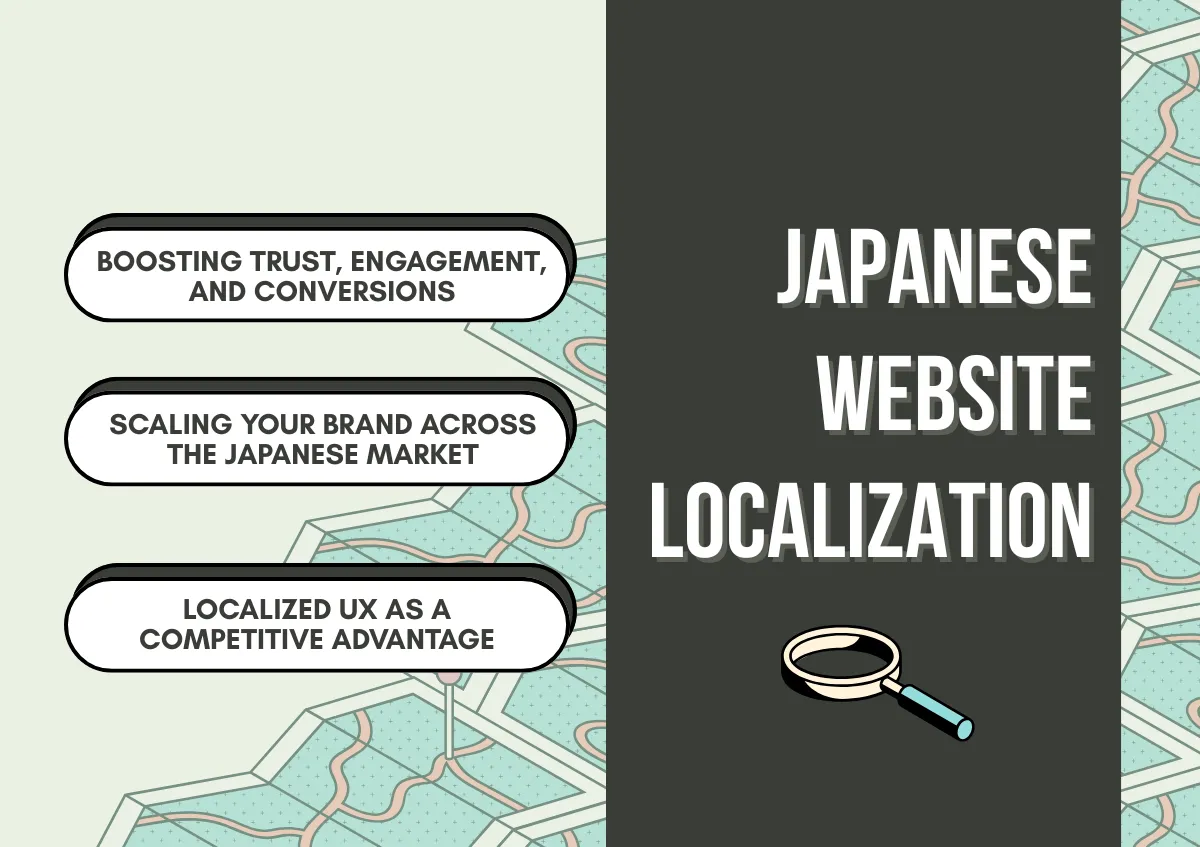
Localizing your website into Japanese goes beyond language; it builds trust and drives measurable business outcomes. When users encounter a site that feels native, they engage more deeply and convert more often. Below are three core benefits of this approach:
A localized site acts as a launchpad for broader market reach. By speaking directly to Japanese consumers in a culturally relevant way, you position your brand for long-term growth.
Design expectations in Japan differ markedly from Western norms. Brands recognizing this can outpace competitors who are still relying on English-only or poorly adapted pages.

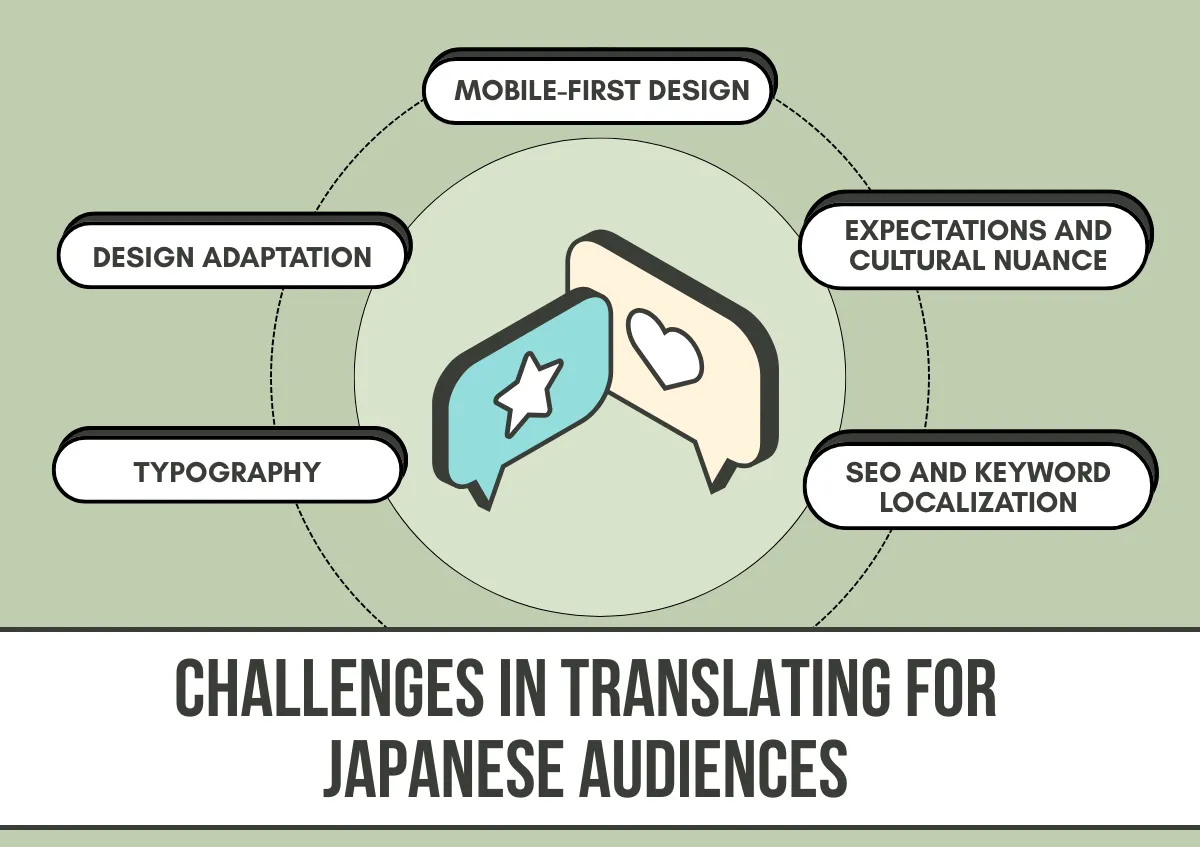
Translating a website for a Japanese audience is not a straightforward linguistic task—it’s a multidisciplinary process that requires strategic planning, cultural fluency, and design adaptation. Japan's digital ecosystem, consumer expectations, and language structure present complex challenges that, if mishandled, can severely impact user experience and brand reputation. Understanding these hurdles is the first step toward creating a website that feels native, builds trust, and achieves business objectives in one of the world’s most discerning markets.
Translating a website for a Japanese audience requires more than accurate language—it must also look and feel right. Japanese users have unique expectations when it comes to tone, structure, and visual design. To succeed, businesses must align content presentation with Japanese design preferences, navigation habits, and reading behaviors. Here's where the challenges—and opportunities—begin.
Western websites often rely on minimalism—ample white space, short phrases, and a clean visual hierarchy. In contrast, Japanese websites tend to present dense blocks of information above the fold, with less emphasis on white space and more focus on immediate access to detailed content. This is not an oversight—it reflects a local cultural preference for completeness and transparency.
Japanese users often expect a website to “prove” its value immediately. This means presenting comprehensive product specs, trust-building assurances (like return policies or certifications), and pricing breakdowns directly on landing or product pages. They are accustomed to scrolling through layered content rather than relying on separate subpages or hidden dropdowns. For example, it's common to find multiple pricing tiers, usage notes, customer reviews, and callouts like “安心・安全” (peace of mind and safety) all on a single screen.
Adapting to this style often requires restructuring your content layout completely, not just translating it. Designers must anticipate the increased text volume and ensure that the page still feels navigable and trustworthy despite its density.
Japanese typography introduces unique technical constraints that are rarely an issue in Western languages. For starters, Japanese writing doesn’t include spaces between words. This makes automated line breaks unreliable and forces designers to manually adjust spacing, especially when using kanji-heavy content or vertical layouts.
Additionally, translating from English to Japanese doesn’t follow a predictable expansion or contraction pattern. Some English terms become much longer in Japanese (e.g., “Sign up now” becomes “今すぐ登録する”), while others become more compact, potentially throwing off the layout balance. Navigation bars, buttons, and callouts must be flexible enough to accommodate these variances without breaking the design.
To preserve legibility and user comfort:
These micro-adjustments have a macro impact on user trust. A site that “feels” off due to poor spacing or broken layouts can quickly erode confidence among detail-oriented Japanese users.
Japan’s mobile internet penetration is among the highest globally, and many users access the web exclusively via smartphones. Influencers are especially popular across platforms like Instagram, YouTube, and TikTok, often seen as trusted tastemakers—particularly when backed by well-known agencies. However, mobile design for Japanese audiences demands more than just responsive scaling.
Japanese text lacks spaces and contains intricate kanji, which can become visually overwhelming on small screens. This makes it essential to:
Also, Japanese mobile users are susceptible to visual clutter and loading speed. Heavy media or animation that seems “premium” in the West might feel intrusive or slow in Japan. Therefore, streamlined graphics, optimized file sizes, and culturally familiar icons are key to maintaining usability.
Translation without cultural localization often results in content that technically makes sense, but feels foreign or awkward. Japanese consumers are highly attuned to subtle social cues, polite language structures (keigo), and formalities that convey respect. For instance, using plain language where honorifics are expected can be disrespectful or unprofessional.
Understanding these nuances is vital. Consider the tone used in business communications versus lifestyle or entertainment content—each has its own set of unwritten rules. Even word choice matters: “無料” (free) may be appropriate for casual offers, while “無償提供” might suit more formal or corporate contexts.
Moreover, Japan is a market where emotional tone can make or break a message. Japanese users often value empathy, modesty, and harmony in communication. Overly assertive or salesy language—common in Western marketing—may feel aggressive or untrustworthy. Tailoring the message to reflect local sensibilities builds trust and relatability.
Cultural trends also play a role. From seasonal imagery to pop culture references, timely and culturally aware content makes a brand feel present and in tune. Missing these cues can result in campaigns that feel tone-deaf or irrelevant.

Japan’s search engine ecosystem has distinct characteristics that affect how localized websites are discovered and ranked. Although Google dominates the global market, Yahoo! Japan still holds a significant share domestically and operates under a unique set of ranking priorities.
One of the most critical challenges is keyword localization. Direct translation of keywords is often ineffective, as Japanese users may search with entirely different terms, phrasing, or even keigo (polite language) compared to English users. For example:
Keyword research must be done from the ground up using tools like Google Japan’s Keyword Planner or Yahoo! Japan’s analytics platforms. Simply localizing metadata or headers isn’t enough—your content must reflect how Japanese users think and search.
Additionally, Japan's key SEO signals are longer dwell times and lower bounce rates. A well-localized, content-rich site with intuitive navigation will naturally keep users engaged longer, improving these metrics. Search engines reward that engagement with higher rankings.
Finally, Japanese users are particularly cautious when evaluating unfamiliar brands, often relying on third-party reviews, aggregated rating systems, and trust seals. Including locally recognized trust elements on your website can indirectly enhance click-through rates and SEO by improving overall engagement.
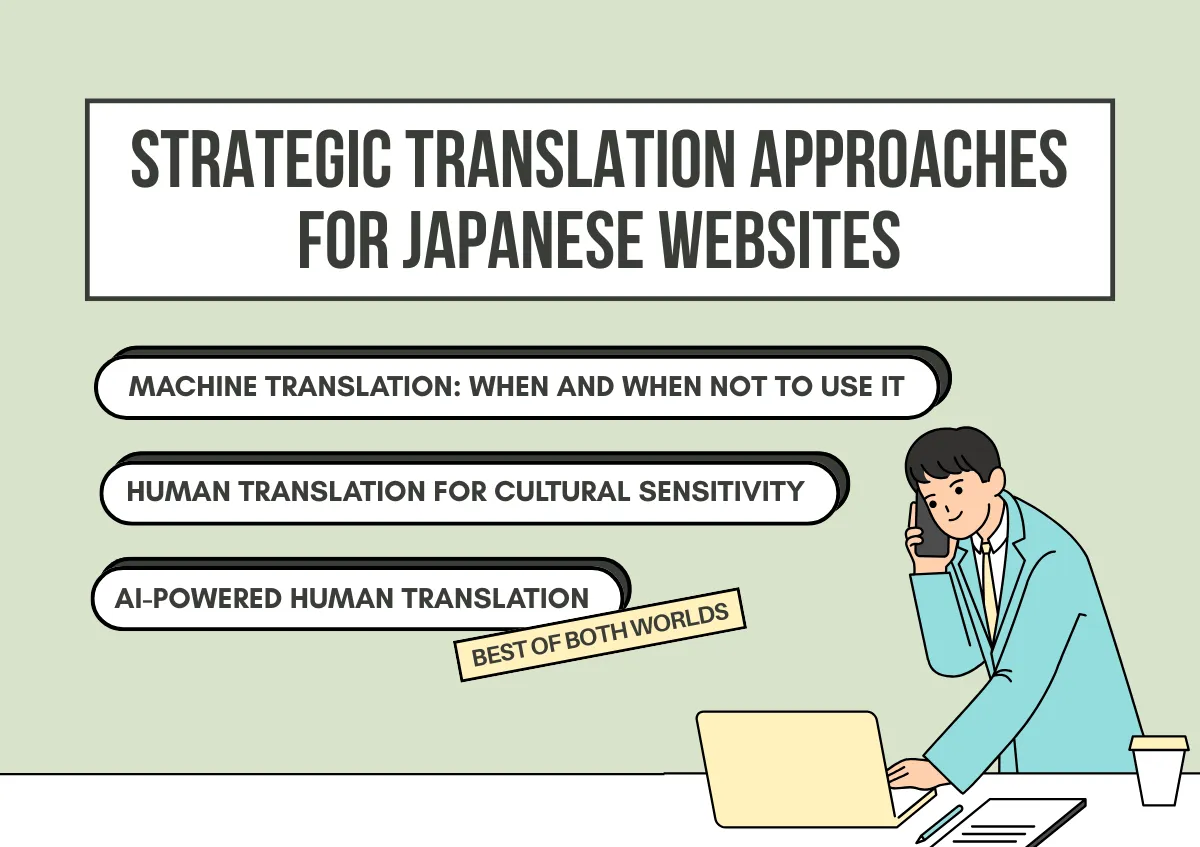
Translating a website for the Japanese market requires more than converting text from one language to another—it demands strategic thinking, cultural sensitivity, and technical precision. Choosing the proper translation method can make the difference between a site that feels local and foreign. Below are the three main approaches businesses can take when localizing their content for Japanese audiences.
Machine translation (MT), powered by neural machine translation (NMT) engines like Google Translate or Microsoft Translator, offers a fast and scalable solution for translating large volumes of content. These tools can handle simple sentence structures and provide instant results, making them attractive for businesses with limited time or budget.
Best Use Cases for Machine Translation:
Limitations for Japanese Localization:
Despite its convenience, machine translation struggles with the complexity of the Japanese language:
While MT can be a valuable starting point, relying on it alone for customer-facing websites, especially in Japan, can compromise the user experience and harm brand credibility.
Human translation remains the most reliable approach for conveying linguistic accuracy and cultural authenticity. Professional Japanese translators understand not only the language but also the societal norms, business etiquette, and communication subtleties that shape how Japanese users perceive online content.
Advantages of Human Translation:
Drawbacks to Consider:
For Japanese audiences—known for their attention to detail and cultural precision—human translation is essential for any content where accuracy, brand voice, or consumer trust is at stake.
Given the competitive hiring environment in Japan, many companies choose to outsource this work to trusted local partners, ensuring consistent quality without the challenges of building in-house language teams.
A hybrid approach—AI-powered human translation—combines the speed of AI with the precision of human expertise. In this method, AI tools generate a first-draft translation, which human translators then review and refine.
This approach offers:
For Japanese websites, AI-powered human translation is particularly effective for:
By leveraging AI for initial drafts and human translators for final revisions, businesses can ensure their websites maintain cultural accuracy, clarity, and a professional tone while saving time and resources.
Many businesses are turning to AI-powered human translation to balance speed, cost, and quality. In this model, AI tools generate an initial translation, which a professional human translator reviews, edits, and polishes. This hybrid approach significantly improves efficiency without sacrificing cultural fidelity.
Benefits of AI-Powered Human Translation:
Ideal Applications in the Japanese Market:
By combining AI automation with human translators' insight, this method ensures Japanese users receive explicit, natural, and culturally attuned content while helping businesses manage resources more efficiently.
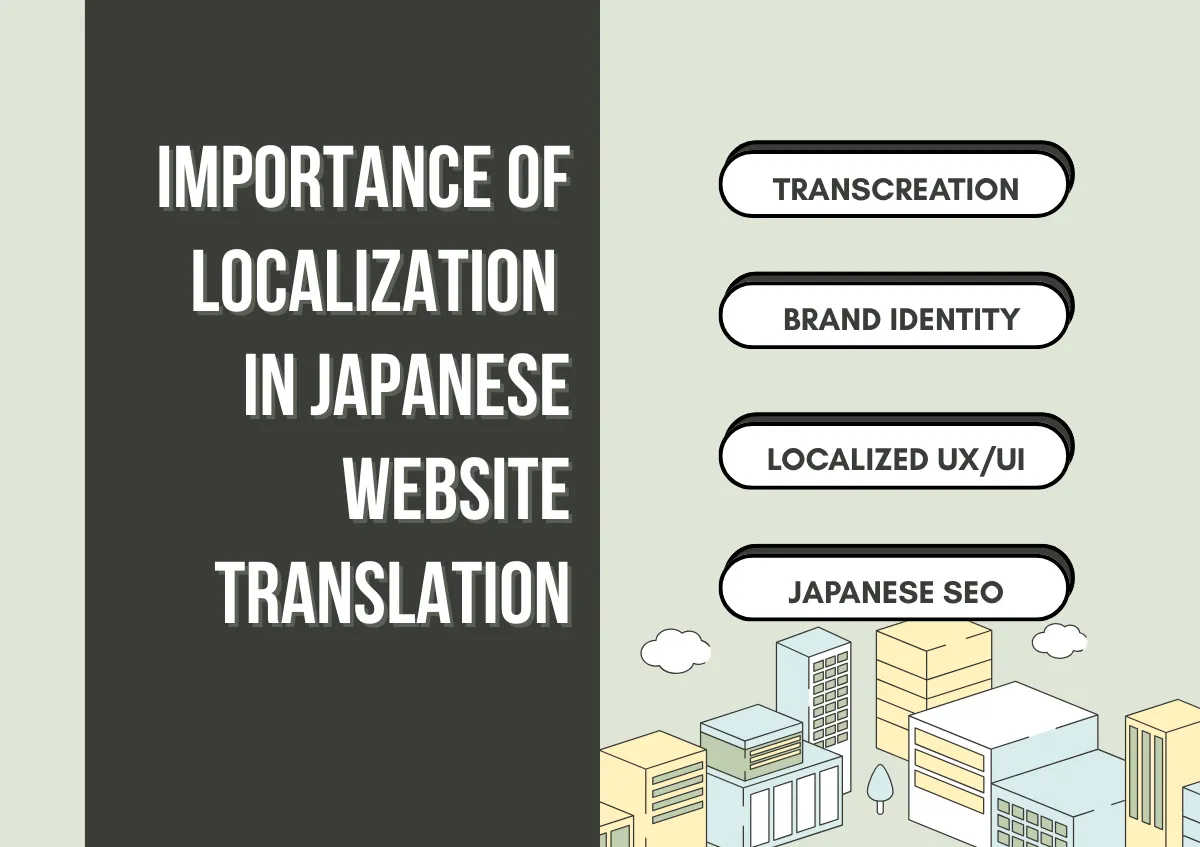
Successfully entering the Japanese market requires more than just converting text from English to Japanese—it requires localization. Translating means adapting the language and the cultural nuances, tone, visual presentation, and digital behavior that define the Japanese online experience. Japan’s unique blend of formality, high consumer expectations, and detail-oriented communication demands a localized approach that feels natural and trustworthy to native users.
Even digital marketing tactics, like link building, must be adjusted to align with local expectations—where trust, reputation, and relationship-building take precedence over the more direct, transactional strategies common in Western markets. Below are four key pillars of effective localization for Japanese websites.
Transcreation goes beyond literal translation to ensure your message resonates with Japanese values, emotions, and expectations. It involves rewriting content to preserve the original message's intent, style, and emotional appeal, while aligning it with local cultural norms.
In Japan, where consumer decision-making is heavily influenced by nuance, context, and trust, transcreation is especially critical in marketing content. A slogan that works well in Western markets may need to be reimagined entirely to evoke a similar emotional response in Japan. For example, emphasizing exclusivity and craftsmanship—rather than general luxury—tends to resonate more with Japanese audiences.
This technique is fundamental for:
Transcreation ensures your message doesn’t just “make sense” in Japanese—it feels right, boosting engagement and brand credibility.
Maintaining brand identity while adapting to local expectations is a delicate balancing act. Japanese consumers are known for their emphasis on professionalism, quality, and consistency. As such, a brand’s tone, visuals, and messaging must often shift slightly to align with these priorities.
For example, a casual and playful Western brand may need a more polished, detail-oriented, and service-driven voice in Japan. However, it doesn’t mean abandoning the core identity—it means reinterpreting it for a different cultural context.
Effective brand adaptation might involve:
By aligning brand communication with local values while preserving the essence of the original identity, companies can establish a strong, culturally relevant presence in Japan.
Website design preferences vary significantly between Japan and Western markets. Japanese users prefer more information-dense pages, smaller fonts, and multiple visual cues over minimalist layouts.
Key localization tactics for Japanese UX/UI include:
While Western users may favor simplicity and white space, Japanese users expect comprehensive content that helps them make informed decisions. Tailoring your UX and visual hierarchy to reflect these expectations will significantly improve usability and conversion rates.
Search engine optimization (SEO) in Japan involves more than keyword translation. It requires understanding how Japanese users search, which platforms they prefer, and what kind of language they use in queries.
Effective Japanese SEO localization includes:
Media buying in Japan also differs significantly from Western markets. Relationships, trust, and cultural alignment play a larger role, particularly in direct media placements. Japanese publishers often prefer to work with local partners, and ad creative must be carefully tailored to reflect local values and aesthetics. Success depends not only on data and technology but also on an understanding of local business etiquette and consumer expectations.
Ignoring these factors can result in poor visibility even if your content is high quality. By optimizing content with a Japan-specific SEO strategy—and aligning media buying efforts with local norms—businesses increase their chances of appearing in relevant search results and capturing attention across both organic and paid channels.
Navigating the complexities of Japanese website translation requires more than just converting text from one language to another. It involves deeply understanding cultural nuances, user expectations, and local market trends. By addressing the benefits of Japanese website translation, such as scalable growth and enhanced user engagement, you set the stage for meaningful connections with your audience. Recognizing and overcoming challenges like ensuring accuracy and relevance are vital to creating a truly localized experience.
The unique considerations in translating from English to Japanese - like managing cultural differences and understanding linguistic nuances - highlight the need for a strategic approach. Employing a mix of AI and human translation methods can bridge gaps in accuracy and cultural sensitivity. Moreover, prioritizing localization through transcreation, adapting your brand identity, and optimizing for Japanese SEO will enhance your online presence and build lasting trust with Japanese consumers.
A well-executed localization strategy is the key to unlocking your brand's potential in Japan. It transforms your website from a mere translation to a powerful tool that resonates with local audiences and drives business success in a competitive market.
Translating for Japanese audiences goes far beyond converting words from English to Japanese. It requires a thoughtful, culturally informed approach that respects how language, tone, and design influence trust. In Japan, even subtle missteps in formality or nuance can alienate users. These takeaways highlight why precision in translation—and true localization—is essential for building credibility and connection in one of the world’s most discerning digital markets.

Translating your website into Japanese requires more than just words—it demands strategy, cultural insight, and expert UX design. At IGNITE, we specialize in helping international businesses localize their websites to truly connect with Japanese users.
From high-impact website translation and local SEO optimization to custom UI/UX design and full-site localization, our bilingual team based in Osaka ensures your digital presence not only resonates but also performs and scales effectively in Japan.
Don’t let your message get lost in translation. If you’re ready to go beyond basic translation and build a culturally relevant website that converts, contact IGNITE today to start crafting a digital experience that feels native and drives real results.
EN-JA bilingual project manager with experience leading Japanese translation and localization projects. Oversees SEO-focused content quality, production, and coordination.

Building a fast, multilingual e-commerce site for a Sakai-based kitchen knife store, boosting traffic and international sales through Shopify and Webflow integration.

Localizing over 1,100 sake and shochu listings into English, driving a 148% increase in inquiries through SEO-focused translation and website optimization.

Delivering accurate Japanese-English localization for a pet product website, optimizing industry-specific vocabulary to support international marketing expansion.

Providing high-quality multilingual translations for a pet supplies brand’s brochures and website, ensuring global appeal at international exhibitions.

Translating YouTube content into four languages to help a Japanese fitness creator grow global views by 132% through SEO-optimized subtitles, tags, and descriptions.
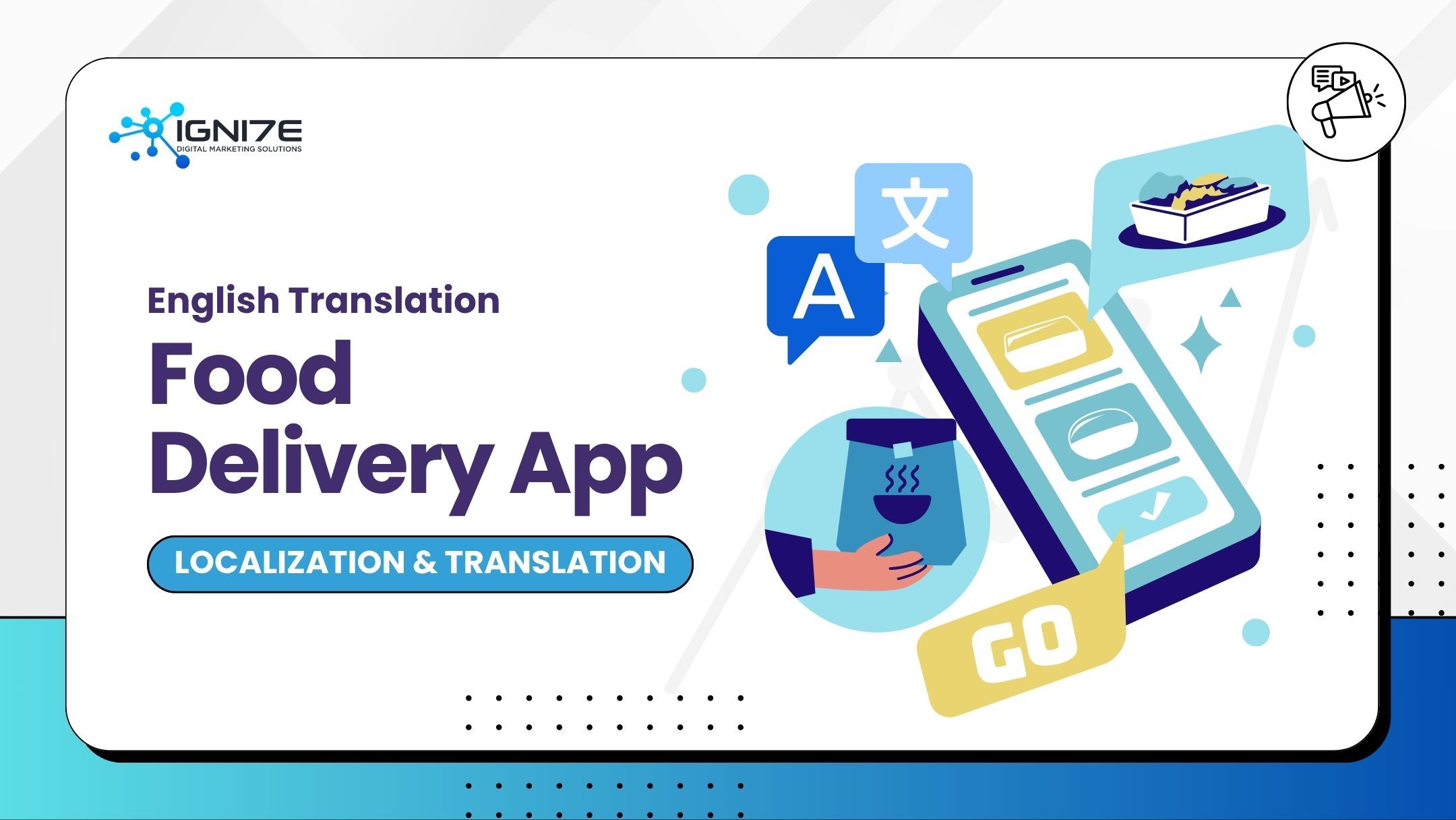
Providing comprehensive translation services, we supported a global food delivery app in translating over 30,000 restaurant menus into English with speed, accuracy, and scalability.
Find the right service to grow your business in Japan.