

Japanese SEO Content Creation for Hotel Search Engine
Creating Japanese SEO content for a hotel search engine, boosting impressions by 371% and URL rating by 529% in two months through keyword targeting and link-building.



Entering the Japanese market requires more than just translating existing content; it demands mastering Japanese copywriting. Understanding cultural nuances, effective localization, and strategic copywriting is crucial for foreign companies. Whether you're launching a new venture or expanding an existing one, starting a business in Japan means aligning every aspect—from legal setup to brand voice—with local expectations. This article explores essential insights, from the impact of Japanese culture on marketing to the importance of specialized team roles. By leveraging these strategies, your business can achieve better visibility, brand awareness, and sales in Japan. Discover how consultants can help you navigate the complex landscape and succeed in the Japanese market.

Copywriting in Japan is essential for foreign companies seeking to impact their unique and competitive market significantly. Japanese consumers value authenticity, precision, and cultural relevance in the content they engage with. Therefore, Japanese copywriting goes beyond simple translation; it requires a thorough understanding of local customs, cultural nuances, and consumer preferences. Effective copywriting in Japanese helps brands connect with their audience on a deeper level, fostering trust and loyalty. By mastering the art of copywriting in Japan, foreign companies can enhance their brand visibility, build stronger customer relationships, and ultimately achieve greater success in the Japanese market.
Copywriting in Japan involves crafting persuasive, engaging, and culturally relevant content tailored to Japanese consumers. For foreign companies, mastering Japanese copywriting is crucial for several reasons.
First, it enhances visibility. Well-written copy that resonates with the local audience ensures your brand stands out in a crowded marketplace. By using precise language and culturally appropriate references, your content is more likely to capture the attention of potential customers.
Second, effective copywriting in Japanese significantly boosts brand awareness. When your content aligns with Japanese consumers' cultural expectations and values, it helps build a strong and recognizable brand presence. Consistent and culturally sensitive messaging fosters trust and loyalty among your target audience.
Finally, it powerfully increases sales. A persuasive and well-crafted copy can drive consumer action, encouraging purchases and improving conversion rates. Your content can effectively motivate Japanese customers to choose your products or services over competitors by addressing their specific needs and preferences.
Japanese copywriting encompasses various forms of content tailored to different marketing needs. Each type is crucial in effectively reaching and engaging the target audience. Media buying in Japan often works hand-in-hand with copywriting, as culturally attuned messaging is essential to ensure ad placements resonate with local consumers.
| Type of Copywriting | Description | Effective Use Cases in Japan |
|---|---|---|
| Website Texts | Establishes online presence with explicit, culturally relevant content. | Companies like Rakuten use detailed product pages to boost trust. |
| Blog Articles | Provides valuable information, builds authority, and improves SEO. | Muji's minimalist lifestyle blogs enhance brand ethos and SEO. |
| Product Descriptions | Convincing details for e-commerce, focusing on benefits and features. | Amazon Japan uses precise, informative descriptions to increase sales. |
| Category Descriptions | Helps organize products and guide customer navigation. | Nitori's furniture categories simplify browsing for consumers. |
| Social Media Posts | Engages audience on platforms like X, Facebook, and Instagram with concise, impactful messages. | Uniqlo’s Instagram showcases seasonal trends with concise captions. |
| Newsletter Texts | Keeps subscribers informed with updates, promotions, and valuable content. | JAL's newsletters offer exclusive deals, boosting loyalty. |
| Advertising Slogans | Creates memorable messages that reinforce brand identity and emotional appeal. | SoftBank’s "Oto-san" (Father) campaign uses humor to enhance recall. |
| Naming | Develops catchy, culturally appropriate names for products, services, or campaigns. | Calbee's "Jagabee" name resonates as cute and friendly. |
| Emails | Provides direct, personalized communication with customers for engagement and conversion. | ANA's personalized travel updates increase booking rates. |
By mastering these diverse forms of copywriting in Japan, foreign companies can effectively engage their audiences and successfully achieve their marketing objectives. In today’s digital landscape, By mastering these diverse forms of copywriting in Japan, foreign companies can effectively engage their audiences and successfully achieve their marketing objectives. In today’s digital landscape, social media plays a critical role in shaping brand perception, and influencer marketing has become a powerful tool for building trust and driving consumer behavior—especially when aligned with culturally relevant messaging.
Even the most compelling copy can lose its impact if it's not presented within a culturally attuned user experience. Website layout, tone of voice, choice of visuals, and even button text all influence how Japanese users interact with your brand online. Localization isn't just about language—it’s about creating a seamless experience that feels native to Japanese visitors.
To truly resonate with local consumers, businesses need more than translation—they need a strategic content and UX approach tailored to Japan’s unique digital landscape.
Ready to make your website work in Japan?
Our guide, Optimizing Your Website for a Japanese Audience, teaches you how to optimize your content and design for Japanese users.

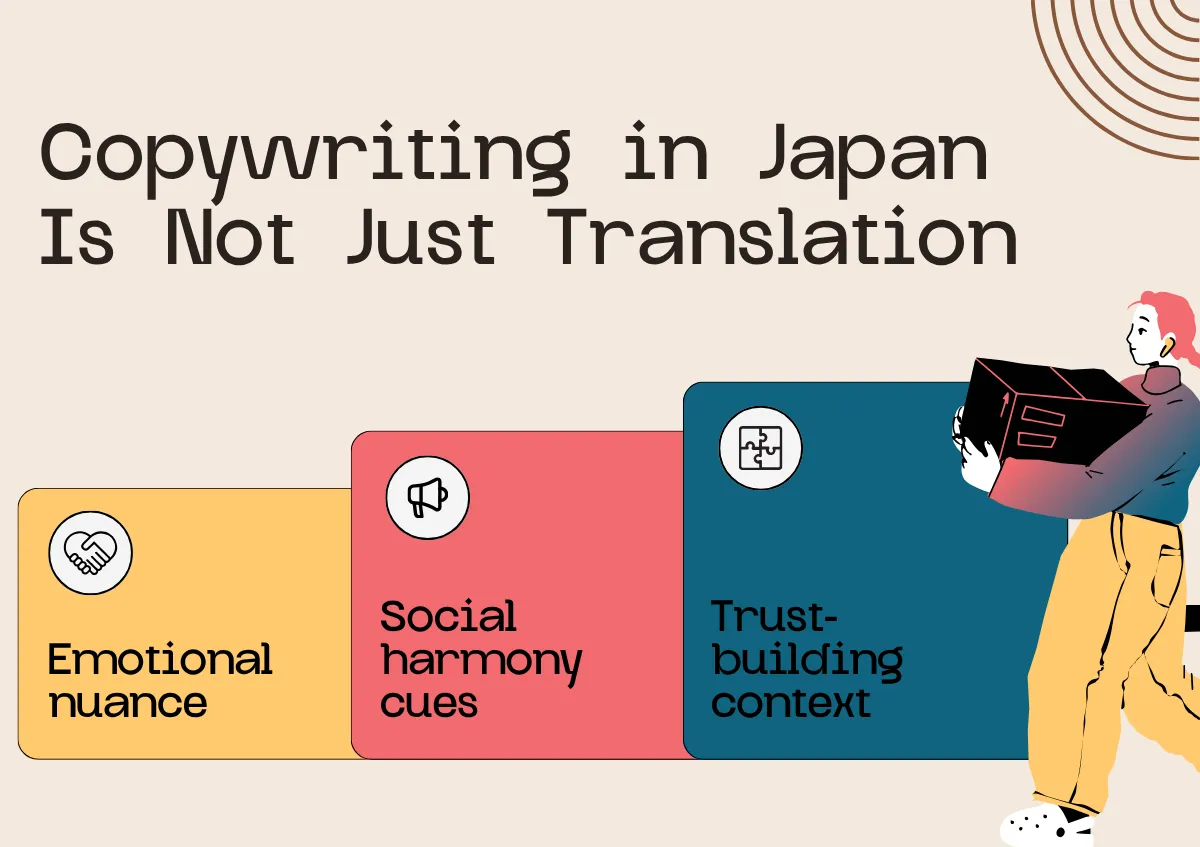
For foreign companies entering Japan, it can be tempting to treat copywriting as a simple translation task—taking what works in English, converting it to Japanese, and expecting similar results. However, that method almost always falls short.
Japanese copywriting goes far beyond translating words. It involves reshaping the message to fit cultural norms, meet reader expectations, and resonate with the psychology of Japanese consumers. Action-oriented copy—designed to drive user behavior such as clicking a button, filling out a form, or making a purchase—is where these differences become especially critical.
In Japan, getting someone to act requires more than a strong call to action. It demands:
While translation ensures that the words are accurate, it often strips away the persuasive structure that makes copy effective in Japanese. A good Japanese copywriter doesn’t ask: “How do I say this in Japanese?” They ask: “How would a Japanese person need to hear this in order to act?”
For example:
Western copy might push: “Sign up now and get 25% off.”
Japanese copy will reframe: 「今なら、初回限定25%オフでお試しいただけます。」
(“For a limited time, first-time users can try it with 25% off.”)
Both convey the same offer, but only one feels appropriate to a Japanese audience.
Japanese users often need more context before acting. They’re risk-averse, detail-oriented, and responsive to messaging that shows understanding of their situation or role (especially in B2B or SME environments). Effective Japanese copywriting requires restructuring the message, not just translating it.
If you simply translate your English content:
But when you rewrite based on Japanese reading behavior, tone, and cultural cues, the same content becomes engaging, polite, and persuasive, ultimately driving better results.

Understanding the differences between Western and Japanese copywriting is critical if you want your message to convert, not just be understood. Western copy tends to be built around clarity, brevity, and strong calls to action. In contrast, Japanese copywriting emphasizes politeness, indirectness, emotional assurance, and social harmony.
Here are the core differences that directly impact how your copy should be written:
Western: Straight to the point. Strong CTAs like “Buy now,” “Start your free trial,” or “Don’t miss out!” are common.
Japanese: More indirect and respectful. You’ll often see softer phrasing like:
A direct command in Japanese can feel abrupt or even rude. Instead of pushing, the Japanese copy invites and reassures.
1. Structure and Flow
Western: Often follows AIDA (Attention, Interest, Desire, Action) or PAS (Problem-Agitate-Solution) frameworks.
Japanese: Similar frameworks can be applied, but they must be softened with contextual buildup and social proof (e.g., customer count, testimonials, trust badges). Flow is more circular than linear, with subtle transitions that feel natural.
In the Japanese copy, don’t jump straight into the ask. Build trust first with shared concerns, results, or empathy.
2. Emotional Triggers
Western: FOMO (fear of missing out), scarcity, urgency.
Japanese: Security, community, responsibility. Consumers want to feel reassured and socially aligned, not pressured.
For example:
Same meaning, but framed with respect and implied demand, not desperation.
3. Language Density
Western: One sentence = one idea.
Japanese: One sentence often implies multiple layers of meaning, with fewer words.
This means translated copy is often shorter in Japanese but less effective unless rebuilt with the proper emotional cues and value explanation.
Japanese and English operate under different rules of grammar and logic. In Japanese, it’s common to omit the subject, use contextual cues instead of explicit phrasing, and rely heavily on implied meaning. The result: translated copy often ends up shorter, but also emptier.
Many foreign companies go wrong here. By simply translating English copy line-by-line, they unknowingly remove crucial context and emotional weight, both essential for effective marketing in Japan.
What gets lost in translation:
The key is: Don’t translate — reconstruct.
Effective Japanese copywriting isn’t about linguistic accuracy, functional clarity, and emotional flow. You should rebuild your message around how Japanese users process and respond to information. That means:
Example:
Original English: “Our software helps small businesses automate their invoicing.”
Bad Japanese translation: 「私たちのソフトは中小企業の請求書作成を自動化します。」
Effective Japanese copy:
「毎月の請求書作成が、もっとカンタンに。中小企業向け自動化ツール。」
The revised Japanese version leads with the outcome and speaks directly to the reader’s problem. It transforms an introductory statement into a copy block that drives interest and action.
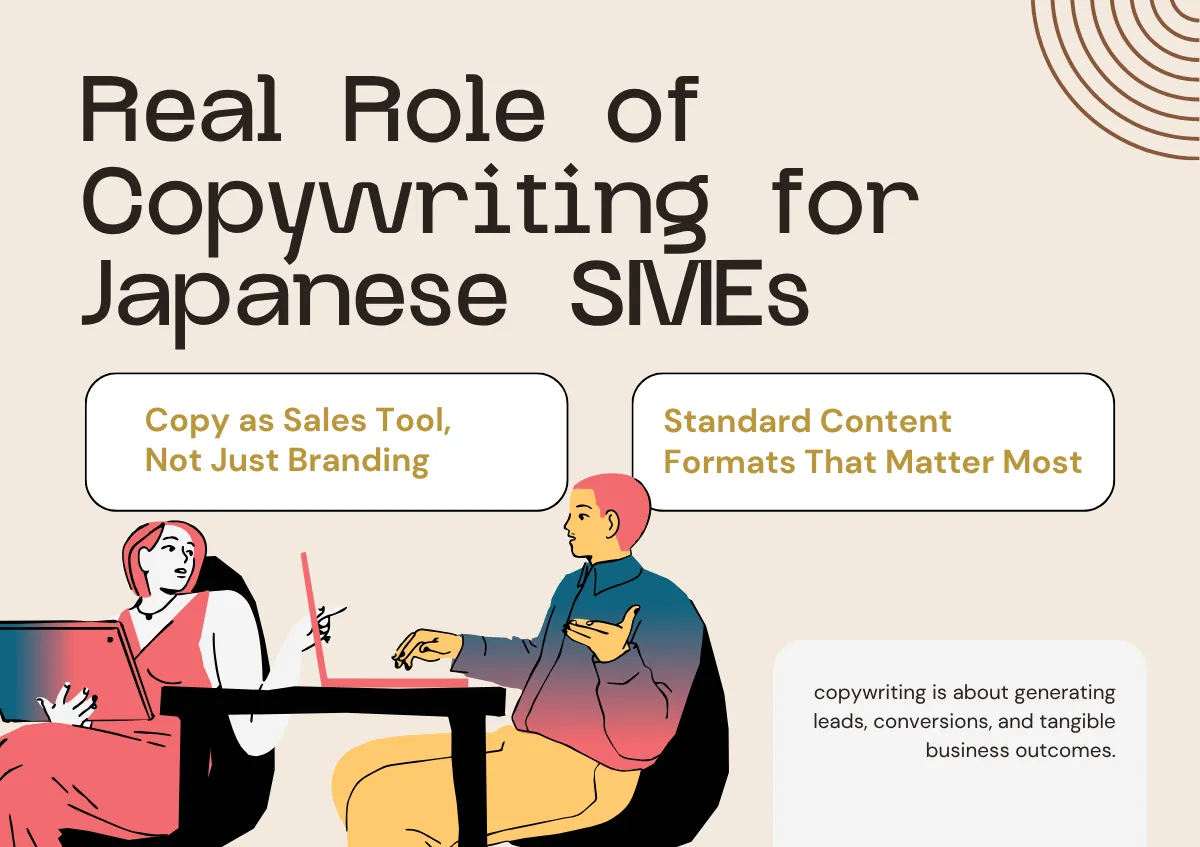
For small and mid-sized businesses (中小企業) in Japan, copywriting isn’t just about expressing brand values—it’s about generating leads, conversions, and tangible business outcomes.
Unlike large corporations with the resources for long-term branding campaigns, SMEs require copy that delivers immediate results—landing pages that generate inquiries, LINE messages that prompt clicks, and email sales letters that lead to bookings. In such a context, copywriting needs to serve as a direct-response sales tool rather than simply expressing brand identity.
Foreign companies entering Japan must rethink their content strategy accordingly. The goal isn’t to sound “fluent in Japanese”—it’s to write in a way that makes Japanese customers act.
In Japan, your website is more than just an online brochure—it’s your virtual storefront, and your copy is the salesperson. A good copy doesn't simply describe what you do; it guides the customer to why it matters to them and gives them a culturally appropriate way to take the next step.
Bad Example (Feature-Focused Copy):
「私たちは最高の家を作ります。」
(We build the best homes.)
Too vague. Focuses on the company, not the user. Offers no benefit or action.
Better Example (Benefit + Emotional Hook):
「家族と過ごす毎日が、もっと快適になるリフォームをご提案します。」
(We offer renovations that make everyday life with your family more comfortable.)
Shows empathy, highlights the outcome, and speaks directly to the user’s lifestyle.
Effective Japanese copywriting for SMEs is about leading with the benefit and guiding the reader to a soft close, such as a contact form or consultation request.
To reach Japanese consumers, especially as a foreign business, you must excel at the formats where action happens. Here are the most critical ones for SMEs and how to approach them:
Landing Pages
Should be structured with benefits, followed by proof, trust elements, and a gentle CTA.
Start with a clear emotional value:
「請求書処理の時間を、1日30分短縮しませんか?」
(What if you could save 30 minutes a day on invoicing?)
LINE Ads & Social Posts
Short, polite, and value-driven.
「今すぐ使える業務効率化のヒントを、LINEでお届けしています。」
(We send helpful business tips straight to LINE.)
Product Pages
Focus on what the product helps the user achieve, not just specs.
「このツールで、見積もり作成のミスがゼロに。」
(Eliminate errors in your quotation workflow with this tool.)
Email Sales Letters
Use 丁寧語 and a soft action invitation:
「ご興味がございましたら、ぜひ一度ご相談ください。」
(If this interests your business, we’d be happy to discuss further.)
1. Benefit-First Messaging (ベネフィット先行型)
Don't start with who you are. Start with what the customer gains.
Bad: 「当社の製品は…」 (Our product is...)
Better: 「導入するだけで、毎月の経費を10%削減。」 (Cut monthly expenses by 10% with one simple tool.)
2. Trust-Building Language (丁寧語 + 実績)
Japanese readers look for professionalism and social proof. Include:
3. Soft Close CTAs
Instead of “Buy now,” use:
These phrases remove pressure while gently guiding the user to act.
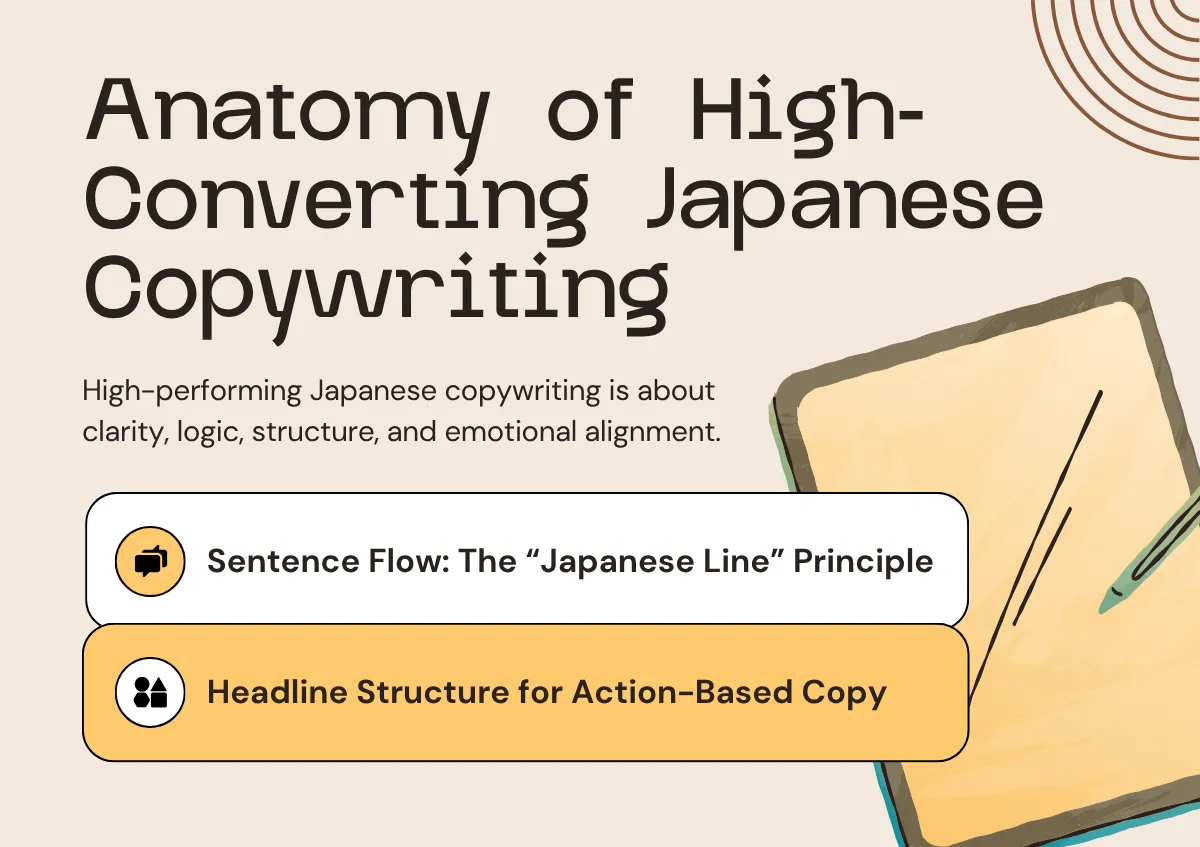
High-performing Japanese copywriting doesn’t just sound good—it moves people to take action in a way that feels natural, trustworthy, and culturally appropriate. It’s not about flashy slogans or clever wordplay. It’s about clarity, logic, structure, and emotional alignment.
In a culture that values subtlety and order, copy must guide readers through a smooth, respectful journey. Japanese consumers respond best to messaging that builds context and trust before inviting any commitment—an approach especially important in B2B, SaaS, and service-based sectors where skepticism is common and competition is fierce.
The distinct cultural landscape in Japan also means that link building strategies must be adapted to fit local expectations and business practices, which differ significantly from Western approaches.
Want to dive deeper? Read our comprehensive marketing guide to discover how to craft culturally tailored copy and effective link building and SEO strategies that truly resonate with Japanese audiences.
If you’ve ever stood in a perfectly formed line at a Japanese train station, you’ve already seen how excellent Japanese copy should work.
Think of your copy as a queue:
This is what we call the “Japanese Line” Principle:
Sentences should flow with precision, logical, frictionless, and purposeful.
This mirrors Joseph Sugarman’s famous “slippery slope” principle, where each sentence exists to get the reader to read the next. But in Japanese, this flow must feel polite and effortless, not pushy.
Example text: Automate your tasks with our tool. Download now!
English-style translation:
「このツールであなたの業務を自動化します。今すぐダウンロードしてください!」
(This tool will automate your tasks. Download now!)
Abrupt. Rushed. The tone doesn’t match local expectations.
Japanese-style flow:
「毎日の業務に、もっと余裕を。自動化ツールで、時間とコストを削減しませんか?」
(Create more breathing room in your daily workflow. Save time and costs with our automation tool.)
Smooth. Value-first. The message flows toward a soft, persuasive next step.
Headlines are often the first and only thing a reader sees. In Japan, where users scan quickly and expect immediate clarity, your headline must deliver three things at once:
Formula: [Benefit] + [ターゲット明示 (target audience)] + [信頼構築 (credibility signal)]
This structure delivers what matters most to the Japanese reader:
Example:
「忙しい中小企業のための、手間いらず請求書管理ツール」
(An effortless invoicing tool—designed for busy SMEs)
Breakdown:
You don’t need to be clever—you need to be transparent and customer-focused.
Additionally, try to avoid vague or abstract phrases like 「最先端のソリューション」 (cutting-edge solutions)—too corporate and empty.
Use specifics:
Use language your audience uses, and not what sounds fancy in English.
Translation is only the beginning. To build genuine connections with Japanese customers, foreign companies must move past direct conversions and develop copy that reflects local emotions, communication styles, and decision-making habits.
Effective localization goes beyond selecting the right words—it demands a careful reworking of meaning so the message aligns naturally with Japanese cultural and business norms. When the objective is to inspire action rather than simply deliver information, a deeper, more strategic approach is essential.
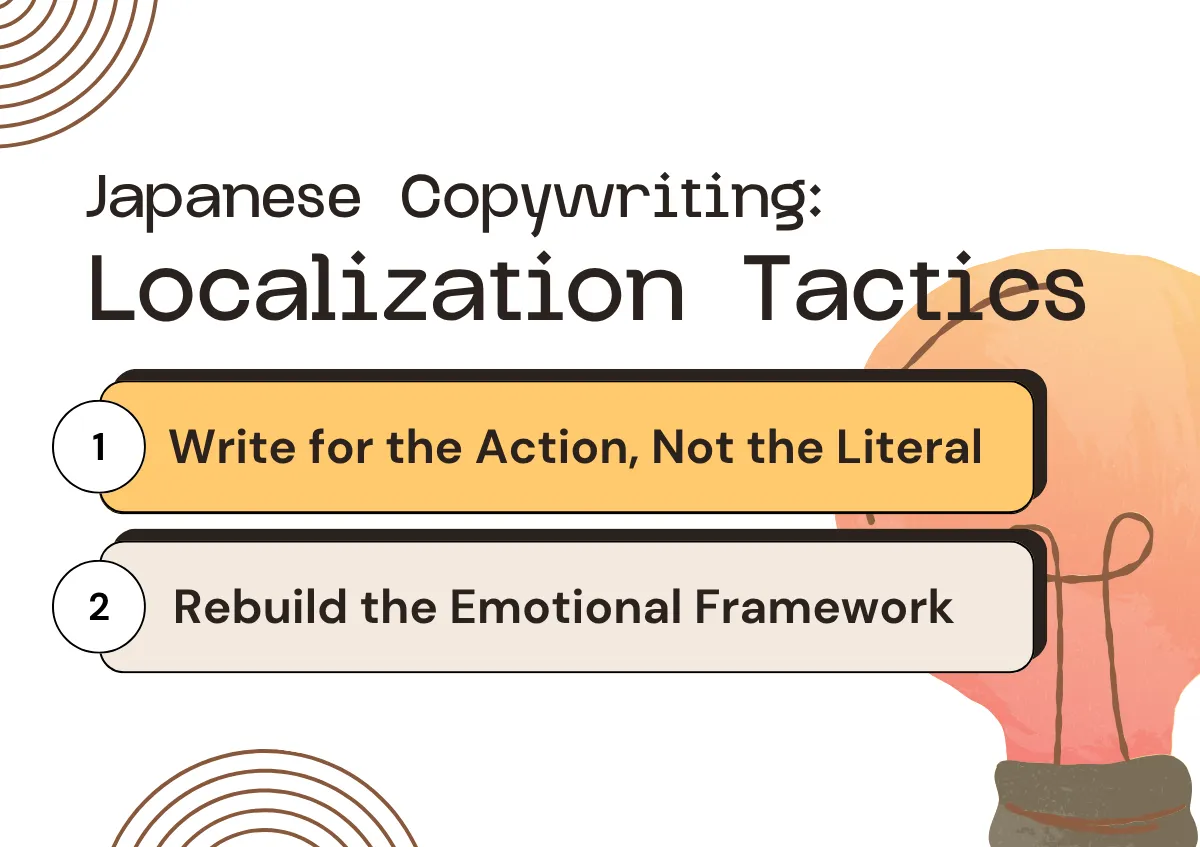
Below are two proven localization tactics that help drive stronger engagement in Japanese marketing.
Many companies translate their English CTAs directly into Japanese, losing trust, tone, and effectiveness in the process. Literal translations often sound robotic, unnatural, or even pushy. A good Japanese CTA invites the reader to take action in a low-pressure, benefit-focused, and polite way.
Common Literal Translation:
English: “Try it now”
Japanese (literal): 「今すぐ試してみてください!」
→ Too direct. Feels like a command. Lacks warmth and context.
Localized, Reader-Friendly Versions:
「今すぐ、体験してみませんか?」
(Why not give it a try now?)
「無料でお試しいただけます」
(You can try it for free.)
These versions:
This soft yet persuasive approach is essential for Japanese B2B and consumer audiences who value modesty, calm confidence, and clarity.
One of the most overlooked elements in localization is emotional tone. Japanese copywriting tends to be more seasonal, contextual, and emotionally restrained compared to Western content.
To make a message resonate, it needs to feel at home in the reader’s current emotional environment. Familiar seasonal language (季語), weather-based metaphors, and references to social harmony are all effective ways to create that connection.
Seasonal Framing Example:
Let’s say you’re promoting a home heating product in winter.
Western-style line (literal): “Stay warm this winter with our new heater.”
Japanese emotional framing:「寒い季節に、あったかく過ごす知恵をお届けします。」
(Sharing warm solutions for the cold season.)
This version feels:
Use cases for seasonal/emotional localization:
Email subject lines:「春の新生活を応援する特集」 (Support for your spring lifestyle transition)
Website banners:「年末年始の業務をスムーズに」 (Streamline your year-end operations)
These touches may seem small, but they dramatically increase emotional relatability, which is key to getting Japanese readers to trust and act.
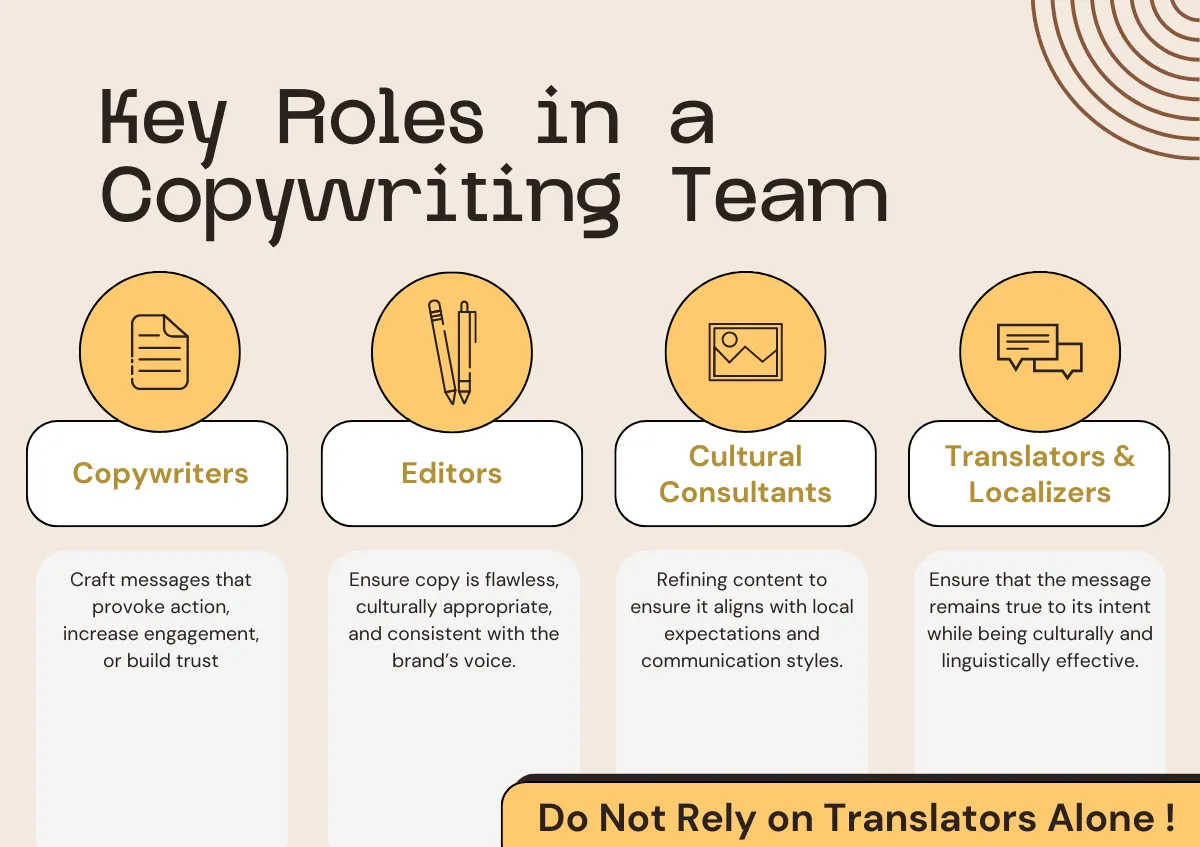
Compelling Japanese copy doesn’t come from translation—it comes from strategy. To create messaging that drives action, you need a team built for performance: copywriters who understand cultural nuance, editors who ensure clarity and tone, and specialists who know how to turn language into results.
This section breaks down the key roles you need and explains how to find the right people to make your message work in Japan.
A well-structured copywriting team ensures that every aspect of clarity, engagement, and cultural alignment is addressed. The following are the essential roles in crafting compelling Japanese copy:
A copywriter’s job is not merely to write but to craft messages that provoke action. Whether the goal is to boost conversions, increase engagement, or build trust, a good copywriter understands the psychology behind the audience’s decision-making process.
In Japanese copywriting, a skilled copywriter must:
Companies often mistakenly believe that any fluent speaker can be a copywriter. However, copywriting is a learned skill, much like coding, graphic design, or sales strategy. The best copywriters train extensively, refine their craft over the years, and consistently produce results.
Editors polish copy to ensure it is flawless, culturally appropriate, and consistent with the brand’s voice. They focus on:
Japanese consumers value refinement and attention to detail, and minor errors can severely damage credibility. Having an editor ensures that the copy is compelling and aligns with Japan’s high standards for professionalism.
Even a well-written piece of copy can fall flat if it lacks cultural resonance. Cultural consultants bridge the gap between language and social expectations, ensuring that messaging:
Translators and general writers may have strong language skills, but they often lack the insight needed to tailor messaging for Japanese audiences. Cultural consultants play a crucial role in refining content to ensure it aligns with local expectations and communication styles.
Translation and localization ensure that the message remains true to its original intent while being culturally and linguistically effective. However, translators are not copywriters; a direct translation often fails to capture the persuasive elements necessary for marketing success.
The best approach is to pair translators with copywriters. While the translator ensures linguistic accuracy, the copywriter adapts the message for maximum impact in the Japanese market.
Many companies delegate copywriting to translators, bilingual staff, or general writers, assuming fluency equals marketing skill. But copywriting—especially in Japan—is a specialized craft. It blends psychology, strategy, cultural sensitivity, and persuasive structure. Simply translating text, no matter how accurately, will rarely produce content that moves a Japanese reader to act.
A copywriter is not a translator. A translator converts language. A copywriter converts attention into action.
If you're trying to enter the Japanese market, especially as a B2B or direct-response brand, you need a Japanese-speaking copywriter who understands marketing psychology and Japanese consumer behavior. This means someone who knows:
Without this skill set, even the best translation will fall flat.
Hiring the right copywriter is as critical as hiring the right designer, developer, or strategist. You’re not looking for someone who’s simply “good at writing”—you’re looking for someone who knows how to generate results with words, and do it for a Japanese audience. In Japan, where outsourcing creative work is common, partnering with a specialist who understands both language and local market dynamics can make all the difference.
Here are key questions to ask when evaluating a Japanese copywriter or agency:
1. Have you written landing pages (LPs) for Japanese B2C or B2B audiences?
Look for experience in action-driven formats—especially those that require emotional appeal and structured flow.
2. Can you show performance-based results?
Ask for data or examples related to conversion rate (CVR), click-through rate (CTR), or lead generation success. An excellent copy doesn’t just sound nice—it performs.
3. How do you adapt tone and CTAs for Japanese readers?
A qualified copywriter should be able to explain how they adjust:
Even better, ask them to show before-and-after examples of rewritten or localized copy to increase engagement.
Understanding the theory behind compelling Japanese copy is a solid start. But applying that knowledge to create high-converting content is where the real challenge lies, especially for small to mid-sized businesses where every word must work hard.
This section provides practical tips to help your team move beyond translation and start crafting Japanese copy that drives action, clicks, leads, and purchases. Forget high-concept branding campaigns. This is about conversion.
What Performance-Based Japanese Copy Actually Looks Like
Let’s look at how Japanese copywriting works in a direct-response, SME context—not with global brand slogans in mind but with real-world conversions in mind.
Example 1: B2B SaaS Website
Too vague (translation-style copy):
「私たちのソフトは業務を効率化します」
(Our software improves your operations.)
Effective rewrite (conversion-focused):
「面倒な経費精算を、月5時間削減。中小企業向けクラウド管理ツール」
(Cut 5 hours of expense report work each month. A cloud management tool for SMEs.)
Why it works:
Example 2: Online Course Landing Page
Generic CTA:
「今すぐ登録して始めましょう」
(Sign up now to get started.)
Effective rewrite:
「3ヶ月で売上アップを実現。個人事業主向けマーケ講座、受付中」
(Boost your sales in 3 months. Marketing course now open for sole proprietors.)
Why it works:
In Japanese copywriting, word choice signals exactly who the content is intended for. Vocabulary becomes one of the most important—yet often overlooked—strategic levers in effective localization.
1. Audience-Specific Language
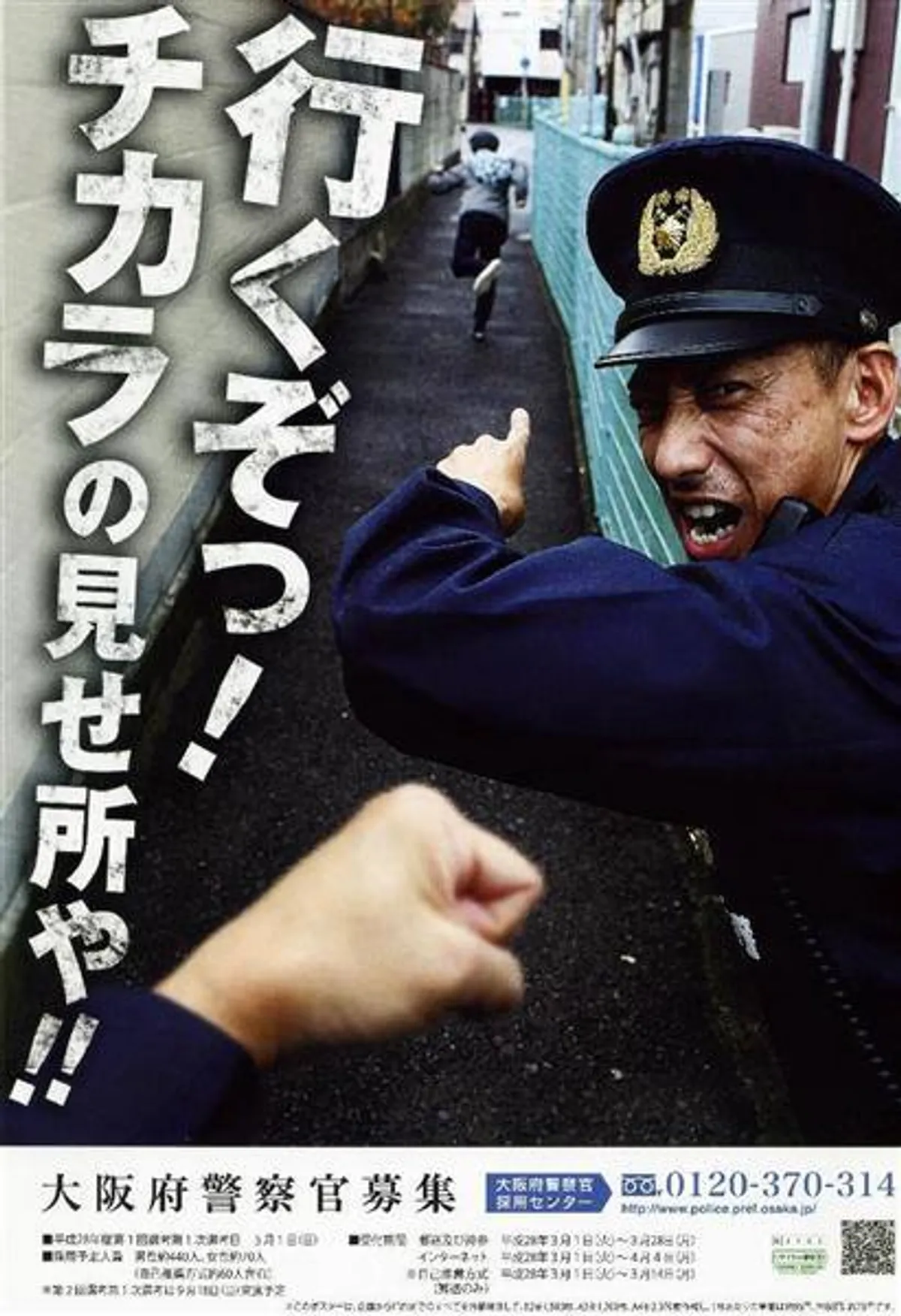
A good example of this contrast is found in recent police department recruitment posters:
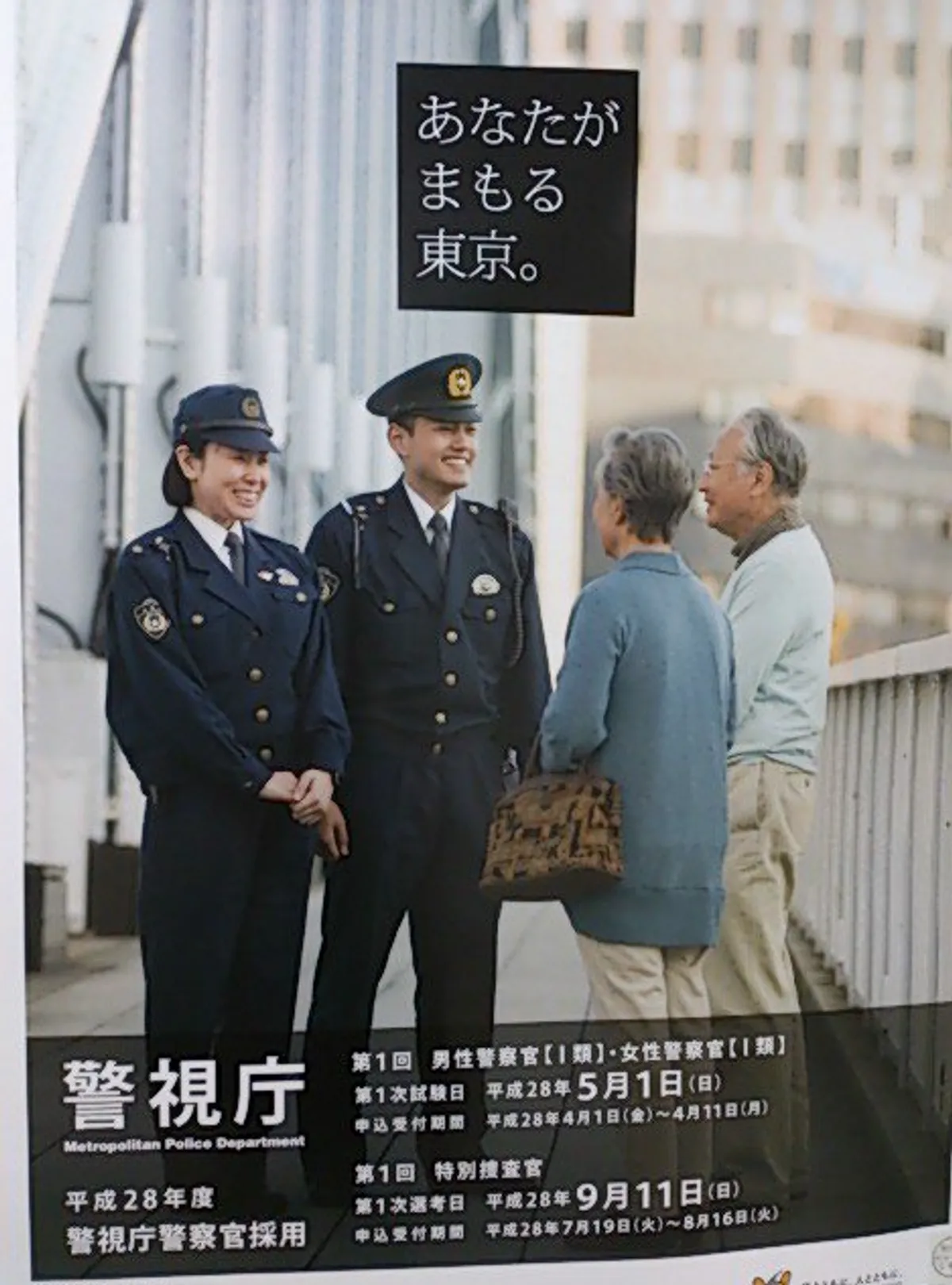
Tokyo version: 「あなたがまもる東京。」
(“You protect Tokyo.”)
A calm, civic message paired with imagery of smiling officers and elderly citizens, designed to invoke trust and responsibility.
Osaka version: 「行くぞっ!チカラの見せ所や!!」
(“Let’s go! Time to show our strength!!”)
Bold, loud, and full of local flavor, with officers running after suspects—more action-oriented and expressive, reflecting Osaka’s cultural tone.
Same goal, completely different style—because regional copy matters.
2. Industry-Specific Terminology
You can’t use the same words across beauty, finance, logistics, and education. Even seemingly simple words can mean different things depending on context.
Example:
Useful Tip:
Build an internal vocabulary list by:
Rather than using general-purpose grammar tools that don’t work well in Japanese (like Grammarly), focus on tightening your internal copywriting process with these practices:
✖ 「AI搭載のチャットツール」
✔ 「顧客対応を自動化して、月10時間の時短を実現」
(Automate customer support and save 10 hours/month)
For B2B: 「まずは無料でご相談ください」
For consumers: 「今すぐチェック」 or 「気軽に試せます」
Navigating the complexities of Japanese copywriting is essential for foreign companies aiming to significantly impact the country’s market. The intricacies of the Japanese language and culture extend far beyond translation; they encompass an understanding of cultural variations, consumer behaviors, and local communication styles. From there, the importance of collaborating with local experts surfaces.
Engaging with seasoned Japanese copywriters and marketing professionals offers unparalleled insights into the subtleties of effective communication in Japan. Experts possess a profound grasp of regional dialects, consumer preferences, and cultural contexts, which is crucial for crafting messages that truly resonate with Japanese audiences. Their expertise ensures that your content is culturally relevant and engaging.
Local professionals can help avoid common pitfalls, such as misinterpreting cultural references or delivering messages that fail to align with local expectations. By leveraging their knowledge, you can create compelling, emotionally resonant content that aligns with Japanese values and preferences.
Partnering with Japanese copywriting specialists is a strategic investment that enhances your market presence and fosters deeper connections with your target audience. Their guidance will elevate the quality and effectiveness of your messaging, ensuring that your brand communicates with authenticity and impact in the Japanese market.
Successfully entering the Japanese market requires more than translation—it demands a strategic shift in communication. Japanese copywriting is a tool for action, trust, and connection, especially when targeting SMEs and B2B buyers.
Here’s what matters most:
When you approach Japanese copywriting with intent and insight, you don’t just communicate—you convert.
If your copywriting isn’t driving results in Japan, it’s not a translation issue—it’s a strategy issue.
At IGNITE, we specialize in crafting Japanese copy that is built to convert. Whether you need landing pages, ad campaigns, product messaging, or full-site localization, we deliver culturally tuned, benefit-focused, and action-oriented copywriting.
We don’t just translate. We:
Our team of multilingual marketers, native copywriters, and localization strategists works directly with global brands to launch effective campaigns in Japan.
Don’t settle for “native-sounding.”
Build a copy that performs.
Contact IGNITE to create Japanese copy that works—strategically, culturally, and commercially. Let’s turn words into action.
Content director responsible for managing the production process and quality control of high-quality Japanese content. Leverages editing and proofreading skills to create SEO-focused content.

Creating Japanese SEO content for a hotel search engine, boosting impressions by 371% and URL rating by 529% in two months through keyword targeting and link-building.

Creating a high-impact landing page to connect Japanese dyed crafts with global audiences through authentic storytelling, localized content, and optimized design.
Find the right service to grow your business in Japan.