










Anime Merchandise SEO Content for Global Growth
Creating and optimizing SEO-focused content, we helped a Japanese anime merchandise retailer boost global search rankings and drive organic traffic to their e-commerce site.


Are you thinking of entering the Japanese market? Read this before your link building strategy hits a wall.
Japan may be a mature and highly connected market, but link building here is anything but straightforward. The strategies that drive results in Western markets often fall flat in Japan due to deep-rooted cultural norms, rigid editorial standards, and a fundamentally different approach to digital marketing. Without a localized strategy—and a clear understanding of how Japanese businesses operate—you may find yourself investing time and budget into outreach efforts that go nowhere.
This guide outlines the unique barriers to link building in Japan and what your team needs to know before launching an SEO campaign. Whether you're just starting to explore the market or already running into resistance, understanding these local nuances is essential to avoid costly missteps.
Japanese link building requires a tailored approach that accounts for local search behaviors, cultural expectations, and the overall digital ecosystem. Many foreign businesses mistakenly apply Western link building tactics in Japan, only to find them ineffective. Unlike in Western markets, where high-volume link acquisition and aggressive outreach strategies are common, Japanese SEO emphasizes trust, credibility, and long-term relationships.
Japan’s search market is also unique in its structure:
Beyond technical aspects, several cultural and structural factors complicate link building in Japan:
Given these challenges, link building in Japan is far from plug-and-play. It requires a thoughtful, localized strategy prioritizing relationship-building and cultural nuance over speed and volume.
Link building in Japan has evolved significantly over the past two decades. Early on, many businesses relied on simple tactics like directory submissions, paid links, and link exchanges to improve search rankings. However, with the introduction of Google’s Penguin Algorithm in 2012, many of these methods became ineffective or even harmful. When Google rolled out its December 2022 Link Spam update, many of these techniques had become obsolete. Instead of penalizing websites outright, this update neutralized the effect of spammy links, making them useless for improving rankings.
Despite these changes, some SEO agencies in Japan still use outdated tactics that can lead to wasted efforts, or even future penalties when Google updates its algorithms again. Understanding which techniques no longer work is essential for businesses building a sustainable SEO strategy.
The Japanese digital landscape differs significantly from Western markets, influencing how SEO and link building strategies should be developed. Japanese users expect high professionalism and trustworthiness from websites, making backlinks essential in establishing credibility. Unlike in the U.S., where large-scale outreach and link exchanges are prevalent, Japanese link building is more about securing authoritative links through genuine industry recognition.
Another key factor is the influence of third-party review platforms. Sites like Tabelog (for restaurants), Hot Pepper Beauty (for beauty services), and Kakaku.com (for e-commerce) hold significant weight in consumer decision-making. Earning backlinks from these platforms or maintaining a strong presence can be as valuable as ranking high on search engines.
Additionally, Japan is a mobile-first market, with over 70% of users primarily browsing on mobile devices, making mobile-optimized content essential for SEO success. Japanese audiences also value high-quality, visually appealing content, reinforcing the need for well-crafted and culturally relevant materials. Given these factors, businesses looking to succeed in Japanese link building must focus on credibility, localization, and strategic partnerships rather than volume-based tactics.

Japanese internet users and search engines favor domestic websites. Local trust plays a significant role in SEO rankings, meaning links from Japanese domains (especially those with a .jp extension) carry more weight than foreign backlinks. Businesses entering the Japanese market should focus on acquiring links from established local sources, such as industry-specific Japanese blogs, news websites, and reputable business directories.
Additionally, Japanese consumers tend to be skeptical of unfamiliar brands, making brand reputation a key factor in digital marketing. Companies should prioritize earning links from authoritative, well-regarded Japanese sites to establish credibility rather than relying on international link building techniques.
Unlike in Western markets, where guest posts and mass outreach are used widely for link building, Japan’s SEO ecosystem leans more toward local business directories and niche blogs. Search engines and users highly value directories such as Yahoo! Japan Business Directory and industry-specific listing platforms. Many Japanese internet users rely on these directories to discover and verify businesses before engaging with them.
Japanese blogs also play a significant role in link acquisition. However, Japanese bloggers prioritize trust and relationship-building before linking to external sites rather than accepting widespread guest posts. A personalized, culturally sensitive outreach approach is essential to earning backlinks from these sources.
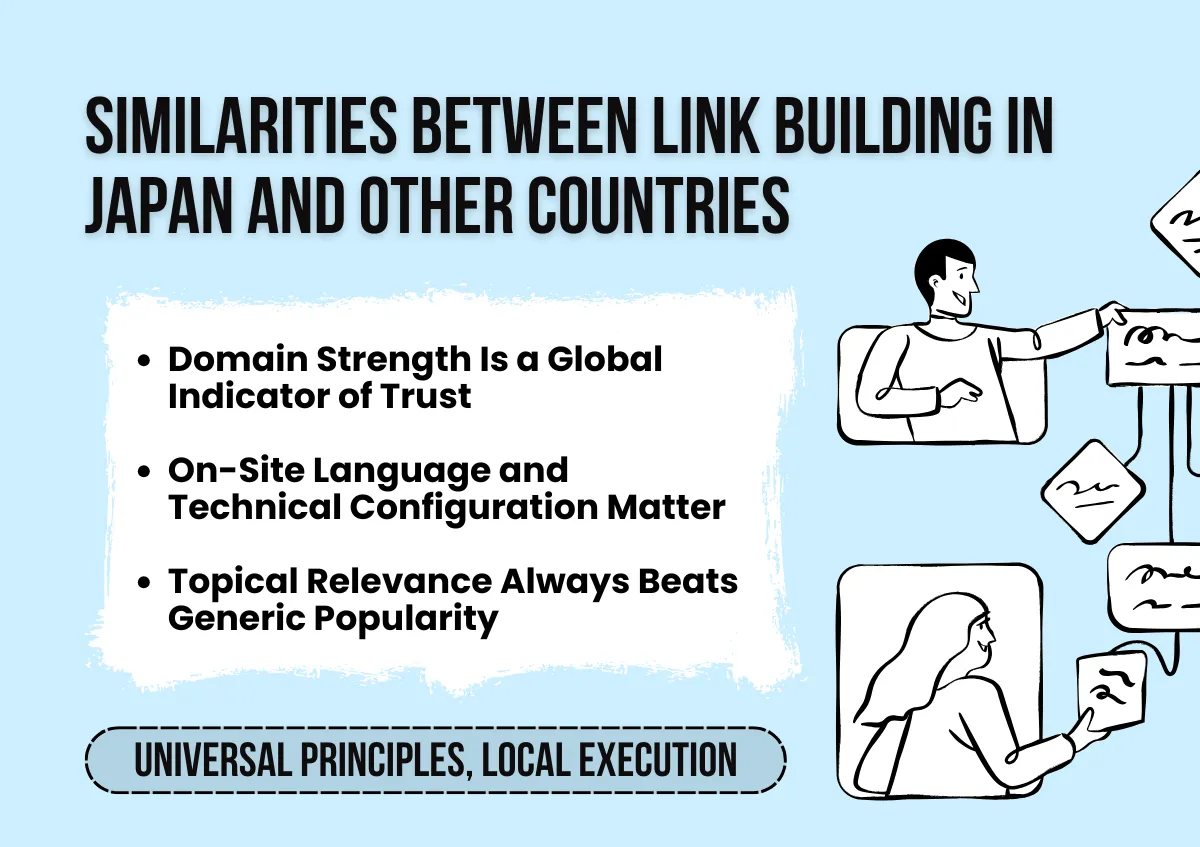
Before discussing the regional nuances of Japanese link building, it must be recognized that Japan still follows many foundational rules governing link building worldwide. Whether targeting search visibility in Japan, the U.S., or Europe, the fundamentals of what makes a good backlink remain universal.
Here are several core principles that apply equally in Japan and other markets:
Domain authority is a universal metric for evaluating the strength of a backlink. In the U.S., links from .edu, .gov, and high-authority .com domains are seen as trustworthy and influential. The same holds true in Japan, except the most trusted domains are region-specific.
For example:
No matter the country, search engines reward backlinks from verified, trustworthy, and contextually relevant domains in the region and industry.
Another shared element is the technical accuracy of a site’s language settings. It’s not enough for a website's text to be written in Japanese—search engines also look at the HTML lang attribute to confirm the intended language of the content.
For example:
Using the correct language declaration helps search engines deliver the right content to the appropriate audience. When the declared language doesn’t align with the visible content, it can cause indexing problems or poor rankings in regional SERPs. Accurate language settings are a standard best practice across global markets and play a vital role in effective link building strategies in Japan.
Link relevance remains one of the most globally consistent ranking signals in SEO. A link is more valuable when the referring domain’s content closely aligns with the target site’s topic. The same principle applies in Japan, as in the U.S. or the U.K.
For example:
Search engines prioritize contextual relevance. A strong backlink profile is built not just on numbers or domain scores but on how semantically and topically aligned the linking content is to the target site.
In short, Japan hasn’t reinvented the wheel regarding link building. The same foundational principles—domain strength, language consistency, and niche relevance—still apply. What changes in the Japanese market are the sources, cultural cues, and outreach styles used to execute these strategies effectively.
Understanding this shared foundation is critical because it shows that the SEO playbook doesn't fundamentally change by geography—it simply needs to be localized with the right tools and tactics.
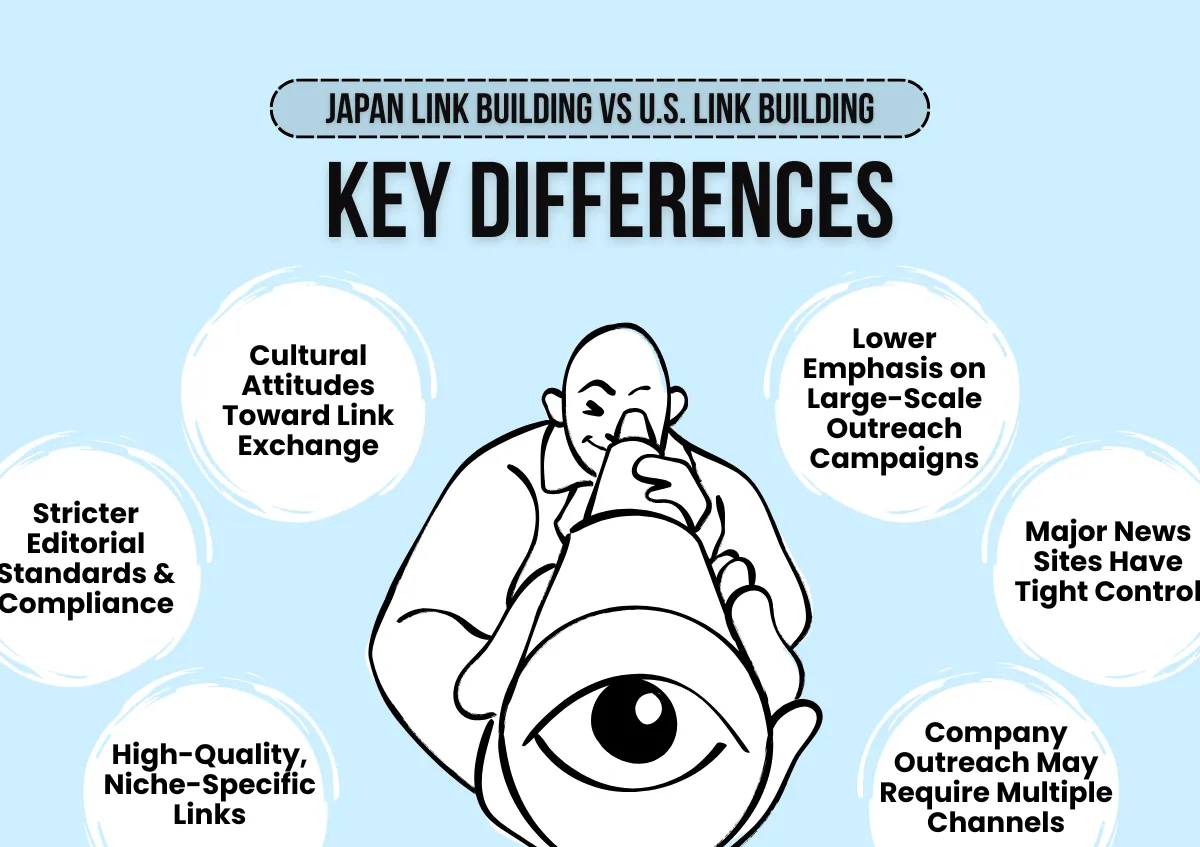
One of the primary differences between Japanese and U.S. link building strategies is the approach to outreach. In the U.S., email outreach for guest posting, link exchanges, and sponsored content is commonplace. However, direct cold outreach is often considered intrusive and ineffective in Japan. Instead, link building in Japan leans heavily on building trust through consistent engagement, networking, and reputation-building. Additionally, Japanese websites tend to have stricter editorial policies, making it harder to secure backlinks through traditional guest blogging techniques.
One of the fundamental differences between Japanese and U.S. link building strategies is the cultural approach to link exchange. In Japan, business relationships are deeply rooted in a “give and take” mentality, meaning that mutual exchanges, including backlinks, are still reasonably common in some industries. While Google has devalued reciprocal links in Western markets, some Japanese small businesses and local companies continue to engage in link trading to establish credibility within their networks.
However, relying on reciprocal linking as a primary strategy for Japan-focused link building is not recommended. Major Japanese publishers and authoritative sites are typically highly selective and often reluctant to link externally—even to high-quality content. Unlike in the U.S., where backlinks are frequently earned through purely informational, high-value content, Japanese site owners tend to be cautious about linking out unless a prior relationship exists. As a result, relationship-building becomes a critical component of any successful link building strategy in Japan.
Japanese websites, especially those with authority, maintain stricter editorial standards than their U.S. counterparts. Editors prioritize credibility, accuracy, and professionalism, making it challenging to secure links unless your content is exceptionally well-researched and localized. Unlike in Western markets, where outreach success often depends on compelling pitches and high-quality content alone, Japanese publishers consider additional factors such as the sender’s reputation, industry standing, and the long-term value of the relationship.
Moreover, compliance plays a significant role in Japan's link building landscape. The country enforces strict privacy and advertising regulations, including detailed guidelines on sponsored content. As of 2023, newly introduced stealth marketing laws require clear disclosure of paid promotions, leading some websites to decline link placements or explicitly label them as “advertising.” In contrast, many sponsored links in the U.S. remain undisclosed despite Google's policies. Businesses aiming to build links in Japan must navigate these legal requirements carefully while ensuring their outreach aligns with local publishing standards.
In the U.S., large-scale outreach campaigns are a standard link building tactic. Marketers often send hundreds or even thousands of outreach emails to secure backlinks, leveraging automation tools to streamline the process. However, this approach does not work as effectively in Japan. Japanese website owners value personalized communication and long-term relationships over mass outreach, making a high-volume, transactional approach less successful.
Cold emails, especially those written in informal or direct language, are often ignored or perceived as intrusive. Japanese business culture strongly emphasizes etiquette and outreach emails must be carefully crafted using formal, honorific Japanese (keigo) to establish credibility. Furthermore, since many companies use generic contact forms rather than direct email addresses, getting in touch with the right person can be challenging. A more effective approach to Japan link building involves targeted, relationship-driven outreach rather than mass email campaigns.
In Japan, securing links from niche-relevant, high-authority websites carries more weight than acquiring a high volume of lower-quality backlinks. While this is generally true in any SEO strategy, it is imperative in Japan, where domain authority alone does not necessarily guarantee a valuable link. Japanese search engines prioritize contextual relevance, meaning a link from an industry-specific site will have a much more significant impact than a link from a general directory or low-authority blog.
Additionally, content quality plays a significant role in earning links. Japanese audiences expect detailed, polished, and visually appealing content, and publishers are unlikely to link to websites that do not meet these standards. Unlike in the U.S., where repurposed or translated content can still attract backlinks, Japanese publishers prefer original, well-localized content that directly appeals to their audience. Businesses looking to succeed in Japan link building must invest in high-quality, niche-specific content that meets Japanese user expectations.
Due to Japan’s privacy regulations and conservative approach to business communication, which we will talk more about later in this blog, reaching decision-makers for link building opportunities can be more difficult than in the U.S. Many Japanese businesses do not list direct contact information, making it necessary to go through company contact forms, which often yield lower response rates. In some cases, even if an inquiry is received, it may take longer to get a response due to Japan’s consensus-driven decision-making process.
Depending on the industry, businesses may need to leverage multiple channels, including social media platforms like Twitter, LinkedIn, or even Instagram, to improve outreach success. Some Japanese professionals are more responsive to social media messages than emails, particularly in industries where online engagement is common. Additionally, networking at industry events, participating in forums, and establishing credibility through content marketing can help open doors that traditional email outreach might not.
Major news websites in Japan exercise strict control over outbound links, making securing backlinks from high-authority media sources difficult. In the U.S., media outlets like Forbes or Business Insider sometimes offer opportunities for guest contributions, interviews, or sponsored posts that include links. In Japan, however, most major news platforms—such as Yahoo Japan, ITMedia, and Nikkei—rarely allow do-follow links in their articles. Even if a company is featured in a news piece, the backlink may be nofollowed or omitted entirely.
Despite this limitation, being mentioned in major news publications still holds significant SEO and branding value. Brand mentions can improve search engine recognition and contribute to overall domain authority even without backlinks. Securing press coverage can also lead to secondary link opportunities, as smaller blogs and industry sites may pick up the story and link back to the company’s website. Businesses should incorporate PR-driven strategies into their Japan link building efforts to maximize visibility, even if direct links from major news sites are challenging to obtain.
Similarly, media buying in Japan often prioritizes brand alignment and trust over link equity or direct response, with ad placements carefully curated by publishers to maintain editorial standards and cultural relevance.
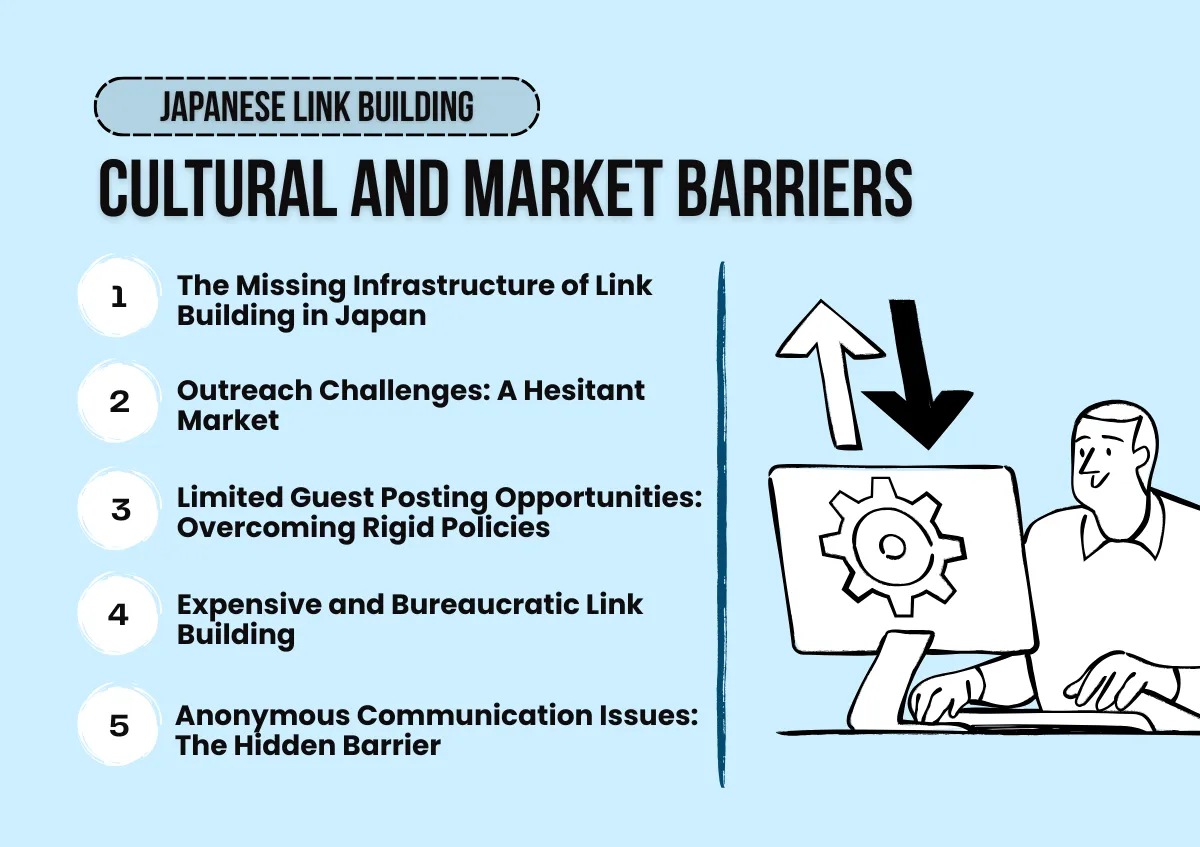
Japan’s approach to link building is fundamentally different from that of Western markets. The conservative nature of website owners, strict editorial standards, privacy regulations, and deeply rooted business customs make conventional link building tactics—like mass outreach or guest posting—far less effective. Foreign companies often find it challenging to secure backlinks or establish domain authority using the same strategies that work elsewhere.
To succeed, digital marketing efforts must align with Japan’s unique cultural and communication expectations—starting with how your website presents itself. For a deeper look at how to localize your online presence and build trust with Japanese users, explore our blog: Optimizing Your Website for Japanese Audiences: Key Translation Strategies.
One of the biggest challenges in executing successful link building campaigns in Japan is that the foundational ecosystem simply doesn't exist in the way it does in the U.S. or Europe. In many Western markets, there’s a clear understanding of SEO, monetization through backlinks, and even an informal economy of guest posting and sponsored content. In Japan, that base is either significantly underdeveloped or absent altogether.
Most site owners have never been approached about backlinks. They may not even realize that monetizing their site through link placements is an option, and in some cases, they worry it might violate advertising or legal guidelines. This low link-building literacy leads to confusion, hesitation, or outright refusal when foreign brands attempt traditional outreach.
Without this shared context, businesses entering the market are essentially starting from scratch. Education, trust-building, and careful cultural navigation become non-negotiables.
If Japan doesn’t have a ready-made link building ecosystem, businesses need to build one. That’s exactly why we created IGNITE, a specialized link building framework tailored for the Japanese digital landscape.
IGNITE is more than a tactic—it’s an infrastructure. It fills global brands' cultural, linguistic, and strategic gaps when entering Japan. IGNITE helps businesses build a sustainable and authentic link profile from the ground up by focusing on relationship-first outreach, culturally aligned content, and trusted directories.
Whether you're just entering the Japanese market or looking to strengthen your local SEO, IGNITE gives you the tools, network, and strategy to earn backlinks that move the needle—without relying on outdated or black-hat practices.
Japanese website owners are generally unfamiliar with link monetization and may even view it as ethically questionable. In contrast to Western markets, where link building is a well-established SEO tactic, many Japanese web administrators have never explored the idea of monetizing links. As a result, outreach campaigns often become more complex, with direct link requests frequently met with hesitation or rejection.
In addition, Japanese businesses tend to be highly cautious about compliance. Some site owners are concerned that accepting backlinks in exchange for compensation could violate Google’s guidelines or conflict with domestic business practices. Such uncertainty contributes to a general reluctance to participate in link building proposals.
Japanese privacy laws add another layer of complexity to outreach. The Act on the Protection of Personal Information (APPI) requires businesses to obtain explicit consent before using personal data, including email addresses. Additionally, the Act on Regulation of Transmission of Specified Electronic Mail mandates that all commercial emails must contain clear sender information and an opt-out option.
For link building outreach, this means:
Solutions:
Guest posting is not a widely accepted practice in Japan, but it presents a unique opportunity for those approaching it strategically. Many Japanese companies prefer formal agreements over flexible negotiations, and strict editorial control makes external contributions rare. However, the low competition in guest posting means businesses can stand out if they offer valuable content.
Traditional media sites tend to reject guest posts due to their rigid content policies and corporate oversight. However, niche websites and forward-thinking publishers may be more open, especially if they see a clear business advantage in hosting external content.
Challenges:
Solutions:
While Google has labeled guest posts as “unnatural links” since 2020, the approach still holds potential in 2024, especially when executed with a focus on high-quality, relevant content.
Unlike in the U.S., where many blogs are individually owned, Japanese websites are predominantly operated by corporations or media organisations. That dynamic significantly alters the link building landscape, requiring a more formal, structured approach to outreach and relationship management.
Solutions:
Japanese web admins are particularly wary of outreach emails from unknown senders, especially if the message is poorly written or lacks proper business etiquette. Generic, automated emails are often ignored, and emails with unnatural Japanese phrasing are immediately marked as spam.
Additionally, many Japanese companies prefer to work with domestic firms rather than foreign agencies, as it provides a sense of reliability and cultural alignment.
Solutions:
Here are some link building strategies businesses should avoid in Japan in 2025:
Submitting websites to online directories was once a widely used SEO technique. In the past, businesses could improve rankings by listing their sites on platforms like JOY (Japanese Yellow Pages) or Portalnet.info. However, this method is now obsolete.
Why It Doesn’t Work:
What to Do Instead: Focus on high-quality, industry-specific directories such as professional associations and chamber of commerce websites, which are more relevant and authoritative.
Outreach is a key part of link building, but using translation software to send emails in Japanese is a big mistake. While tools like Google Translate may get the basic structure right, they often fail to convey the correct tone and nuance required in Japanese business communication.
Why It Doesn’t Work:
What to Do Instead: Work with a native Japanese speaker or a professional translator who can craft personalized outreach that feels natural and respectful. In many cases, outsourcing this kind of localized digital work to experienced local teams can bridge the cultural gap and ensure your efforts resonate with the right audiences.
To learn more about exploring how to build a local team or scale your operations without the usual hiring challenges, check out Why Outsourcing in Japan Works: A Guide for International Companies.
Creating multiple satellite sites (small, separate websites that link back to a leading site) was once a popular link building tactic in Japan. However, Google's algorithm updates have clarified that these sites are ineffective unless they provide real value.
Why It Doesn’t Work:
What to Do Instead: Focus on genuine content marketing and outreach to real, authoritative websites instead of trying to manipulate rankings with artificial networks.
Buying links has always been a risky SEO strategy, and it’s no different in Japan. Many services still offer paid link placement, but Google explicitly considers this a black-hat technique that violates its guidelines.
Why It Doesn’t Work:
What to Do Instead: Invest in natural link building strategies such as digital PR, guest posting, and media partnerships.
While exchanging links with relevant partners is not inherently bad, excessive link trading (Sogo link lists in Japan) is a red flag for Google. Some businesses still reach out with "I’ll link to you if you link to me" requests, but this tactic has lost effectiveness.
Why It Doesn’t Work:
What to Do Instead: Instead of direct link exchanges, focus on offering unique value, such as social media exposure or guest content, in exchange for a backlink.
Some businesses try to buy expired domains with existing backlinks and redirect them to their main site to gain SEO value. While this may seem like a shortcut to authority, Google has primarily neutralized this tactic.
Why It Doesn’t Work:
What to Do Instead: If you acquire an old domain, make sure it is highly relevant to your industry and contains legitimate, quality backlinks before redirecting it.
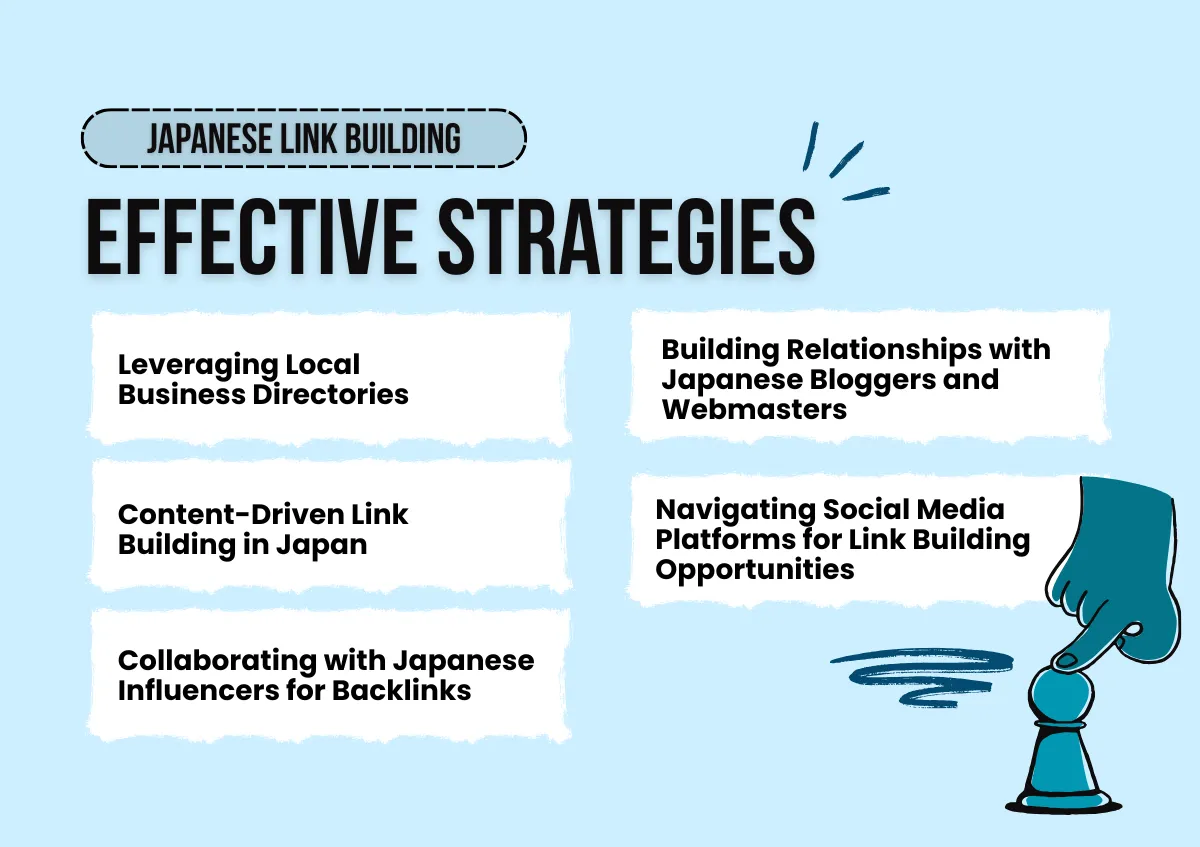
To succeed in Japanese link building, businesses must prioritize quality over quantity. One of the most effective approaches is earning backlinks naturally through high-value content that aligns with Japanese users’ interests. Another strategy is leveraging local directories and business listings, which still play a significant role in Japan’s digital space. Participating in industry-specific forums and collaborating with authoritative local publications can also help build a strong link profile.
IGNITE offers end-to-end digital marketing services tailored to the Japanese market for businesses looking to execute these strategies precisely. With a multilingual team based in Osaka, IGNITE helps companies from overseas navigate the complexities of Japanese SEO and link building through culturally attuned, data-driven campaigns.
Unlike Western markets, where large-scale guest posting and outreach campaigns are common, Japan emphasizes trust and credibility more. One of the best ways to build authoritative backlinks in Japan is by leveraging local business directories.
Japanese consumers rely heavily on trusted platforms for business recommendations, making directories important to online visibility. Platforms like Kakaku.com (a price comparison site), Rakuten (Japan’s largest e-commerce platform), and Hot Pepper (a popular restaurant and service directory) are widely trusted by users. Getting listed on these directories improves local SEO and drives targeted referral traffic.
Since Japanese consumers tend to trust established platforms over unfamiliar individual websites, securing a presence on well-known directories can help businesses gain credibility. Additionally, these directories often rank high on Google Japan’s search results, increasing the chances of attracting potential customers through organic searches.
Businesses should consider several high-authority directories for link building efforts in Japan. Some of the most reputable ones include:
Kakaku.com – A leading price comparison website covering electronics, services, and various consumer goods.
Rakuten – Japan’s largest e-commerce platform with business listings and a strong online marketplace presence.
Tabelog – A restaurant and food service directory that heavily influences dining choices in Japan.
Hot Pepper – A popular local directory for restaurants, beauty salons, and lifestyle services.
Yahoo! Japan Local Business Directory – A widely used business directory that helps with visibility and credibility.
Gurunavi – A food and restaurant guide similar to Yelp, frequently used by locals for dining recommendations.
These platforms help generate backlinks and also serve as valuable traffic sources for businesses targeting Japanese audiences.
Getting listed in Japanese business directories typically requires a structured application process. Most directories prioritize businesses legally registered in Japan, so having an official business registration (such as a Japanese corporate entity or branch office) can increase the chances of approval.
Here are some general steps to secure listings in Japan’s major directories:
By strategically leveraging Japan’s most trusted directories, businesses can secure valuable backlinks, enhance their online authority, and attract potential customers in a market that values credibility and trustworthiness.
Unlike in Western countries, where bloggers often welcome collaboration requests, Japanese bloggers and web admins tend to be more cautious. The best way to build relationships is through long-term engagement. Commenting on their posts, sharing their content, and gradually introducing collaboration ideas can yield better results than direct outreach. Personalized, well-researched approaches that align with their audience’s interests are more likely to be successful.
In Japan, relationships are crucial in business interactions, and link building is no exception. Unlike in Western markets, where link acquisition is often transactional, Japanese bloggers and web admins value trust and long-term engagement.
Key factors in building trust for link acquisition:
Businesses can establish a sustainable and high-quality backlink profile in Japan by prioritizing relationship-building over immediate link acquisition.
Successful Japanese link building outreach requires a highly personalized and culturally sensitive approach. Emails should be written in keigo (polite Japanese) and focus on relationship-building rather than direct requests.
Best practices for outreach emails:
Example email template:
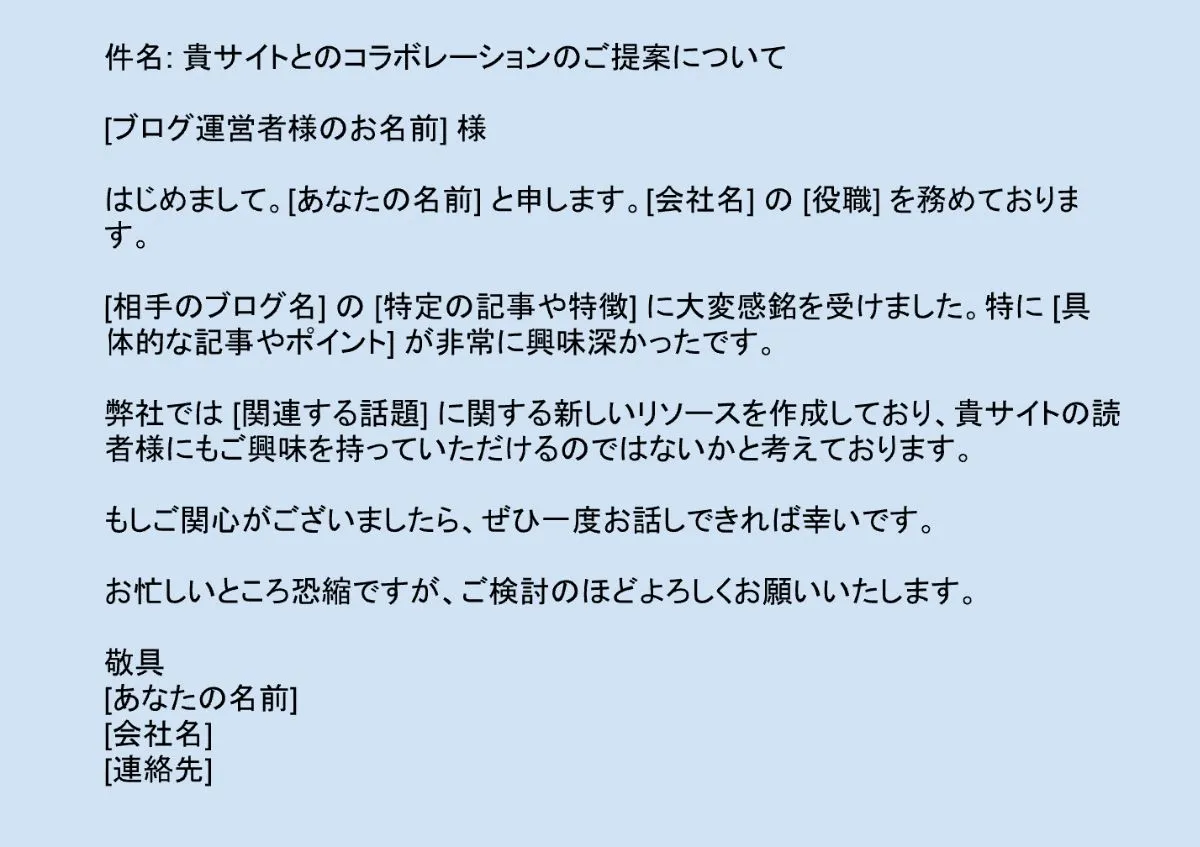
This approach fosters trust and increases the likelihood of acquiring high-quality Japanese backlinks.
Content is at the heart of effective Japanese link building. However, merely translating English content into Japanese is not enough. Japanese audiences value localized, well-researched, and culturally relevant content. Creating original case studies, industry reports, and informative blog posts in Japanese can attract natural backlinks. Additionally, visual content, such as infographics and explainer videos, performs well in earning links in Japan.
Evergreen content is a cornerstone of Japanese link building strategies, as it continues to attract traffic and backlinks over time. Japanese audiences appreciate well-researched, informative content that remains relevant.
Effective evergreen content types for Japan:
Investing in high-quality, evergreen content helps businesses gain natural backlinks while positioning themselves as thought leaders in the Japanese market.
Japanese consumers and webmasters respond well to visual content, making infographics a powerful tool for Japan link building. Well-designed visuals improve engagement and encourage organic sharing.
Key elements of compelling infographics:
Strategies for leveraging infographics:
By incorporating infographics into content marketing, businesses can enhance Japanese link building efforts while catering to the country’s preference for visually appealing and informative content.
At IGNITE, we create original, localized content strategies—from evergreen blog posts to visually engaging infographics—explicitly tailored to the Japanese market. Our team understands that content must be designed for Japan, not merely translated, and that’s where our in-depth research and cultural fluency come into play. Expert Japanese copywriting is a core part of this process, ensuring every message resonates deeply with the target audience and drives meaningful engagement.
Influencer marketing is a powerful tool for link building in Japan. Many Japanese influencers, known as "KOLs" (Key Opinion Leaders), maintain blogs or websites that can provide valuable backlinks. Unlike Western influencers, who often expect monetary compensation for collaborations, Japanese influencers may prefer partnerships that align with their personal brand and values. Engaging with influencers through sponsored content, product reviews, or interviews can help earn high-authority backlinks.
Partnering with Japanese influencers is an effective way to secure high-quality backlinks while enhancing brand visibility. However, selecting the right influencers requires a strategic approach.
Key factors in choosing the right influencer:
Businesses can use platforms like Ameblo, Twitter (X) influencer lists, and PR Times, a popular Japanese PR site where influencers discover trending brands, to identify potential influencers.
Social media is a crucial part of Japan link building, as many influencers and bloggers use these platforms to share content and engage with their audiences. Understanding each platform's role can help businesses maximize their link building efforts.
Key platforms for link building in Japan:
Strategies for leveraging social media for backlinks:
By strategically using Japanese social media platforms, businesses can tap into a sustainable, influencer-driven link building approach.
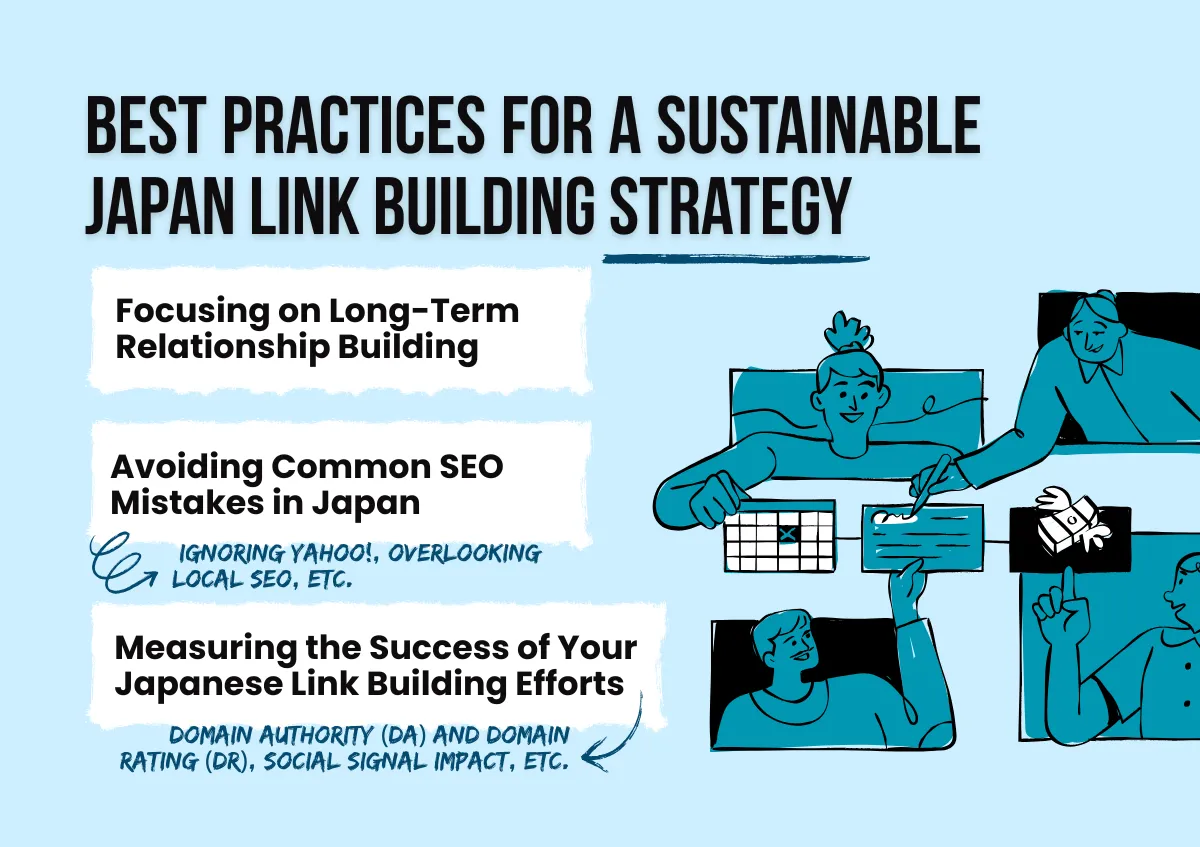
Sustainability is key to a successful link building strategy in Japan. Businesses should avoid spammy tactics and instead focus on long-term relationship-building, high-quality content creation, and ethical SEO practices. Regularly monitoring backlinks, removing harmful links, and staying updated with algorithm changes ensure the strategy remains effective. Diversifying link sources, including news sites, blogs, directories, and social media, also helps build a robust and natural link profile.
Japanese SEO strategies emphasize relationship-driven networking. Link acquisition in Japan requires gaining trust before a backlink is granted.
Key elements of long-term link building success in Japan:
Japanese link building requires a slow, deliberate approach, but once trust is established, it leads to stronger, high-authority backlinks that sustain long-term SEO success.

Many foreign businesses fail at Japan link building due to cultural and linguistic misunderstandings. Below are critical mistakes to avoid:
By avoiding these mistakes, businesses can build a stronger SEO foundation tailored to Japan’s digital landscape.
Tracking Japan's building performance requires different metrics than Western markets due to cultural and algorithmic variations.
Key performance indicators (KPIs):
1. Domain Authority (DA) and Domain Rating (DR)
2. Organic Traffic from Japan
3. Ranking Improvements for Japanese Keywords
4. Referring Domains Growth
5. Social Signal Impact
Tools for tracking Japan-specific SEO performance:
By measuring these KPIs, businesses can optimize and refine their link-building efforts to ensure sustained success in the Japanese market.
As your dedicated Japanese marketing team, IGNITE doesn’t just offer strategy—we execute and continuously refine it. From tracking your backlink profile to maintaining long-term influencer relationships, we function as your embedded partner in the Japanese market.

If you’re considering link building services for the Japanese market, you may have questions about how the process works, what strategies are most effective, and what kind of results to expect. This section aims to address the most common inquiries we receive from clients. Our goal is to provide clear, transparent information about our approach to Japanese link building so you can make an informed decision about working with us.
At IGNITE, we prioritize quality over quantity in our link building (link-earning) strategies. We do not guarantee a specific number of backlinks, as acquiring high-quality links naturally takes time and trust-building.
Focusing solely on quantity can lead to links from low-quality websites, which may negatively impact SEO and even result in Google penalties. Instead, we focus on securing authoritative, niche-relevant backlinks that provide long-term SEO benefits for your brand.
Our strategy ensures that all acquired backlinks are:
This organic and sustainable approach yields stronger SEO results over time.
SEO is a long-term investment, and the timeframe for seeing measurable results from link building varies based on:
At IGNITE, we typically observe improvements in search rankings and organic traffic within 3-6 months of implementing our link building campaigns.
Consistent content marketing, influencer collaborations, and backlink acquisition will compound these results, ensuring continued growth in the Japanese market.
At IGNITE, we evaluate domain strength based on multiple factors rather than relying solely on third-party SEO metrics.
We analyze:
Since SEO metrics from third-party tools are not always accurate, we focus on securing backlinks from trusted, niche-specific Japanese websites, which naturally improves domain authority over time.
For foreign businesses entering Japan, link building can be one of the toughest SEO challenges—and for good reason. Japan’s digital landscape is built on trust, not tactics. Link acquisition isn’t something that can be scaled with automation or bulk outreach. It takes time, cultural fluency, and authentic relationship-building.
Japanese websites are typically cautious about linking out, especially to unfamiliar foreign brands. Many are run by individuals or small businesses who expect formal communication and won't respond to Western-style outreach. Language is another major hurdle—literal translations won’t cut it, and a misstep in tone or etiquette can hurt more than help.
But while it’s difficult, it’s not impossible. Businesses that commit to localizing their strategy, investing in high-quality content, and earning links correctly can stand out from competitors who try to shortcut the process. The effort pays off in a market where trust is everything—creating long-lasting digital authority and sustainable SEO growth.
Building links in Japan requires patience, cultural understanding, and a strategic approach distinct from other markets. Keep these essential points in mind to establish credibility and long-term SEO success:

Don't let cultural missteps and outdated tactics hold your business back. At IGNITE, we don’t just translate your strategy—we transform it. Our Japan-based team brings cultural fluency, local insight, and SEO expertise to craft authentic, high-impact link building campaigns that resonate with Japanese audiences.
Whether you're just entering the market or refining your current approach, IGNITE helps you connect, convert, and earn trust correctly.
Contact us now and discover how IGNITE can localize your SEO strategy for real results in Japan.
Content director responsible for managing the production process and quality control of high-quality Japanese content. Leverages editing and proofreading skills to create SEO-focused content.

Creating and optimizing SEO-focused content, we helped a Japanese anime merchandise retailer boost global search rankings and drive organic traffic to their e-commerce site.

Executing a full marketing strategy to boost global visibility for a sake and shochu association, resulting in a 15,185.7% increase in organic traffic.

Creating localized SEO content to drive a 181.5% increase in organic traffic for a food delivery app through targeted keywords and strategic internal linking.

Boosting organic traffic and lead quality for a matchmaking app through advanced SEO, content creation, and automation, resulting in lower acquisition costs and higher conversions.
Find the right service to grow your business in Japan.