Japan’s dynamic economy presents significant opportunities for global companies, but achieving success requires more than just market entry. This guide outlines a clear roadmap—from researching consumers and navigating regulations to localizing operations and adapting to cultural expectations. With practical insights and comparisons to other markets, it shows how businesses can overcome challenges and thrive in Japan’s unique business landscape.
Japan is the world’s third-largest economy and one of the most attractive markets for international expansion. Its reputation for technological leadership, high consumer purchasing power, and strong business stability makes it an appealing destination for global companies of all sizes. But entering Japan is rarely straightforward.
For small and medium-sized enterprises (SMEs), Japan presents both opportunities and challenges. On one hand, the country is home to sophisticated consumers who are willing to spend on products and services that meet their high standards. On the other hand, the market is complex, relationship-driven, and highly competitive, with cultural expectations and business practices that differ significantly from those in Western countries.
This guide offers a comprehensive step-by-step approach to entering the Japanese market, covering research on consumers and competitors, navigating regulations, localizing content beyond translation, and preparing for the unique challenges of doing business in Japan. Each step draws comparisons with other markets, allowing you to clearly see what makes Japan different and how to adapt to this unique market.
However, before diving into strategy, it’s essential to understand the current state of the Japanese market, including its demographics, consumer behavior, and emerging opportunities.
What the Japanese Market Looks Like
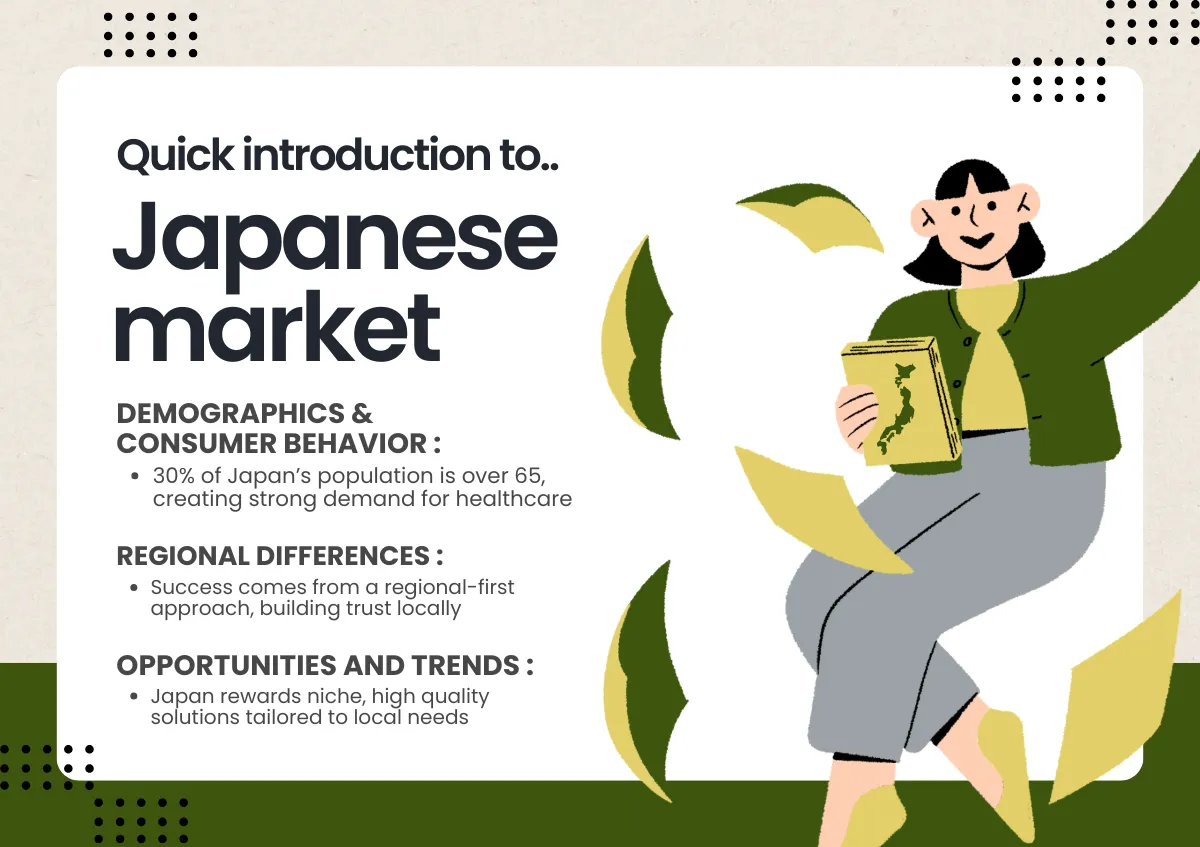
Before deciding how to enter the Japanese market, SMEs need to understand the consumer landscape in which they’ll be operating. Japan is the world’s third-largest economy, but it’s not just its size that makes it unique; it’s the combination of an aging population, high standards for quality, and rapidly evolving technology trends. These factors shape what products succeed and how companies must position themselves.
Demographics and Consumer Behavior
Nearly 30% of Japan’s population is over 65, creating strong demand for healthcare, senior-friendly products, and wellness services. At the same time, younger consumers are driving growth in tech gadgets, digital entertainment, and sustainable fashion. Across all demographics, Japanese buyers are detail-oriented, quality-conscious, and loyal to brands they trust.
Regional Differences
Urban centers, such as Tokyo and Osaka, tend to prioritize luxury goods, technology, and new experiences, whereas rural regions emphasize practicality and tradition. For SMEs, this means success often comes from a regional-first approach, building trust locally before expanding nationwide.
Opportunities and Trends
Japan offers openings in technology, healthcare, e-commerce, logistics, and digital transformation. SMEs that focus on niche solutions, tailor offerings to local needs, and meet Japan’s high standards can find strong growth potential.
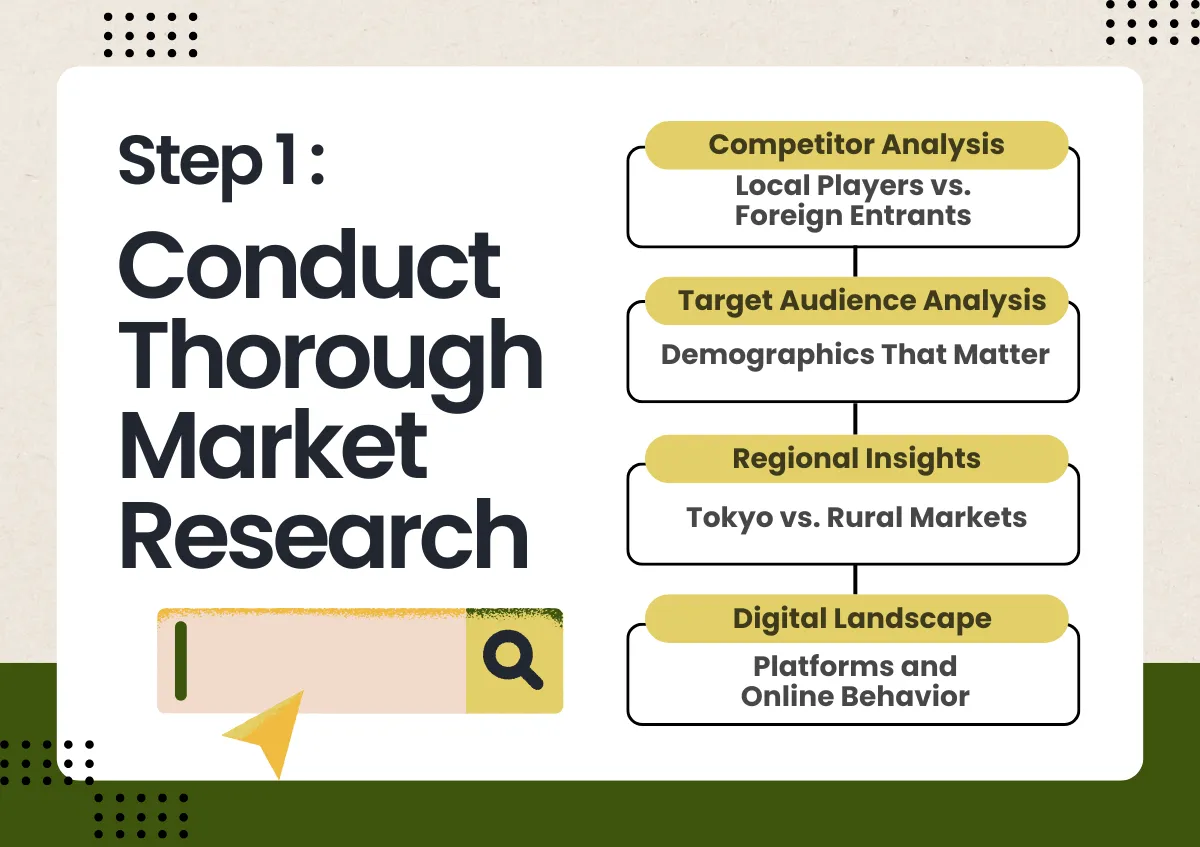
Step 1: Conduct Thorough Market Research
Before setting foot in Japan, SMEs must thoroughly understand the local market landscape. While large multinationals may rely on their brand recognition, smaller companies must compete strategically by finding niches, understanding consumer behaviors, and selecting the right entry points.
Competitor Analysis: Local Players vs. Foreign Entrants
Japan has a strong base of domestic companies with deep consumer trust, ranging from household names like Muji (specializing in minimalist lifestyle products) to regionally focused SMEs. For new entrants, the challenge is not simply pricing or quality, but competing against decades of brand loyalty and localized know-how.
Local competitors: Japanese SMEs often thrive by specializing (e.g., artisanal food, niche fashion, eco-friendly home goods). These businesses resonate with Japan’s culture of quality and craftsmanship.
Foreign SMEs: Unlike in the U.S. or EU, where smaller foreign brands can quickly gain traction via Amazon or Shopify, in Japan, consumer adoption is slower. Trust is earned through long-term commitment and visible local presence.
Tip for SMEs: Identify gaps where domestic companies are less dominant (e.g., sustainable packaging, specialized B2B services, or cross-cultural products).
Target Audience Analysis: Demographics That Matter
Japanese consumers are highly segmented. For SMEs, selecting the right target audience is more crucial than attempting to appeal to a broad audience.
Aging population (~30% of total) → Huge demand for healthcare, senior-friendly technology, wellness products, and easy-to-use home appliances.
Younger generations → Interested in digital services, fashion, gaming, and sustainable products. They’re also more open to foreign brands if marketed through the proper channels (Instagram, LINE).
Niche segments → Pet care, organic foods, and educational services for children are growing markets that SMEs can tap into.
In Europe or the U.S., SMEs often target middle-income families as a broad consumer group. In Japan, precision is key; over-targeting is better than under-targeting.
Regional Insights: Tokyo vs. Rural Markets
Where you launch in Japan matters.
Tokyo & Osaka: Best for trend-driven products, fashion, and tech. Consumers here are cosmopolitan and willing to try new things, but the competition is fierce.
Secondary cities (Fukuoka, Sapporo, Nagoya): Often overlooked but present strong opportunities for SMEs, especially in lifestyle products and B2B services.
Rural areas: Consumers are more conservative, prioritizing practicality, tradition, and local loyalty. Foreign SMEs with agricultural tech, food exports, or community-focused services may succeed here.
In the U.S., SMEs often scale nationwide quickly via e-commerce. In Japan, it’s smarter to focus on one region, build a reputation, and expand slowly.
Social media: LINE is indispensable. It’s more than a messaging app; it’s a payment system, e-commerce hub, and marketing platform. Instagram is well-suited for lifestyle products, while X (formerly Twitter) is more effective for news-driven or trend-sensitive sectors.
E-commerce: Rakuten and Yahoo! Shopping may be more accessible for SMEs than Amazon Japan, as they offer loyalty programs and more localized support for sellers.
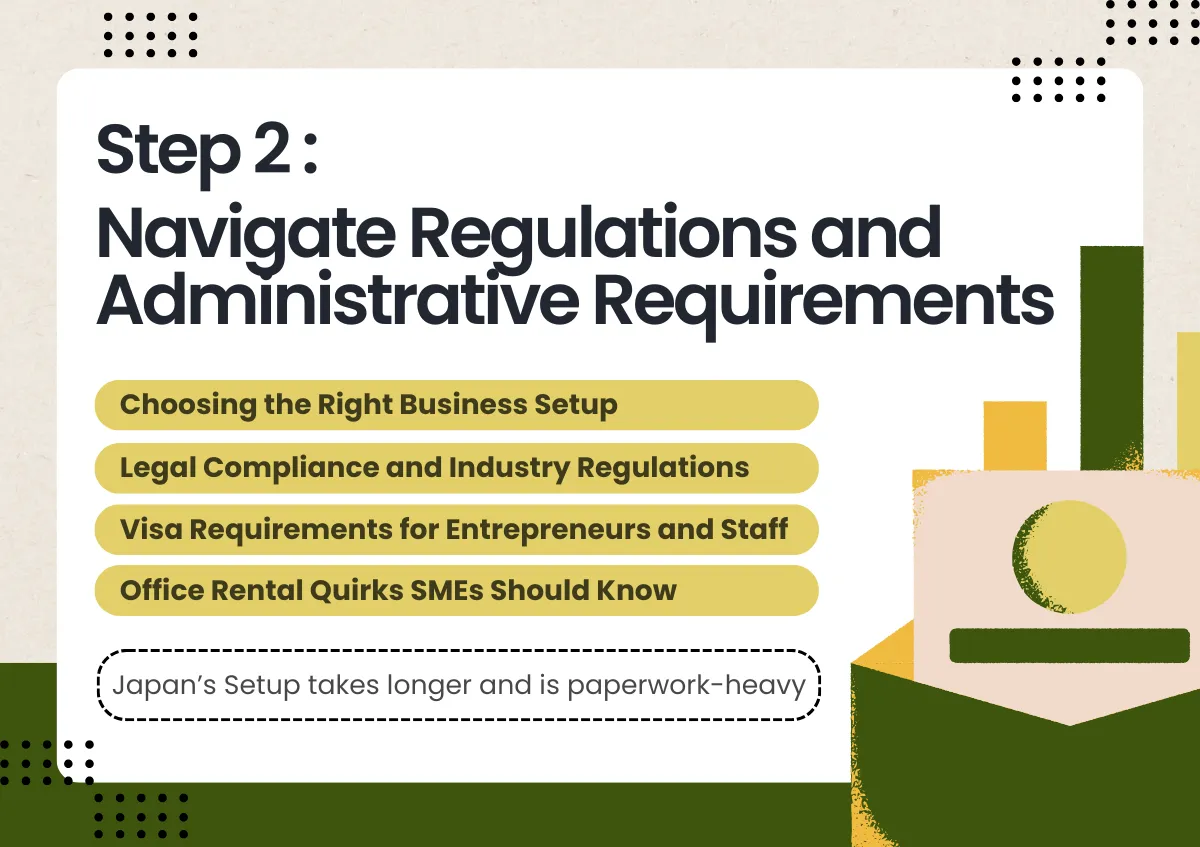
Step 2: Navigate Regulations and Administrative Requirements
Even after identifying opportunities in Japan, SMEs often face one of the most challenging parts of entry: navigating the administrative and regulatory environment. Unlike markets such as Singapore or Hong Kong, where procedures are fast and cost-effective, Japan’s system is more formal, relationship-driven, and regulation-heavy. Careful planning is essential to avoid costly mistakes.
Choosing the Right Business Setup
Foreign SMEs have several entry modes, each with different costs, tax implications, and operational freedoms:
Representative Office: Easiest to set up, useful for market research, but cannot conduct sales or open a corporate bank account. Often, the first step for small firms is testing the waters.
Branch Office: Allows for sales activities and contracts but is taxed only on Japanese-sourced income. Suitable for SMEs seeking a limited online presence.
Subsidiary (Kabushiki Kaisha or Godoshikigaisha): Most common for SMEs planning long-term growth. A subsidiary is a Japanese legal entity that is taxed on its global income. While setup costs can be higher, they signal a commitment to the market and build trust with Japanese clients and partners.
Subsidiaries are often viewed more favorably by Japanese partners, especially in B2B industries, because they demonstrate permanence and accountability.
Japan enforces strict standards and industry-specific laws. SMEs must pay attention to:
Product compliance: Goods must meet Japanese safety and quality standards (overseen by JISC and METI).
Import regulations: Products need proper documentation and may require testing or labeling in Japanese.
Zoning & building codes: Offices and stores must comply with earthquake safety standards (shin-taishin) and local zoning rules.
Foreign investment rules: Some industries (telecom, energy, transportation, agriculture) require prior government approval. For SMEs in less restricted industries, reporting requirements are lighter but still mandatory.
For SMEs with limited resources, partnering with a local consultant or legal specialist is highly recommended to ensure compliance with relevant regulations.
Visa Requirements for Entrepreneurs and Staff
Foreign managers and employees need proper visas to operate legally in Japan:
Start-up Visa: Available in select prefectures, this visa allows foreign entrepreneurs to develop a business plan while residing in Japan. Ideal for SMEs still testing their model.
Business Manager Visa: Required for running a company in Japan. Typically, it is granted when a physical office is secured and sufficient capital is invested.
SMEs should factor visa timelines into their entry schedule, as approval can take several months to process.
Office Rental Quirks SMEs Should Know
Renting office space in Japan can surprise many SMEs:
Shiki-kin (敷金) → Refundable deposit, often several months’ rent.
Rei-kin (礼金) → Non-refundable “key money,” a cultural custom unique to Japan.
Guarantor requirement → Many landlords require a Japanese guarantor, which can be difficult for foreign SMEs without local partners.
Building standards → Premises must comply with earthquake safety rules for offices built after 1981.
These upfront costs make office rental more capital-intensive than in other countries. Many SMEs start in co-working spaces or business incubators to reduce costs and meet visa requirements.
Quick Comparison
Singapore & Hong Kong:
Business registration in days
Low upfront costs
Minimal relationship-building is required for leases
Japan:
Setup takes longer and is paperwork-heavy
Upfront costs for offices (shiki-kin, rei-kin) are significant
Process is relationship-driven; having a local guarantor or partner smooths the way
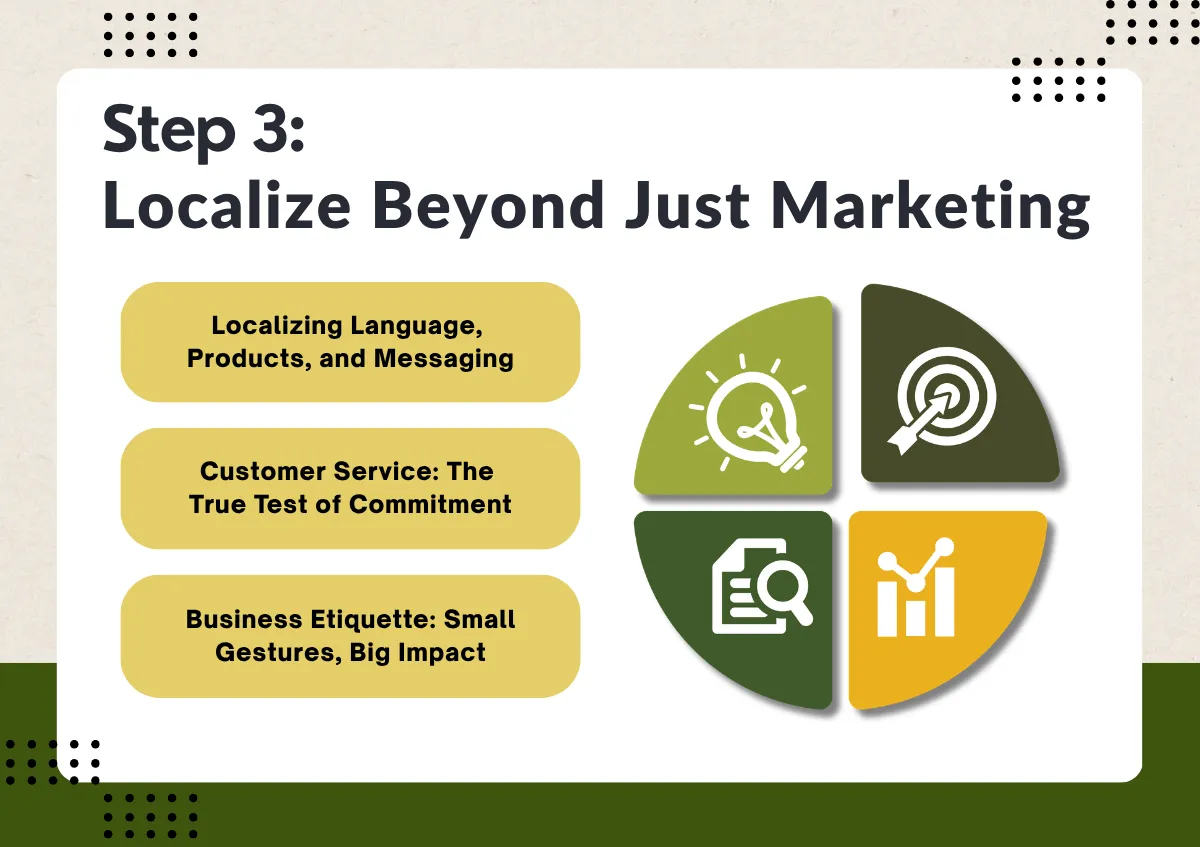
Products & Packaging: Japanese consumers value details. Seasonal designs, culturally meaningful colors, and clean, elegant layouts resonate more than bold or minimalist Western packaging. For example, using autumn leaves on limited-edition packaging shows cultural alignment.
Marketing & Advertising: Avoid aggressive slogans about “disruption” or “beating the competition.” Instead, emphasize harmony, precision, and collective benefit. SMEs that frame their product as “enhancing life” rather than “revolutionizing it” tend to win consumer trust faster.
Tone of Voice: In Japan, polite, humble, and precise wording is essential. Overly casual or humorous approaches that work in the U.S. may be perceived as unprofessional in Japan.
Example: HubSpot Japan adapted its content by softening direct calls-to-action and focusing on polite, helpful educational content; a model SMEs can learn from.
For Japanese customers, excellent customer service is not a bonus; it is the baseline expectation. This is where many foreign SMEs struggle, as their home markets may be more tolerant of self-service or automated support.
Local Office or Presence: Even a small representative office can make a difference. Japanese customers want to know there is someone local to contact if issues arise.
Telephone Line: Unlike in the U.S. or Europe, where live chat or chatbots are acceptable, many Japanese consumers expect a dedicated local phone number with professional support during business hours.
After-Sales Support: Long-term trust is built on how issues are resolved after purchase. Offering proactive follow-ups, warranties, or customer check-ins can help SMEs stand out from competitors.
If budgets are tight, consider starting with a shared office solution or hiring a bilingual representative on a part-time basis to handle calls and emails. This is far better than trying to manage everything remotely.
Business Etiquette: Small Gestures, Big Impact
Japanese business etiquette can feel overly formal to newcomers, but these rituals are crucial for establishing respect and credibility. For SMEs entering Japan, learning and practicing these customs can smooth introductions and build long-term relationships.
Meishi (名刺) Exchange: Business cards must be exchanged with both hands, with the Japanese side facing the recipient. Cards should be treated with respect (never written on or shoved into a pocket).
Keigo (敬語): Polite, honorific language is a key part of professional communication. Even if you rely on an interpreter, showing effort to learn a few polite phrases demonstrates respect.
Bowing: Different bowing angles signify different levels of respect. While perfect mastery isn’t expected of foreigners, effort counts.
Patience in Decision-Making: SMEs must be prepared for slow, consensus-driven negotiations. The nemawashi process (informal discussions before decisions) means deals take longer than in the West.
Japanese partners will likely assess how well you respect these formalities before committing to a business relationship. Etiquette isn’t just a “nice to have,” as it is part of the trust-building process.
Business etiquette (meishi exchange, bowing, keigo) is central to building credibility.
Decisions take longer, as consensus-building is essential.
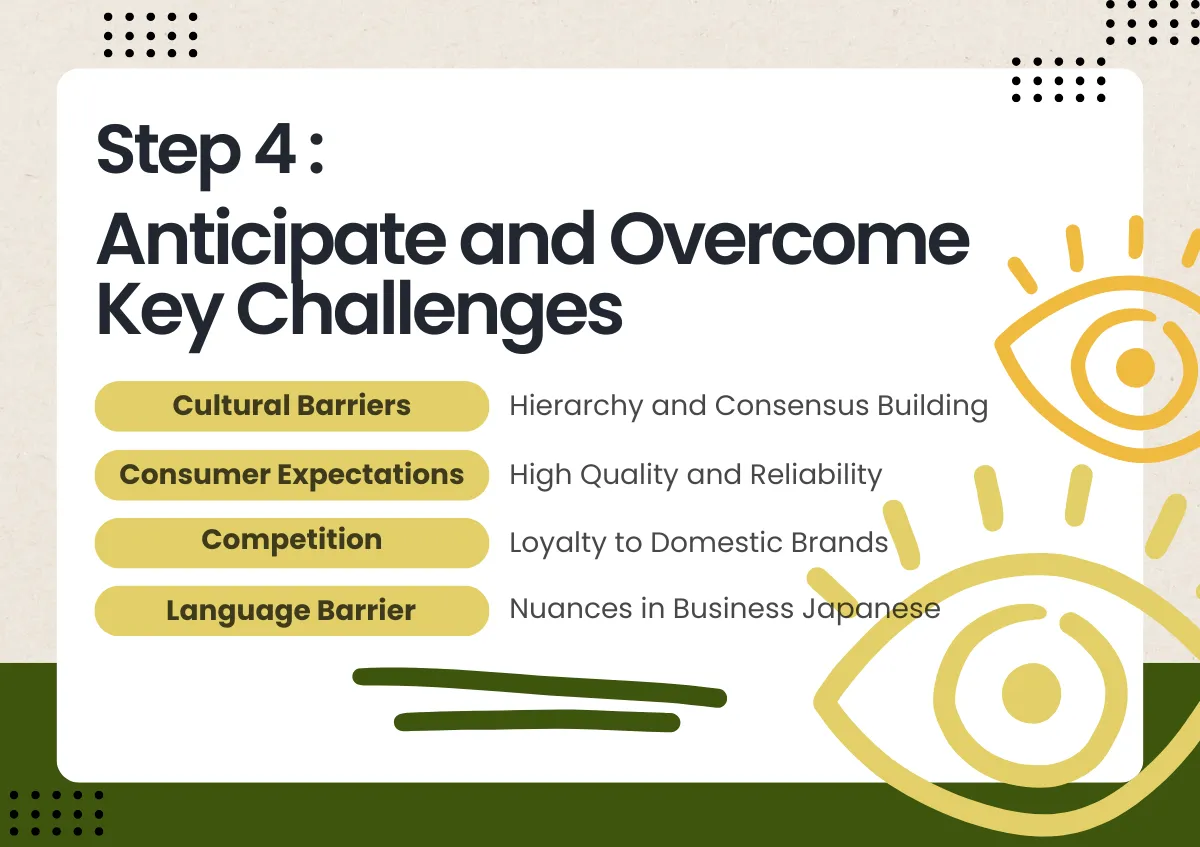
Step 4: Anticipate and Overcome Key Challenges
Even with strong research, careful planning, and localization, SMEs entering Japan will face obstacles that differ from those in most other markets. Japan is not only competitive and highly regulated but also culturally distinct, with consumer expectations that set an exceptionally high bar. Anticipating these challenges and preparing for them can be the difference between slow failure and long-term success.
Cultural Barriers: Hierarchy and Consensus Building
Hierarchical Structure: Junior employees rarely challenge seniors, and decisions move upward before being finalized. SMEs that expect quick “yes/no” answers will be frustrated.
Consensus Building: Companies often avoid direct refusals. Instead, you may hear phrases like “we will consider it,” which often means no. SMEs must learn to read these subtleties.
Patience as a Strategy: Success comes to SMEs who accept this pace and invest time in building trust. Hosting regular follow-ups, offering detailed proposals, and demonstrating persistence without being pushy are key.
Hiring a Japanese advisor or consultant who understands corporate decision-making hierarchies can shorten this process and prevent miscommunication.
Consumer Expectations: High Quality and Reliability
Japanese consumers are among the most demanding in the world. For SMEs, this can feel intimidating, but it also presents opportunities for those who value craftsmanship and attention to detail.
Quality First: Products and services must meet the highest durability and safety standards. Even minor defects can damage a reputation permanently.
Reliability & Service: Timeliness, attention to detail, and strong after-sales support are not optional. A customer complaint ignored once can undo months of trust-building.
Seasonal Product Launches: Japan’s retail calendar revolves around seasonality. Limited-edition packaging, seasonal flavors, and event-driven campaigns (e.g., cherry blossom season, autumn leaves, New Year) attract attention and boost sales.
It is better to launch a smaller product line that exceeds expectations than a broad range that risks underwhelming consumers.
Japan’s market is saturated with well-established local companies, from global icons like Shiseido to smaller regional brands that dominate their niches.
Deep Loyalty: Consumers often remain loyal to brands they trust, even if alternatives are cheaper or more innovative. Breaking this loyalty requires long-term visibility and consistency.
Strong Domestic Competitors: Local SMEs often excel at specialization (e.g., a regional food producer perfecting one product for decades). Foreign entrants must differentiate clearly rather than compete head-to-head.
Market Entry Through Partnerships: For smaller foreign companies, teaming up with local distributors, retailers, or forming joint ventures is often the most viable way to penetrate the market.
Example: When Uber entered Japan, it failed initially because it tried to replicate its U.S. model. Only after partnering with licensed taxi companies and pivoting to Uber Eats did it find a sustainable niche.
Keigo (敬語): Business Japanese uses honorific language that signals respect. Misusing it can seem careless or disrespectful.
Indirect Communication: Japanese favor subtlety. A direct “no” is rare, and foreign SMEs must learn to interpret hesitation or non-verbal cues.
Documentation in Japanese: Contracts, compliance filings, and even product instructions are often required to be in Japanese. SMEs without Japanese-speaking staff or partners will face bottlenecks.
Budget for a bilingual staff member, interpreter, or localization consultant early on. This is essential for negotiation, compliance, and customer trust.
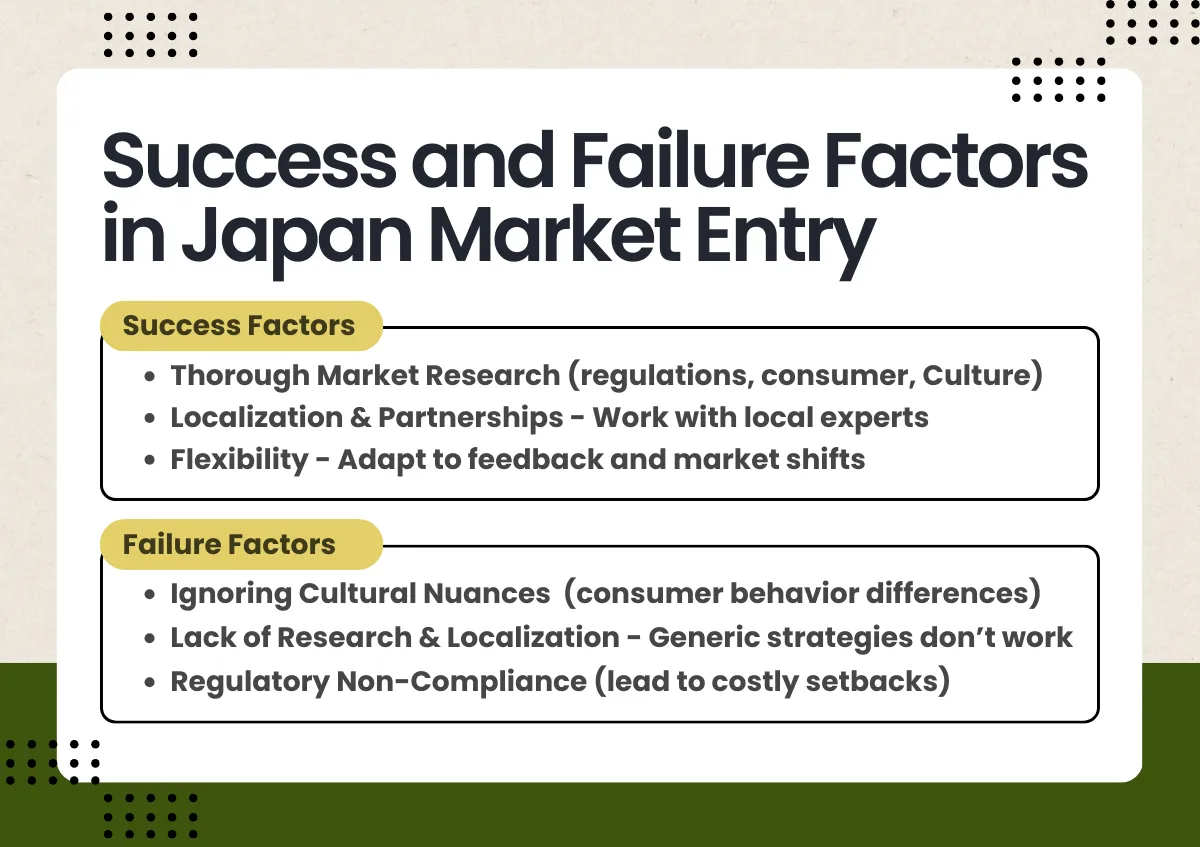
Success and Failure Factors in Japan Market Entry
Successful market entry hinges on several key factors. First and foremost, as we have seen, is the adoption of a market entry strategy informed by comprehensive market research and analysis. This involves understanding consumer preferences, regulatory requirements, and cultural nuances to position products and services effectively.
Navigating market entry barriers and problems also plays a critical role, and companies that proactively address these challenges through localization, partnerships with local experts, and compliance with legal standards are better positioned for success.
Flexibility and adaptability are essential traits for businesses entering the Japanese market. Being responsive to market changes, consumer feedback, and competitive pressures allows companies to adjust their strategies and offerings accordingly.
Conversely, factors contributing to failure in entering the Japanese market often stem from underestimating cultural differences, insufficient market research, or a lack of a localized strategy. Poor understanding of consumer behavior, inadequate adaptation to local business practices, and regulatory non-compliance can lead to setbacks.
By examining success and failure factors through case studies and examples, businesses can gain valuable insights and lessons learned from successful market entries and the challenges faced by others. This knowledge enables informed decision-making and enhances the likelihood of achieving sustainable growth and profitability in Japan.
Case Studies and Examples
One notable example of a failed market entry is eBay's experience in Japan. Despite its global success, eBay struggled to gain traction in Japan's competitive e-commerce market, which is dominated by local players such as Yahoo Auctions and Rakuten. eBay's failure highlighted the importance of understanding local consumer preferences and adapting strategies to fit the Japanese market. Cultural differences, consumer trust issues, and the dominance of established local platforms were significant barriers eBay faced.
In contrast, Nike's successful market entry into Japan illustrates effective strategies for international brands. Nike localized its marketing campaigns to resonate with Japanese consumers, emphasizing quality, innovation, and cultural relevance. By partnering with local athletes and celebrities, Nike built brand credibility and connected with the Japanese youth market. Additionally, Nike invested in retail experiences that catered to Japanese preferences for customer service and shopping ambiance.
Another successful example is McDonald's, which adapted its menu and restaurant ambiance to appeal to Japanese preferences. By introducing menu items like the Teriyaki McBurger and launching seasonal offerings such as the Tsukimi Burger in autumn, McDonald's has successfully tailored its products to local tastes, thereby solidifying its position as a popular fast-food choice in Japan.
These case studies highlight the importance of tailoring market entry strategies to match Japan's distinct cultural, economic, and consumer landscape.
Conclusion: Building a Sustainable Path in Japan
Entering Japan is one of the most rewarding yet challenging moves an international company can make. The country’s high consumer standards, competitive domestic market, and unique cultural landscape mean that quick wins are rare, but the long-term rewards for those who get it right are substantial.
Success depends on preparation, adaptability, and cultural sensitivity. Companies that invest in research, respect local business practices, and commit to actual localization position themselves not just to enter Japan, but to thrive there. Failures, on the other hand, often come from trying to force global strategies onto a market that demands its own tailored approach.
For global businesses willing to take the long view: adapting, building trust, and aligning with Japan’s values, the Japanese market offers more than just growth. It provides a chance to establish a strong, respected presence in one of the world’s most discerning and influential economies.
Key Takeaways: Best Market Entry Strategies for International Companies
Entering Japan’s market demands more than ambition—it requires strategy, cultural awareness, and long-term commitment. While the opportunities are significant, success depends on how well companies prepare and adapt to them. Below are the essential lessons and best practices international firms should keep in mind when planning their market entry.
Thorough research is non-negotiable – Understanding Japanese consumer behavior, competitor strengths, and regulatory requirements forms the foundation of a successful entry.
Localization goes far beyond translation – Products, services, marketing, and even customer service must be tailored to Japanese expectations of quality, precision, and respect.
Partnerships accelerate trust – Collaborating with local distributors, consultants, or joint ventures helps companies navigate regulations and establish credibility more quickly.
Patience and adaptability are essential – Japan’s consensus-driven decision-making and brand-loyal consumers require companies to take a long-term, flexible approach.
Learning from others matters – Case studies show that firms that fail often underestimate cultural differences, while those that succeed embrace localization, innovation, and strong local engagement.
Ready to Enter the Japanese Market? Let’s IGNITE Your Success
Breaking into Japan takes more than research; it takes the right partner on the ground. At IGNITE, we specialize in helping international companies overcome cultural, linguistic, and regulatory barriers to build a strong presence in Japan.
Our multilingual team of Japanese and foreign specialists, based in Osaka, works as an extension of your business, not just a simple agency. From market research and localization to digital marketing, web development, and advertising, we provide end-to-end solutions tailored to Japan’s unique landscape.
Whether you’re testing the waters or ready to scale, we’ll help you:
Initiate your entry with in-depth research and data-driven insights.
Localize your brand and messaging to resonate with Japanese consumers.
Scale your presence through high-performance campaigns and long-term growth strategies.
If you’re ready to unlock Japan’s potential and compete with confidence, partner with IGNITE. Together, we’ll navigate the challenges and turn them into opportunities.
EN-JA bilingual project manager with experience leading Japanese translation and localization projects. Oversees SEO-focused content quality, production, and coordination.