

Marketing Strategy and Management for an English School
Helping a Los Angeles-based ESL school succeed in Japan through a localized PPC strategy, optimized landing pages, and CRM improvements to boost conversions and efficiency.


If you’re looking to advertise in Japan, one of the first questions you’ll face is:
Should I use Google Ads or Yahoo PPC?
For many businesses entering the Japanese market, the instinct is to default to Google—after all, it dominates the global market. However, Japan’s digital landscape is unique, and what works elsewhere may not be effective here. Yahoo Japan remains one of the most influential and widely used platforms in the country, especially among older, desktop-oriented users. In fact, it plays a much larger role in Japan than most international marketers realize.
This blog is here to help you decide. If you're not ready to dive into the technical setup just yet—and instead want a clear, non-jargon explanation of how Yahoo PPC compares to Google Ads—you’re in the right place.
We’ll break down the key differences between the two platforms in terms of:
By the end, you’ll have a clearer sense of which platform best fits your goals—and why Yahoo PPC may offer strategic advantages for reaching Japanese audiences that Google Ads simply can’t.
Let’s dive in.
Japan’s digital advertising landscape stands apart from other global markets in both user behavior and platform dominance. While platforms like Google and Facebook dominate much of the world, Yahoo Japan remains a surprising yet significant player in Japan’s online ecosystem.
Yahoo Japan is more than a search engine—it’s a deeply integrated digital hub used daily by millions. From shopping and news to finance and weather, its services are woven into the everyday lives of Japanese consumers. For advertisers, this means not only access to a search platform but also the opportunity to reach users across a wide range of online experiences, all within Yahoo Japan’s extensive network.
Because Japan’s digital environment is so distinct, even common strategies like link building require a localized approach, as the types of publishers, content formats, and trust signals that influence Japanese users differ significantly from Western markets.
In fact, Yahoo Japan consistently generates substantial traffic and ad performance, making it a go-to advertising channel for businesses looking to succeed in Japan. Its seamless integration with popular services like Yahoo Shopping and Yahoo News enables brands to connect ad placements with points of purchase or content engagement, creating a more direct and meaningful customer journey.
The Japanese market itself is dynamic and highly evolved. Digital ad formats, including search-linked ads, display ads, and video ads, are proliferating. Video, in particular, is on the rise—fueled by increased usage of connected TVs and streaming platforms like TVer and ABEMA. Advertisers who adapt to these trends and local media habits stand to gain a strong foothold in the market.
However, succeeding in Japan isn’t just about showing up—it’s about showing up the right way. Japanese consumers often expect content that is visually polished, culturally considerate, and informative without being overly aggressive. This makes it crucial for marketers to adapt their campaigns accordingly.
By leveraging Yahoo Japan’s platform—which offers localized reach, robust targeting tools, and strong brand trust—businesses can create campaigns that feel native to Japanese users while still driving measurable results.
Yahoo Japan remains a powerful force in the country’s digital landscape, offering advertisers access to high-traffic platforms like Yahoo Shopping, News, and Finance. But to fully leverage its potential, campaigns must be tailored to local consumer behavior and cultural expectations. That’s why many international brands choose to outsource Yahoo Ads management to local agencies—a common and strategic practice in Japan. With the right partner, brands can run more effective, culturally aligned campaigns that resonate with Japanese audiences and deliver stronger results.
If you’re exploring digital advertising options in Japan, one name you might not expect to hear is Yahoo. But in Japan, Yahoo is not just surviving—it’s thriving. Its pay-per-click (PPC) advertising platform is a powerful tool for businesses seeking to connect with Japanese audiences in a direct and measurable way.
Unlike some advertising platforms that require a steep learning curve or a significant upfront investment, Yahoo PPC offers a simpler entry point. It allows businesses of all sizes to place ads in front of targeted users and only pay when someone actually clicks on them. For companies still deciding where to spend their digital ad budget in Japan, Yahoo’s combination of reach, affordability, and user trust makes it a compelling option to consider.
While Yahoo has faded in relevance in many Western countries, Yahoo Japan remains a daily digital destination for millions. It’s one of the most visited websites in Japan, reaching over 68% of the population each month.
More than just a search engine, Yahoo Japan serves as a central hub for content and services, including news, weather, finance, shopping, email, and more. This makes it a natural touchpoint for users throughout their day, and a valuable advertising space for businesses looking to meet people where they already are.
Importantly, Yahoo Japan is particularly popular among older users and desktop users, making it a strategic channel for products or services that appeal to professionals, working adults, or B2B audiences. Its credibility and familiarity also help ads feel less intrusive and more trustworthy—crucial factors when building a brand in a market that values reputation. To fully capitalize on this platform, businesses should not only run localized ad campaigns but also translate and optimize their websites and messaging to align with Japanese cultural expectations—where tone, layout, and copywriting quality can significantly impact engagement and trust.


At its core, Yahoo PPC (pay-per-click) ads are a way to get your business in front of the right people, without incurring a cost unless they actually click on your ad. This model helps you make the most of your budget, as you only spend money when someone shows genuine interest.
Here’s how it works, in simple terms:
What makes Yahoo PPC appealing is its strong visibility within the Yahoo Japan ecosystem, which Japanese users are already highly familiar with and trust. Unlike traditional display ads that get ignored, Yahoo PPC ads appear natively within content people are already engaging with, making them more noticeable and effective.
Suppose you're aiming to reach an audience in Japan and want a straightforward, measurable way to get attention. In that case, Yahoo PPC offers a proven platform to do just that, especially if you're targeting more localized or mature demographics.
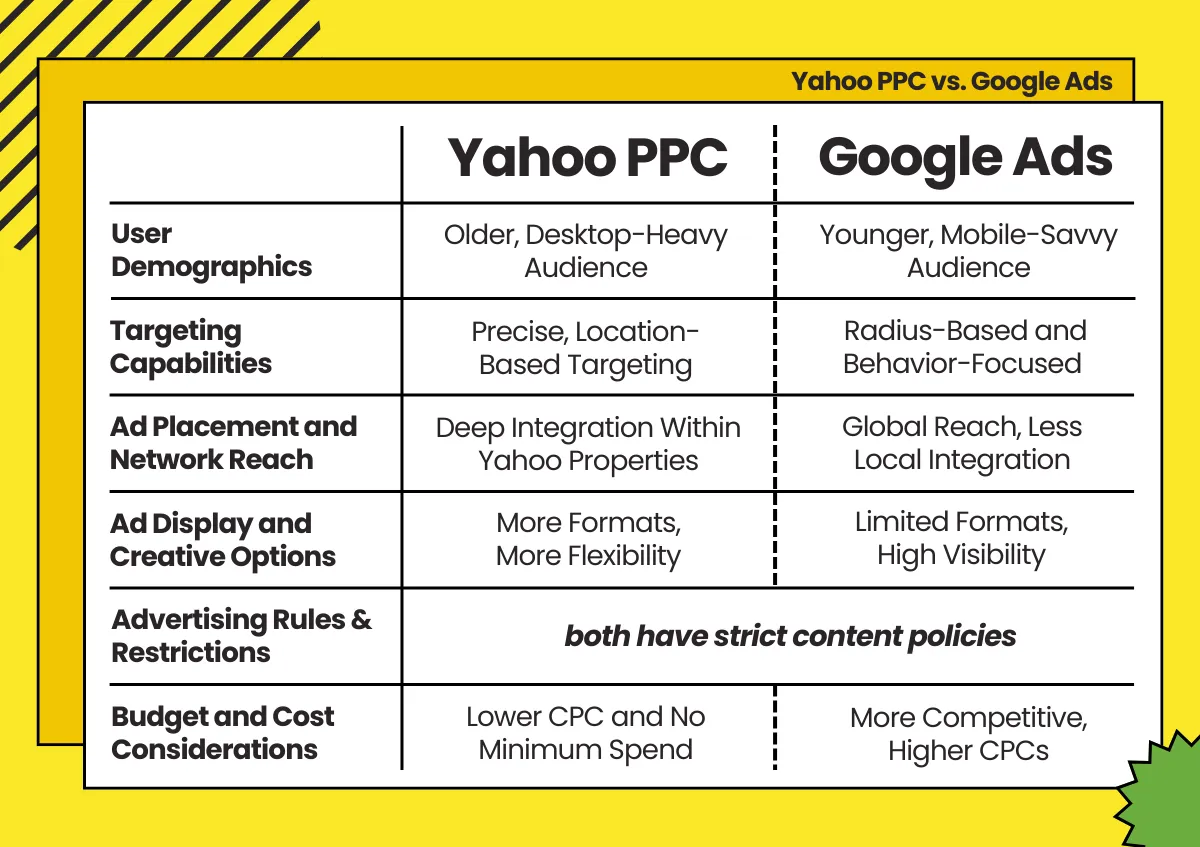
Choosing the right advertising platform can make a significant impact on your campaign’s performance, especially in a unique market like Japan. While both Yahoo PPC and Google Ads offer powerful tools for reaching online audiences, they differ in their operation, target audience, and integration into Japan’s digital ecosystem.
Below, we break down the key differences to help you decide which platform best aligns with your goals.
Yahoo PPC: Older, Desktop-Heavy Audience
Yahoo Japan is especially popular among older users and desktop users, including business professionals and decision-makers. It remains the top platform for PC usage in Japan, with over 20 million active desktop users monthly. This makes Yahoo PPC a strong choice for audiences that include working adults, executives, or B2B buyers who typically search and browse on computers.
Google Ads: Younger, Mobile-Savvy Audience
In contrast, Google dominates with mobile users and younger demographics. It’s widely used by students, tech-savvy individuals, and professionals who rely on smartphones for daily information. If your product or service targets a mobile-first, youthful audience, Google Ads may offer broader access to that group.
Conclusion:
Choose Yahoo for desktop-heavy, mature audiences. Choose Google for younger, mobile-centric consumers.
Yahoo PPC: Precise, Location-Based Targeting
Yahoo offers advertisers granular control over who sees their ads. You can target by specific cities, districts, age groups, genders, interests, and even past search behavior on Yahoo Japan. This is especially valuable for businesses running hyper-local campaigns or targeting particular customer profiles, such as professionals in a single ward of Tokyo or a specific niche of business.
Google Ads: Radius-Based and Behavior-Focused
Google’s strength lies in its ability to track user behavior across the web. Its targeting is highly effective for interest-based and intent-based advertising, using search history, site visits, and app usage data. Location targeting tends to be broader (e.g., radius around a point) but is supported by deep behavioral insights.
Conclusion:
Yahoo offers more precise geographic targeting within Japan. Google excels in behavioral tracking and broader reach.
Yahoo PPC: Deep Integration Within Yahoo Properties
Yahoo PPC ads are shown throughout Yahoo Japan’s suite of services—including Yahoo News, Yahoo Shopping, Finance, Weather, and more. This means your ads are placed in trusted environments where Japanese users are already spending time. The network also includes partner sites, offering strong visibility across Japanese web traffic, especially on desktop.
Google Ads: Global Reach, Less Local Integration
Google Ads provides access to the largest global advertising network, featuring placements across Google Search, YouTube, Gmail, and numerous third-party sites. However, in Japan, its content integration isn’t as deep or localized as Yahoo Japan’s. You may reach more people, but not necessarily with the same level of local contextual relevance.
Conclusion:
Yahoo PPC offers a robust domestic presence and contextual relevance in Japan. Google Ads provides global scale and variety, but with less local immersion.
Google Ads: More Formats, More Flexibility
Google Ads leads the way in creative versatility. Advertisers can choose from a wide variety of formats, including text, image, video, carousel, shopping, app install ads, and more. These ads can be fine-tuned for mobile or desktop, optimized for different user behaviors, and dynamically adjusted for performance. This makes Google an excellent choice for brands looking to test, iterate, and scale with richly interactive ad experiences.
Yahoo PPC: Limited Formats, High Visibility
Yahoo Japan offers fewer ad formats compared to others. Most Yahoo PPC ads are text-based or display-based and appear prominently within native environments, such as Yahoo News, Yahoo Shopping, and Yahoo Finance. While the options may be more limited, the placements are prominent and trusted, especially in Japan, where Yahoo’s services are deeply embedded in users’ daily routines.
Conclusion:
Google wins on flexibility and variety of formats. Yahoo delivers trusted, high-visibility placements in native content environments.
Both Yahoo PPC and Google Ads have strict content policies to ensure user safety and regulatory compliance. These cover everything from prohibited products (like adult content, weapons, and misleading claims) to formatting and landing page standards.
While most categories overlap, there are subtle differences in what’s allowed and how strictly it’s enforced, especially concerning language, health-related content, and financial services. Yahoo Japan may have unique standards tailored to Japanese consumer protection laws, which can be stricter in specific industries.
Conclusion:
Both platforms require compliance with detailed ad policies. Advertisers should review guidelines closely, especially when marketing in regulated industries.

Yahoo PPC: Lower CPC and No Minimum Spend
Yahoo PPC is often the more budget-friendly option, especially in Japan. Cost-per-click (CPC) tends to be lower, making it easier for smaller or local businesses to get started. There’s no minimum ad spend, and campaigns can be scaled gradually. For B2B companies in particular, Yahoo often delivers a better cost-per-acquisition (CPA) due to lower competition.
Google Ads: More Competitive, Higher CPCs
Google Ads is a highly competitive environment, particularly for keywords related to finance, technology, and e-commerce. While it offers strong ROI with the right strategy, advertisers often face higher CPCs, and it’s easier to burn through budget quickly without careful targeting and optimization. That said, it offers powerful automation and innovative bidding tools for scaling results once campaigns are dialed in.
Conclusion:
Yahoo is often more cost-effective in Japan. Google may require larger budgets, but it provides access to a broader range of data and optimization tools.
While many brands benefit from using both platforms in tandem, there are specific scenarios where Yahoo PPC may be the better strategic fit, especially if your goals are locally focused, budget-conscious, or aimed at a more mature audience in Japan.
Yahoo PPC is especially effective for Japan-first, locally targeted, and B2B campaigns, offering a level of regional relevance and cost-efficiency that can be harder to achieve with Google.
| Your Goal or Audience | Best Platform |
|---|---|
| Reaching older, desktop-first users | Yahoo PPC |
| Running a campaign with tight budget control | Yahoo PPC |
| Targeting users by city, district, or neighborhood | Yahoo PPC |
| Reaching a younger, mobile-savvy audience | Google Ads |
| Running a broad international campaign | Google Ads |
| Needing maximum creative flexibility and ad format variety | Google Ads |
For many companies, especially those new to Japan, a blended strategy that uses both Yahoo PPC and Google Ads can deliver the best of both worlds—localized reach and global visibility.
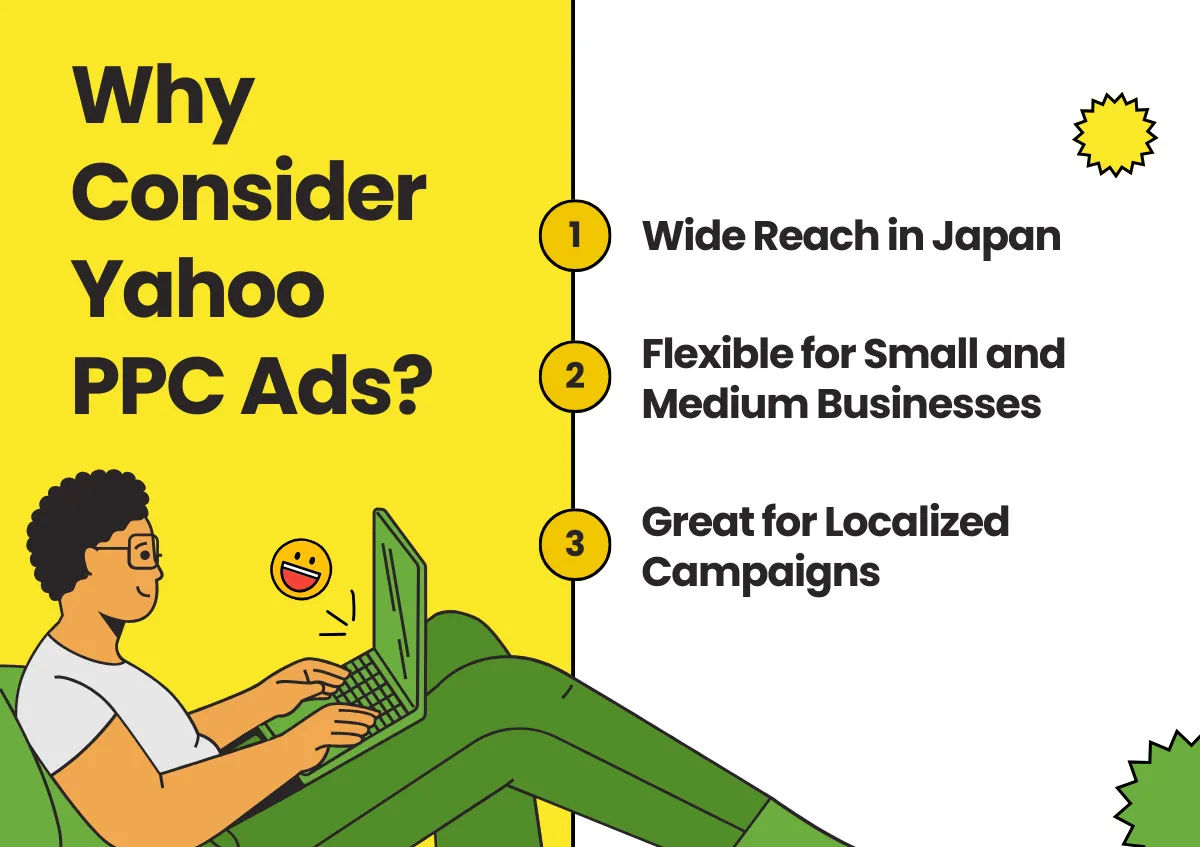
Yahoo Japan’s advertising platform remains one of the most powerful yet underutilized digital tools for businesses targeting the Japanese market. Whether you’re a multinational brand or a local business, Yahoo PPC offers a unique blend of reach, control, and affordability that can be particularly beneficial in Japan’s distinct online environment.
Let’s take a closer look at three reasons why Yahoo PPC deserves serious consideration.
Despite global perceptions, Yahoo Japan continues to command massive traffic and engagement. It's not simply a search engine—it’s a digital ecosystem deeply embedded in the daily routines of Japanese consumers.
This high visibility enables brands to reach the right audience, not just once, but repeatedly across multiple channels. That’s especially powerful for awareness-based campaigns or products with longer consideration cycles.
Google may offer global reach, but Yahoo Japan offers profound, local relevance—exactly where and how many Japanese consumers are spending their time online.
While platforms like Yahoo Japan dominate desktop usage and offer high-impact visibility across trusted content channels, social media plays an equally critical role in shaping consumer behavior—especially among younger and mobile-first demographics. Platforms such as Instagram, X (formerly Twitter), YouTube, TikTok, and LINE are deeply integrated into Japanese daily life, each serving a unique function in the consumer journey.
In this environment, influencer marketing has emerged as one of the most effective ways to build trust and drive engagement, particularly for brands entering the market without an established local presence. Japanese consumers are highly trend-aware, and influencer recommendations often hold more sway than traditional advertising—especially when delivered by talent managed through trusted agencies.
When used strategically, influencer campaigns can complement Yahoo PPC by reinforcing brand awareness, increasing product discovery, and boosting conversion across social touchpoints. For example, a Yahoo Shopping ad campaign can be strengthened by an influencer unboxing video on YouTube or a product feature on Instagram, delivering both broad reach and personal relevance.
Together, Yahoo Japan’s platform-driven visibility and Japan’s unique influencer ecosystem provide a powerful, culturally aligned digital marketing foundation. The most successful campaigns don’t rely on just one channel—they integrate media buying with social and influencer strategies to reach Japanese consumers at every step of the journey.

Yahoo PPC is not just for large corporations. In fact, it’s particularly well-suited for startups, small businesses, and those testing the Japanese market for the first time.
Yahoo PPC reduces financial risk and technical barriers, helping smaller companies experiment and grow without being locked into rigid ad structures.
Japan’s market is highly regionalized, with notable differences in consumer behavior, preferences, and even language across cities and prefectures. Yahoo PPC offers fine-grained geographic and demographic targeting that is especially helpful for localized outreach.
This level of precision is beneficial for:
Yahoo PPC lets you speak directly to the audience that matters, in precisely the location where they’re most likely to convert—a critical advantage in Japan’s hyper-localized market.

If you’re looking to expand your presence in Japan, Yahoo PPC is a worthy consideration. While Google Ads may be the default choice for many global marketers, Yahoo Japan offers distinct strategic advantages, especially when your goal is to connect with local audiences, build trust, and optimize for value.
Throughout this article, we’ve explored how Yahoo PPC compares to Google Ads in key areas, including demographics, targeting, placement, cost, and usability. And the takeaway is clear:
However, the right platform ultimately depends on who you’re trying to reach and how you're doing so. If your campaign is built around mobile-first, global audiences, or you need more flexibility in ad formats and creative control, Google Ads may be the better fit. But if your success depends on local trust, precise targeting, and strong desktop visibility, Yahoo PPC could very well outperform.
When it comes to digital advertising in Japan, many marketers instinctively lean toward Google Ads. But to truly succeed in this unique and highly localized market with its own business culture, it's essential to rethink that default. Yahoo Japan continues to play a dominant role in the country’s digital ecosystem—especially for certain demographics and business goals. If you're serious about reaching Japanese audiences with precision and impact, Yahoo PPC deserves your attention.
Success in Japan requires more than global best practices—it calls for a localized strategy that respects the habits and preferences of Japanese consumers. Yahoo PPC offers distinct advantages that can’t be ignored, especially for brands seeking to build trust, visibility, and ROI in this highly sophisticated market. Whether you use it as a primary channel or in tandem with Google Ads, Yahoo PPC should be a key component of any serious Japan-focused media strategy.

At IGNITE, we specialize in bridging the gap between global brands and Japanese audiences. Whether you’re a small startup testing new markets or an established company looking to scale, we provide end-to-end digital marketing support with a local, multilingual team based in Osaka.
As your one-stop Japanese marketing partner, we don’t just launch campaigns—we:
From Yahoo PPC and Google Ads to landing page design, SEO, content creation, and CRM integration, we’re built to support your whole marketing journey in Japan.
Let’s IGNITE Your Japan Strategy
Contact us today for a free consultation and discover how we can help you reach the right audience with the right message, on the right platforms.
EN-JA bilingual digital marketer specializing in B2B marketing aligned with sales operations and business strategy. Leverages client insights to execute marketing initiatives that drive results.

Helping a Los Angeles-based ESL school succeed in Japan through a localized PPC strategy, optimized landing pages, and CRM improvements to boost conversions and efficiency.

Launching and optimizing targeted PPC and social ad campaigns, we helped a U.S. luxury umbrella brand successfully enter the Japanese market, tripling ROAS within two months.
Find the right service to grow your business in Japan.