

Japanese SEO Content Creation for Hotel Search Engine
Creating Japanese SEO content for a hotel search engine, boosting impressions by 371% and URL rating by 529% in two months through keyword targeting and link-building.



At first glance, content marketing in Japan may seem no different from the global standard. After all, the fundamentals remain the same: provide valuable, relevant content to engage your target audience, build trust, and drive business outcomes. In this sense, content marketing is a universal strategy practiced from San Francisco to Singapore.
But once you look closer, the execution in Japan reveals itself as uniquely nuanced, shaped by cultural values, consumer expectations, and distinct communication preferences.
In Japan, content is not just content. It’s a reflection of trust, tradition, and meticulous attention to detail. Messaging tends to be subtle, design preferences lean toward minimalism, and storytelling often serves a higher purpose than product promotion. Platforms also differ—LINE, Note.com, and Ameblo dominate where Western marketers might expect LinkedIn or Medium.
So yes, content marketing is fundamentally the same everywhere. But how it's done—and how it lands with the audience—can differ dramatically in Japan.
At its core, content marketing is the strategic process of creating and distributing valuable, relevant, and consistent content to attract and retain a clearly defined audience. The goal? To drive profitable customer action, not through overt promotion, but by earning attention and trust over time.
In every market around the world, successful content marketing does a few things very well:
And in this regard, Japan is no exception.
To understand content marketing in Japan, it helps to see how it diverges from traditional marketing methods still prevalent in the local business environment.
Traditional Marketing in Japan
Traditional marketing in Japan, like elsewhere, includes methods such as:
These methods aim for broad exposure and immediate recognition. They’re effective in generating quick visibility but often feel one-sided or impersonal, particularly to modern audiences who expect two-way interaction and authenticity.
The Shift to Content Marketing
Content marketing, on the other hand, is centered on value. It prioritizes audience engagement, relevance, and trust-building over sales pitches. And in Japan, this takes a uniquely patient and polished form:
This is especially significant in Japanese culture, where relationships—whether business or personal—are cultivated slowly and with great care.
A Digital Turning Point
The emergence of social platforms like LINE, YouTube, and Note.com has further widened the gap between traditional and content-driven marketing. Audiences now expect brands to meet them with engaging stories, real-time updates, and shareable content. Companies that still rely solely on top-down, interruptive messaging risk being tuned out completely.
Despite its potential, content marketing in Japan faces several unique challenges that international companies must navigate.
In many Japanese companies, marketing decisions are made by senior leadership, who may be more familiar with traditional channels and hesitant to invest in newer digital approaches. This generational gap can slow down digital transformation and innovation.
Japanese business culture often values consistency and predictability. Change is introduced gradually and cautiously. While this ensures stability, it also makes rapid adaptation—something content marketing usually requires—more difficult.
Japanese consumers expect high-quality content. That means:
The bar for excellence is high, which can make content production more resource-intensive and slow.
Many companies are still in the early stages of shifting from traditional to digital marketing. This often requires not just new tools, but a fundamental change in mindset and organizational structure.


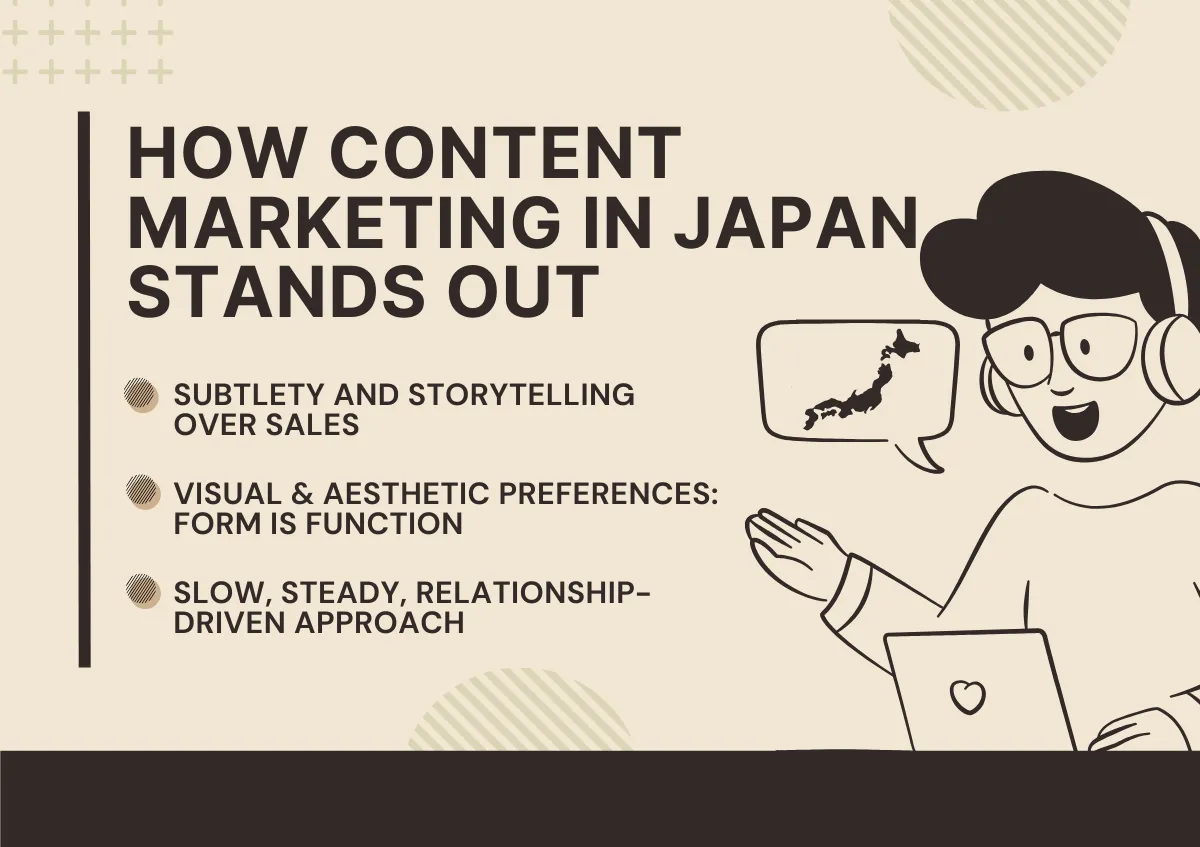
Japanese content marketing doesn’t aim to reinvent the wheel, but it certainly polishes it differently. While the foundational principles align with global practices, the “how” in Japan is shaped by deep cultural norms, subtlety in communication, and an unwavering focus on long-term trust. Let’s explore three defining traits that distinguish Japan’s content marketing landscape from that of other countries.
“Say Less, Mean More” Communication in Japan
Unlike the Western style of messaging, which often prizes bold headlines and call-to-action-driven language like “Buy Now” or “Limited Time Offer,” Japanese content marketing leans heavily on indirect communication. The emphasis is not on shouting for attention, but gently earning it.
Culturally, Japan values “kuuki o yomu” (reading the air)—the social art of understanding unspoken messages and emotional context. This directly impacts marketing content. Instead of leading with benefits or offers, successful Japanese brands:
Storytelling That Honors the Audience
Narratives in Japanese marketing often resemble a cinematic experience—slow-building, reflective, and rich in cultural references. Consider Shiseido’s video campaigns: they often feature minimal product placement, instead focusing on aesthetic themes of self-care, seasonal change, or generational beauty ideals. The message isn’t “Buy this foundation,” but rather “This is how beauty lives through time.”
This style resonates deeply because Japanese audiences do not want to be “sold to”—they want to be respected and emotionally moved.
Why This Matters for International Brands
If you translate Western marketing copy directly into Japanese without cultural adaptation, your message may feel tone-deaf or pushy.Brands entering the Japanese market must:
Minimalism with a Message
Japanese visual culture is built on centuries-old aesthetics like wabi-sabi (beauty in imperfection) and ma (negative space or timing). In marketing, this translates into content that:
Even fast-moving consumer brands tend to embrace clean, harmonious design. Where a U.S. landing page may use bold color contrast and animated pop-ups, a Japanese equivalent often leans on subtle gradients, understated icons, and calm layouts that encourage careful reading.

Seasonal Sensitivity: Timing Is Visual
Japan has a deep cultural appreciation for the changing seasons, and successful brands incorporate this rhythm into their visual storytelling. It’s not uncommon for websites, social posts, or even packaging to change monthly—or even weekly—to reflect current seasons, festivals, or weather.
For example:
Shiseido, again, excels in this regard. Its product launches and visual branding often align with seasonal colors, traditions, and nature imagery, reflecting a cultural understanding far more profound than design trends.
Case in Point: JR East
JR East doesn’t just promote train tickets. Through video, social media, and digital campaigns, they celebrate the journey itself, highlighting local festivals, scenic routes, and hidden gems. Their content often reflects seasonal imagery, conveying a sense of nostalgia, warmth, and national pride.
This approach creates an emotional connection to travel, not just a functional transaction.
Why Speed Doesn't Sell in Japan
One of the most common missteps international companies make in Japan is trying to move too fast. Aggressive funnels, fast-lane conversion copy, and urgency-based tactics don’t always land well with Japanese consumers. Here’s why:
In Japan, a product isn’t just being judged—it’s being quietly observed over time. Brands must patiently show their commitment to quality, reliability, and consistency before consumers are willing to invest.
This dynamic mirrors Japanese business practices, where building rapport precedes transactions, and deals are often made over long-term discussions rather than aggressive pitches.
User-Centered Content Strategy in Practice
At the heart of this slow-burn model is a user-centered content creation strategy. That means:
Successful Japanese content:
Patience = Performance
Think of Japanese content marketing like cultivating a bonsai tree. It’s not about speed—it’s about precision, care, and timing. It takes longer to build momentum, but once that trust is established, the loyalty can be far deeper than in faster-moving Western markets.
| Principle | Japan | Western Markets |
|---|---|---|
| Communication Style | Subtle, indirect, story-driven | Bold, direct, benefits-first |
| Design Aesthetic | Minimalist, seasonal, quiet elegance | Eye-catching, contrast-heavy, dynamic |
| Buyer Journey | Long-term trust, low-risk tolerance | Fast-paced, conversion-oriented |
| Content Focus | Relationship, value, and cultural nuance | Offer-driven, brand-first |
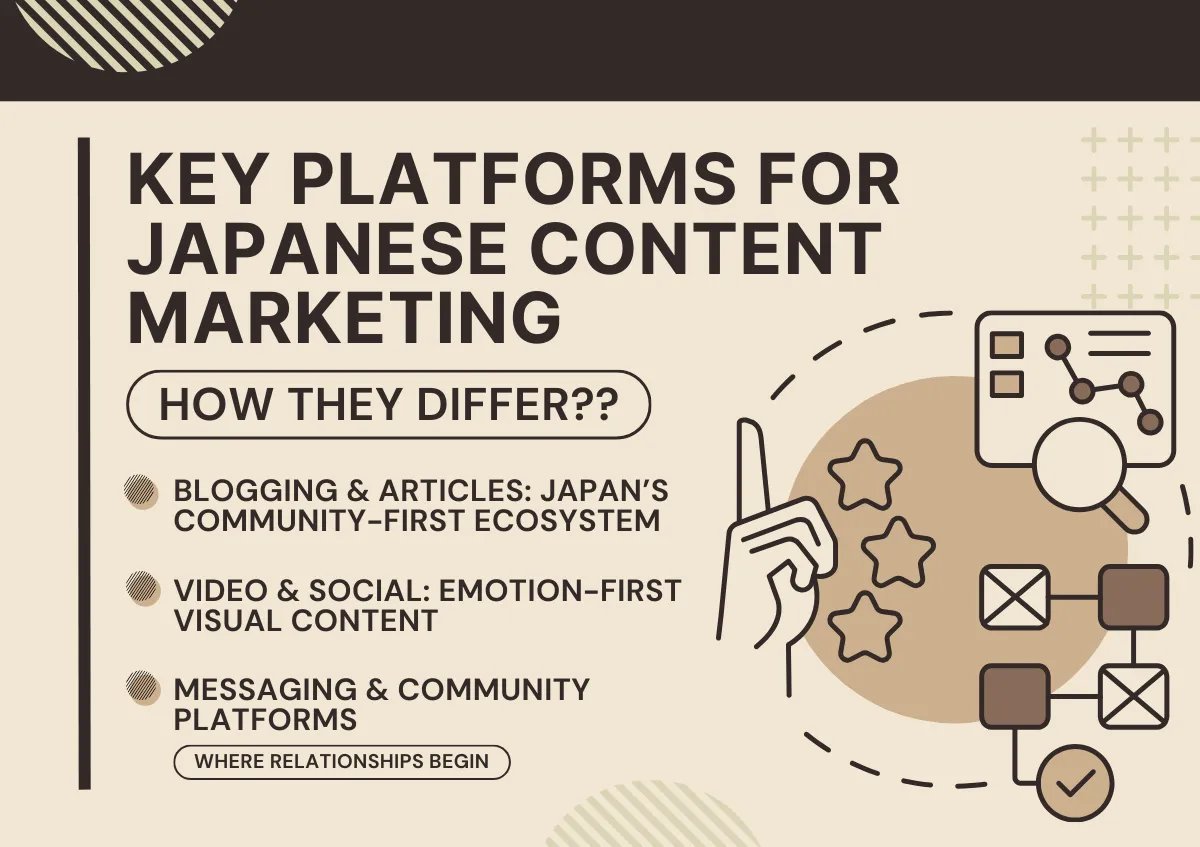
Understanding where your content lives is just as important as the content itself, especially in Japan. While global marketers may assume that platforms like Medium, Substack, or LinkedIn articles dominate the content space, the Japanese digital ecosystem operates quite differently.
Japan’s content platforms are rooted in community, subtle expression, and localized behaviors. Instead of polished professional publishing, many platforms feel more grassroots, personal, and conversational. Below, we break down the core channels used in Japan—alongside how they compare to Western equivalents—and why these differences matter.
Japan: Note.com, Ameblo, Livedoor Blog
Note.com is Japan’s closest equivalent to Medium but with a stronger creator-driven and community-focused foundation. It blends personal blogging with professional publishing, allowing users to share:
Unlike Medium, Note allows direct monetization, meaning users can sell premium content, set up memberships, or receive support from fans.
Used by:
Independent creators, startups, writers, small brands, and corporate media arms can collaborate via Note Pro.
Why it matters:
Note.com prioritizes authenticity and quality, and its C2C orientation gives brands a space to speak as individuals, not faceless corporations. For foreign companies, it’s an ideal platform to localize thought leadership and build trust through storytelling, interviews, and opinion pieces.
Ameblo (Ameba Blog) is more than just a blogging site—it’s a full-fledged community hub. Operated by CyberAgent, it’s especially popular among:
With its friendly interface and low entry barrier, it acts as both a digital diary and an entertainment portal, thanks to the massive volume of celebrity bloggers and its gamified social features.
Features include:
Used by:
B2C brands, influencers, entertainment, beauty, and lifestyle sectors.
Why it matters:
Ameblo thrives on intimacy and relatability. Content here is often less polished, more emotional, and intensely interactive. Unlike Western professional blogs, the focus is on personality over authority. Foreign brands can partner with influential bloggers or sponsor lifestyle content to connect with specific demographics.

Owned by LINE Corporation, Livedoor Blog is one of Japan’s oldest and most versatile platforms. It’s home to everything from:
With no paid tiers since 2015 and an emphasis on user freedom, Livedoor Blog hosts an enormous variety of content.
Features:
Used by:
Hobbyists, indie creators, bloggers who want flexibility without censorship.
Why it matters:
For brands, Livedoor is useful not as a publishing platform per se, but as a monitoring tool. It helps track user sentiment, niche trends, and grassroots dialogue, critical for understanding what resonates before crafting your own content.
Western Comparison: Medium, Substack, LinkedIn Articles
Key Difference:
Japanese platforms center around community interaction, emotional storytelling, and local culture, whereas Western ones focus more on professional polish and authority.
In Japan, visual content reigns supreme—but it’s not about flashy gimmicks or over-the-top virality. Japanese audiences gravitate toward video content that feels authentic, emotionally resonant, and culturally in tune. Whether it’s through long-form storytelling or bite-sized entertainment, the goal is to connect, not interrupt.
Here’s how Japan’s dominant video and social platforms are shaping content marketing.
YouTube: The Bedrock of Video Storytelling
YouTube remains the cornerstone of video content in Japan. While global marketers are familiar with its power, the way it’s used in Japan has unique nuances:
Best for: Beauty, travel, lifestyle, tech, B2B explainers, corporate storytelling
Avoid aggressive intros or over-branding. Focus on visuals that reflect harmony, expertise, or emotional depth. Think: documentary tone, not commercial pitch.
TikTok: Fast-Paced, Trend-Driven, Culturally Sharp
TikTok has seen explosive growth in Japan, particularly among Gen Z and Millennials. But Japanese TikTok culture differs notably from its Western counterpart.
Best for: Fashion, food, entertainment, skincare, consumer tech, youth brands
Localize your content—not just the captions, but the humor, references, and visuals. Global TikTok trends don’t always translate. Collaborate with Japanese creators who understand the pulse of the platform and the expectations of the local audience.
Twitter (X): Still a Social Powerhouse
Twitter (now X) continues to dominate in Japan, far more than in many Western countries. It functions as:
Japanese Twitter users are highly active, with Japan ranking among the highest for tweet volume globally. What makes Twitter special in Japan?
Best for: Gaming, tech, publishing, entertainment, pop culture brands
Consistency matters more than virality. Use Twitter for community-building, announcements, and low-pressure brand engagement. Campaign hashtags work well, especially if tied to seasons, fandoms, or cultural events.
LINE: Japan’s Super-App for Content and Community
LINE is far more than a messaging platform. It’s a whole content ecosystem, combining:
For marketers:
Platform power: LINE enables highly targeted content delivery through push notifications, personalized journeys, and 1:1 communication—capabilities that Western messaging apps (WhatsApp, Messenger) lack.
Western Comparison:
| Platform | Japan | Western Equivalent | Key Difference |
|---|---|---|---|
| LINE | Messaging + content hub | LINE is brand-friendly with content monetization | |
| Slack | B2B chat only | Slack (same) | Japan uses it mostly within tech/startup spaces |
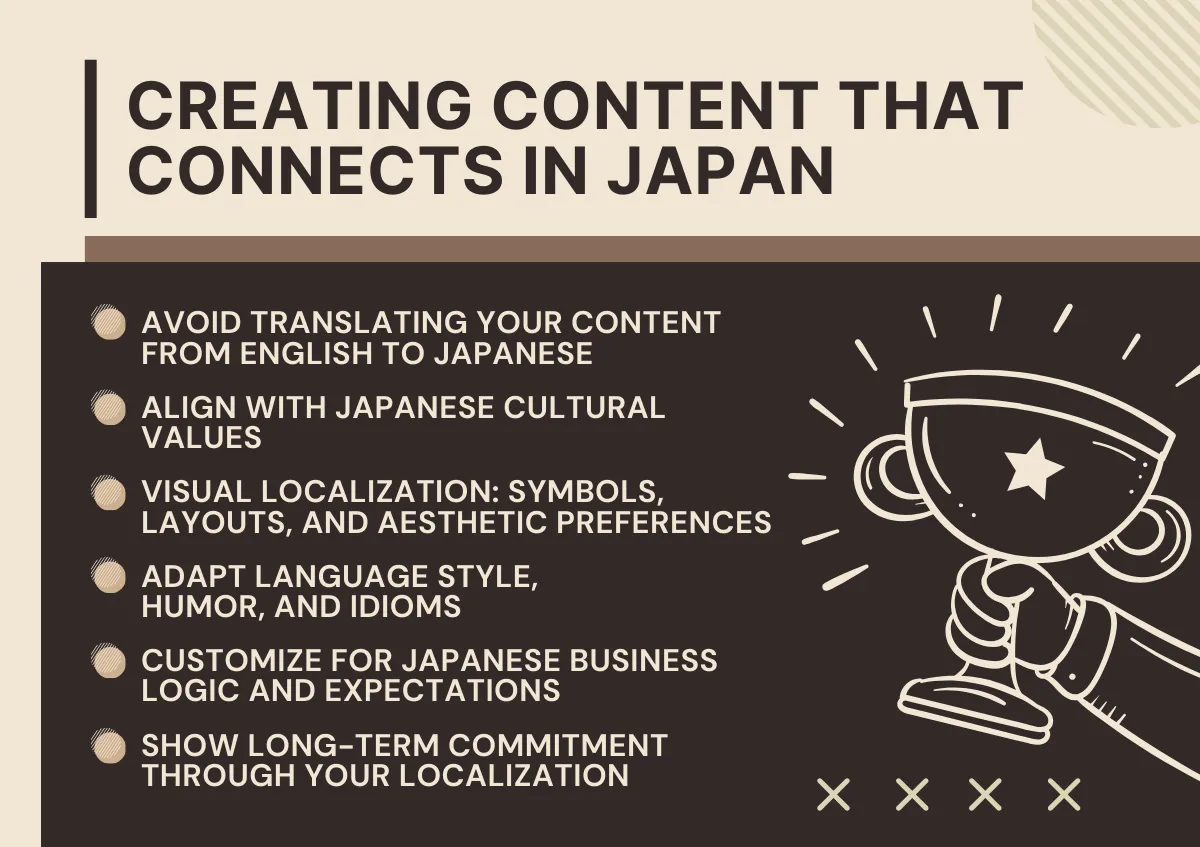
Localization in Japan is not an afterthought—it's a prerequisite. While many international companies approach localization as a line item in their marketing checklist, in Japan, it's the key to earning attention, trust, and ultimately, long-term brand loyalty.
To create content that truly connects, companies must go beyond direct translation and embrace full-spectrum localization—one that considers tone, social norms, cultural symbols, business etiquette, and visual language.
Translation is about language. Localization is about meaning. For Japanese audiences—particularly in the B2B space—this distinction can make or break your content’s effectiveness.
It’s tempting to take existing English content—like a product brochure, case study, or white paper—and run it through a translation service or even an in-house bilingual staff member. But this method risks:
For example:
“AI automation cuts costs and accelerates transformation.”
“AI technologies support continuous operational efficiency, addressing long-term workforce challenges.”
The latter appeals to Japan’s cautious, pragmatic, and harmony-oriented approach to innovation.
Localization must align not just with linguistic norms, but with the emotional and social fabric of Japanese communication. This includes respect for:
| Western Focus | Japanese Preference |
|---|---|
| Speed and disruption | Stability and incremental improvement |
| Bold calls-to-action | Subtle invitations and soft guidance |
| Personal voice or "hero" narrative | Group success, humility, shared journey |
| Humor and casual tone | Politeness, elegance, and subtle wit |
Tip: Instead of commanding action, gently guide the reader. Use language such as:
“ご検討いただけますと幸いです” (We would be grateful for your consideration)
“~についてご紹介します” (We would like to introduce…)
This level of humility is expected and appreciated, especially in formal content.

Content isn’t just read—it’s seen. The design and visual presentation of your content must reflect Japanese sensibilities, which often prioritize:
Colors, icons, and even typefaces have different emotional associations in Japan:
Example: A Western infographic might use a big red “X” to mark a problem area. In Japan, a light gray arrow or an “under construction” icon would feel more tactful.
Idioms Don't Translate (Literally or Figuratively)
English expressions like:
…may confuse or alienate Japanese readers. Japanese business communication is rooted in clarity and professionalism, so any metaphors must be either:
Humor Is Delicate
Humor in Japanese content marketing tends to be:
If your English copy includes jokes or humorous analogies, assess whether they:
Sometimes, replacing humor with warmth and approachability is better—a tone Japanese audiences trust.
Structure, Flow, and Authority
In Japanese B2B content, how you say something is just as important as what you say. Expect readers to value:
Use:
Example: A case study aimed at Japanese executives should not start with a bold claim like “We doubled their sales in 60 days.” Instead:
“After introducing our platform, the client saw measurable improvements in operational efficiency, which over time contributed to significant gains.”
This respects the Japanese preference for credibility over hype.
Localization is more than a technique—it’s a signal. It shows the high quality of customer service and, it tells Japanese customers:
“We’re not just entering your market—we’re here to understand you.”
By going beyond translation, you show:
Ways to demonstrate commitment:
Localization done well leads to deeper engagement, higher trust, and more effective long-term relationships in the Japanese market.

Japanese content marketing continues to evolve in step with technological innovation and shifting consumer values. While cultural sensitivity and emotional nuance remain essential, new formats and priorities are reshaping how brands connect with their audiences.
Below are three significant trends redefining content strategies in Japan today—and what they mean for international marketers looking to stay relevant and resonant.
Smartphones are now the primary device for consuming content in Japan. With high-speed connectivity and widespread mobile usage, users expect seamless digital experiences while commuting, shopping, or relaxing at home.
To meet this expectation, content must be:
Japanese users often engage in short bursts, so content that delivers immediate value—like short blogs, tap-through image carousels, or quick videos—tends to perform well. Visual clarity and simple navigation are critical; overloaded pages or cluttered layouts risk immediate bounce.
This trend affects everything from website design to social media strategy. Brands must think mobile-first not only in technical execution but also in how stories are structured and how quickly they capture attention.
Visual storytelling has always had cultural weight in Japan, but recent years have seen a sharp rise in demand for dynamic, video-based formats, especially among Gen Z and Millennials. Japanese consumers don’t just watch content; they expect it to feel meaningful, beautifully presented, and often, emotionally grounded.
Video content that performs well in Japan typically features:
Interactive elements are also gaining ground. From live streams with audience chat to virtual try-ons and 360-degree video tours, Japanese consumers are embracing content that lets them explore, engage, or participate. Even B2B companies are beginning to adopt formats like webinars with Q&A, interactive case studies, and demo walk-throughs.
While global trends often push for speed and surprise, Japanese audiences respond more deeply to content that feels crafted, measured in tone, and generous in detail.

Sustainability has shifted from a trend to a core value in the eyes of many Japanese consumers. Environmental consciousness, social responsibility, and ethical business practices are increasingly influencing purchasing decisions, especially among younger generations.
For brands, this means sustainability should no longer sit in a silo. It should be embedded into:
But in Japan, subtlety and sincerity are essential. Japanese consumers are highly attuned to inauthentic or overplayed messaging. Rather than bold claims, brands should offer:
Sustainability content that aligns with traditional Japanese values tends to generate not just engagement, but respect.

Content marketing in Japan is not a copy-paste effort from global strategies. While the foundational principles are the same—creating value, building trust, and fostering loyalty—the pathway is distinct. The Japanese audience expects brands to listen first, communicate subtly, and engage with cultural fluency.
Whether you’re publishing a blog, launching a video series, or planning a new campaign, remember: in Japan, long-term resonance wins over short-term noise. Brands that succeed here are those that invest in localization, respect the cultural context, and embrace Japan’s visual and emotional depth.
| Insight | Description |
|---|---|
| Content Marketing Is Universal—But Execution Isn’t | The principles of valuable, trust-building content apply everywhere, but Japan demands a unique tone, pace, and aesthetic. |
| Subtlety and Trust Over Hype | Japanese audiences respond more to emotional storytelling, seasonal cues, and respectful tone than to aggressive sales language. |
| Local Platforms Dominate | Platforms like Note.com, Ameblo, LINE, and TikTok are essential to Japanese digital life, and vastly different from their Western counterparts. |
| Localization Beats Translation | Truly connecting with Japanese audiences means adapting tone, structure, and even visuals, not just converting words. |
| Visual Harmony Matters | Japanese design preferences favor simplicity, cultural symbolism, and seasonal relevance. |
| Emerging Trends Are Changing the Game | Mobile-first formats, video, interactive storytelling, and sustainability themes are becoming central to successful content strategies. |
At IGNITE, we don’t just translate campaigns—we transform them.
As your on-the-ground digital marketing partner in Japan, we offer:
From SEO-optimized blogs to emotionally resonant videos, we know how to speak to Japanese audiences in a way that drives not just clicks, but trust, engagement, and brand love.
Let us help you open Japan.
Contact IGNITE to start building content that connects, converts, and compels in Japan.
Content director responsible for managing the production process and quality control of high-quality Japanese content. Leverages editing and proofreading skills to create SEO-focused content.

Creating Japanese SEO content for a hotel search engine, boosting impressions by 371% and URL rating by 529% in two months through keyword targeting and link-building.

Creating a high-impact landing page to connect Japanese dyed crafts with global audiences through authentic storytelling, localized content, and optimized design.
Find the right service to grow your business in Japan.