Japan’s AI Assistant Market: 2026 Trends and Market Entry Opportunities in Voice and Email Solutions

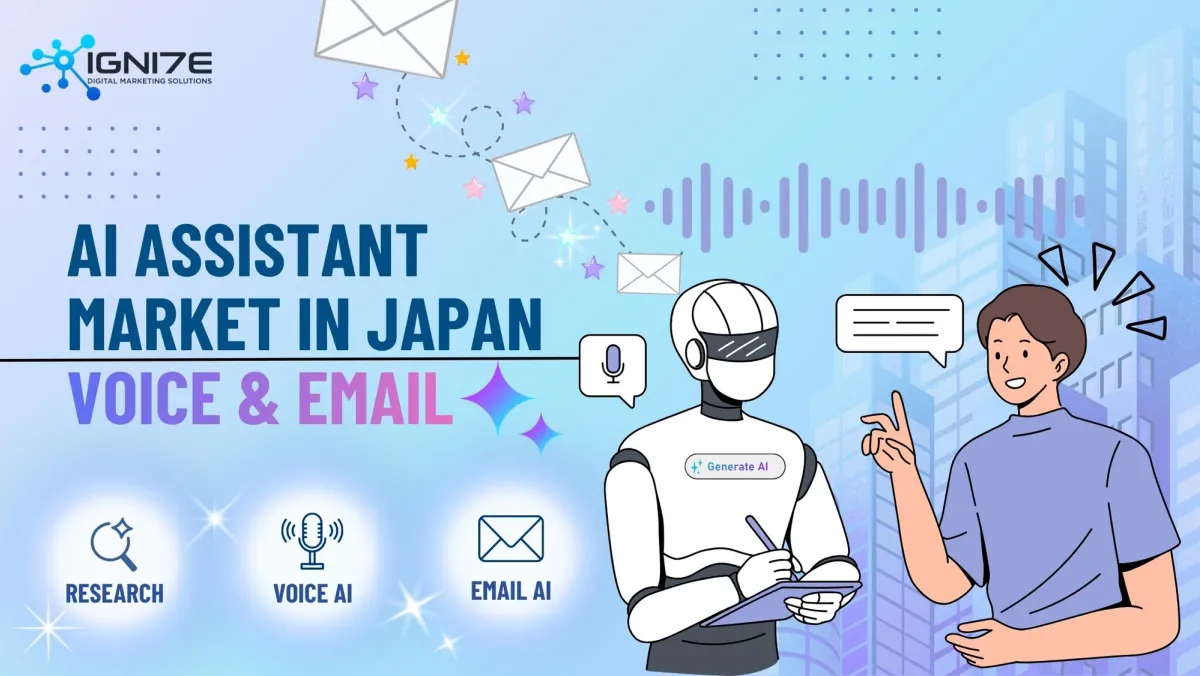
As of 2026, Japan remains one of the world’s largest economies and continues to be an attractive destination for international companies seeking expansion opportunities. Among the sectors drawing increasing attention in recent years is the AI assistant market, which helps organizations improve operational efficiency and boost productivity.
This article is designed for overseas companies considering entering or expanding within Japan’s AI assistant market. It explores not only the market’s size and growth potential but also trends in specific segments, such as the AI speech-to-text and AI email assistant markets. In addition, it examines Japan-specific user preferences and market entry barriers in depth.
We encourage you to read through to the end and use the information below as a reference when evaluating whether to enter Japan’s AI assistant market and which segments may offer the most promising investment opportunities.
Defining Japan’s AI Assistant Market
To understand Japan’s AI assistant market, it is important to begin with the fundamentals—namely, the definition of AI assistants and their unique position within the Japanese market.
What Is an AI Assistant? How It Differs from Generative AI and Its Role
An AI assistant is a software application or system that uses AI technologies to support a wide range of user tasks and automate and streamline business operations. It can handle activities such as responding to voice commands, creating and summarizing documents, managing schedules, and retrieving information, either independently or in collaboration with human users.
One concept often confused with AI assistants is generative AI, but the two are distinct. Generative AI is a broad category of technologies based on large language models (LLMs) that can generate new content, including text, images, and audio.
AI assistants, by contrast, use generative AI as their underlying engine while serving as the execution layer responsible for user interaction, task completion, and integration with external systems. In other words, the AI assistant market rests on advances in generative AI, and the two are complementary.
The Role of AI Assistants Within the Market
Within Japan’s broader AI ecosystem, AI assistants occupy a particularly important position as an application layer directly tied to improving business productivity. Traditionally, efforts to increase efficiency relied primarily on RPA and SaaS solutions. However, with the rise of generative AI, AI assistants have increasingly begun to supplement and, in some cases, replace portions of those functions.
The trend of using AI assistants is especially significant in Japan, where severe labor shortages and an aging workforce have intensified demand for productivity-enhancing technologies. As a result, AI assistants are no longer viewed merely as convenient tools; they are increasingly recognized as strategic infrastructure that enables companies to maintain their competitive edge. As a foundational technology supporting Japan’s productivity transformation, the AI assistant market is expected to become even more important in the years ahead.
Market Size and Growth Potential of Japan’s AI Assistant Market
Japan’s AI assistant market is currently experiencing strong growth. The section below examines the market’s size, the factors driving its expansion, and how it compares with global trends to highlight its overall potential.
Current Market Conditions and Adoption Trends
According to research from IDC Japan, Japan’s AI systems market reached JPY 1.3412 trillion in 2024, representing a 56.5% year-over-year increase and demonstrating rapid growth. The market is projected to expand further, reaching JPY 4.1873 trillion by 2029. The change represents a compound annual growth rate (CAGR) of 25.6% between 2024 and 2029, indicating sustained and significant expansion.
The rapid adoption of generative AI services such as ChatGPT since 2022 has played a major role in the expansion of the AI market. As businesses have become more comfortable incorporating AI into their operations, the number of companies considering implementing AI assistants has increased dramatically.
Supporting the trend, a survey conducted by the Japan Research Center found that the percentage of people who had used generative AI rose from 15.6% in June 2024 to 30.3% in June 2025—nearly doubling in just one year. Such growth suggests that generative AI tools, including AI assistants, are no longer limited to a small group of early adopters but are becoming part of the everyday workflow of business professionals across Japan.
Key Drivers of Market Expansion
Several factors are contributing to the growth of Japan’s AI assistant market. The most significant is the country’s severe labor shortage and the resulting need to improve productivity. Many Japanese companies are under pressure to deliver strong results with limited human resources, making AI assistants that enable automation and efficiency improvements an increasingly essential solution.
Another major factor is technological innovation, particularly the rapid advancement of large language models. These improvements have dramatically enhanced AI assistant capabilities, enabling more natural conversations and more sophisticated task execution based on contextual understanding.
Government-led digital transformation (DX) initiatives and proactive corporate IT investment have also played important roles. The Japanese government continues to strengthen support for AI-related research, development, and implementation, helping stimulate market growth. At the same time, businesses increasingly view AI adoption as a strategic priority for maintaining and strengthening competitiveness, leading to greater investment in AI assistant technologies.
Together, these factors are driving the continued expansion of Japan’s AI assistant market.
Competitive Landscape and Major Players in Japan’s AI Assistant Market
Japan’s AI assistant market is also increasingly shaped by competition between global technology companies and domestic Japanese providers. International firms such as OpenAI, Microsoft, Google, and Anthropic have expanded their presence in Japan through AI assistant solutions, including ChatGPT, Microsoft Copilot, Google Gemini, and Claude. Their strong position is supported by advanced foundation models and seamless integration with widely used productivity platforms, enabling businesses to adopt AI capabilities within existing workflows.
At the same time, Japanese technology companies are actively developing AI assistants tailored to the needs of the domestic market. Major players such as NTT, Fujitsu, NEC, SoftBank, and Hitachi have invested in proprietary large language models and enterprise AI solutions designed to address Japan-specific requirements. Examples include NTT’s tsuzumi and NEC’s cotomi, both of which place a strong emphasis on Japanese-language performance, enterprise security, and regulatory compliance.
While global providers benefit from scale, extensive AI ecosystems, and significant research investments, domestic vendors often differentiate themselves through localization, Japanese-language accuracy, and deployment options that align with the security and governance requirements of Japanese organizations.
Comparison with the Global Market
According to data from Statista, the global AI market is expected to reach USD 826.7 billion by 2030, reflecting rapid growth similar to that seen in Japan. Looking specifically at the global AI assistant market, it is projected to grow from USD 10.15 billion in 2025 to USD 45.16 billion by 2034, representing a CAGR of 18.04%.
In addition, research from Global Information, Inc. projects that the global consumer AI assistant market will grow from USD 3.4 billion in 2025 to USD 4.84 billion in 2026, achieving an impressive CAGR of 42.2%.
Compared with global markets, one defining characteristic of Japan’s AI assistant market is the scale of its untapped growth potential. Individual AI adoption rates in Japan remain lower than in countries such as the United States and China, and similar patterns are evident in the business sector.
At the same time, these numbers suggest that Japan’s AI assistant market is far from saturated. Significant opportunities remain not only in the B2B sector but also in the B2C market. From both a market size and growth perspective, Japan’s AI assistant market represents a highly attractive investment opportunity for international companies.
Key Characteristics of Japan’s AI Assistant Market and How It Differs from Overseas Markets
Successfully entering the Japanese market requires more than understanding its size. Companies must also gain a deep understanding of the cultural and business practices that shape the market. Japan’s AI assistant market is no exception, with several distinctive characteristics that set it apart from overseas markets.
A Market with High Expectations for Accuracy and Quality
Japan is well known for its exceptionally high standards regarding product and service quality, and such expectations extend to the AI assistant market. Japanese users tend to place greater value on accuracy and reliability than on the sheer number of features offered.
For example, users are often highly sensitive to even minor spelling errors, unnatural Japanese phrasing, or small software bugs, all of which can directly affect perceptions of product quality. As a result, simply introducing an AI assistant that has been successful overseas is rarely sufficient. Companies must carefully refine their products to meet the quality standards expected by Japanese users.
Strong Focus on Security and Privacy
Japanese companies are also highly conscious of security and privacy concerns. When evaluating AI assistants, many organizations pay close attention to how submitted information is handled and whether it could potentially be used as training data.
As a result, clearly communicating robust security measures and transparent data-handling policies is essential for building trust. Offerings such as on-premises deployments or private cloud environments, which allow organizations to operate within controlled environments, as well as features designed with strong data governance principles, can serve as powerful differentiators in the Japanese market.
The Importance of User Interface Design and Japanese Language Support
An intuitive and user-friendly interface is essential to enabling users to benefit from an AI assistant’s capabilities fully. However, success in Japan requires more than strong UI design. It also depends on localization, which reflects a deep understanding of the unique characteristics of the Japanese language.
Japanese includes complexities such as honorific language, ambiguity, and a strong reliance on context, making it fundamentally different from many other languages. As a result, simple machine translation often fails to capture these nuances accurately, leading to unnatural responses and potential misunderstandings.
Core Functions of AI Assistants and Three Key Application Areas
To fully understand Japan’s AI assistant market, it is important to examine the specific functions AI assistants provide and the business areas in which they are most commonly used. Below are three major functional categories within the market.
1. Content Creation
One of the most widely adopted capabilities of AI assistants today is content generation. AI assistants are increasingly used for a broad range of business documentation tasks, including drafting and summarizing emails, generating first drafts of proposals and reports, and creating presentation outlines. By significantly reducing the time spent on routine document creation, these tools enable employees to focus on more creative and higher-value work, making them highly attractive to businesses.
2. Operational Efficiency and Task Automation
AI assistants contribute not only to content creation but also to broader process optimization and task automation. Typical use cases include scheduling meetings, submitting expense reimbursement requests, and entering customer information into databases. In addition, integration with RPA solutions enables AI assistants to automate more complex workflows spanning multiple applications.
3. Voice Input and Speech Recognition
Voice-based interfaces are another key capability of AI assistants. In particular, the AI speech-to-text market—which converts meeting discussions into text in real time—is expected to grow substantially. Hands-free voice input systems are also gaining attention in environments such as manufacturing facilities and healthcare settings, where workers need to record reports or maintain records while keeping their hands free.
High-Growth Industry Use Cases: Healthcare, Finance, Education, and Customer Support
While AI assistants are being adopted across a wide range of industries, several sectors in Japan are emerging as particularly high-growth markets due to their strong demand for productivity improvements and specialized knowledge support.
In healthcare, AI assistants are increasingly being used to reduce administrative workloads by generating clinical documentation, transcribing patient consultations, and assisting with medical record management. As Japan faces both a rapidly aging population and a shortage of healthcare professionals, healthcare organizations are exploring AI-powered solutions to improve operational efficiency while allowing medical staff to focus more on patient care.
The financial services sector is also accelerating its adoption of AI assistants. Banks, insurance companies, and securities firms are utilizing AI to support market research, document review, compliance monitoring, and customer interactions. Given the highly regulated nature of the industry, financial institutions are particularly interested in AI assistants that offer strong security controls, auditability, and private deployment options.
In education, AI assistants are being used to support both educators and students. Common applications include lesson planning, content creation, administrative support, personalized learning assistance, and automated feedback generation. As schools and universities continue their digital transformation efforts, AI assistants are increasingly viewed as tools that can enhance learning experiences while reducing the administrative burden on teachers.
Customer support represents another rapidly expanding application area. AI assistants can automate responses to routine inquiries, summarize customer interactions, draft replies for support agents, and provide real-time recommendations during customer conversations. By reducing response times and improving service consistency, these solutions help organizations enhance customer experiences while managing support operations more efficiently.
As AI technology continues to mature, demand is expected to grow for industry-specific assistants that combine general AI capabilities with domain expertise, enabling organizations to address specialized business requirements more effectively.
AI Speech-to-Text Market Trends
As one of the key application areas for AI assistants, AI speech-to-text technology has followed a unique path of development and market growth in Japan. This section traces the evolution of Japan’s AI speech-to-text market over time.
Past: Primarily Adopted for Transcription and Meeting Minutes
In the early stages of Japan’s AI speech-to-text market, the technology was used primarily for transcribing audio recordings. For Japanese companies, where meetings are often lengthy, creating meeting minutes was a significant administrative burden, creating a clear demand for solutions that could streamline the process.
At that stage, the technology still struggled with challenges such as speaker identification and the accurate recognition of technical terminology. As a result, substantial manual editing was often required before transcripts could be finalized. Even so, the technology offered considerable time savings compared with transcribing recordings entirely by hand. Consequently, adoption gradually expanded from niche users such as media organizations and professional transcriptionists to general business environments.
Present: Advancements in Real-Time Processing and Multilingual Support
Today, Japan’s AI speech-to-text market is being shaped by rapid advances in real-time processing and multilingual capabilities. Technological improvements have made it possible to convert spoken content into text almost instantaneously during meetings. As a result, use cases now extend beyond meeting-minute preparation to include providing accessibility support for participants with hearing impairments and enabling attendees to review discussion content in real time as meetings unfold.
At the same time, demand for multilingual functionality is rising quickly as businesses become increasingly globalized. The ability to translate foreign-language conversations in real time and display them as Japanese subtitles is becoming an essential tool for companies engaged in international business.
Future: Japanese-Language Accuracy Will Become the Key Competitive Differentiator
Looking ahead, competition in Japan’s AI speech-to-text market is expected to increasingly focus on how effectively providers address the unique challenges of the Japanese language. Japanese contains many homonyms and frequently omits subjects, making it highly context-dependent. As a result, speech-to-text systems must do more than simply recognize words—they must accurately interpret the overall context of a conversation and the speaker’s intent.
In addition, emotional analysis capabilities that detect and reflect a speaker’s emotions and intonation are likely to become more widely integrated. If speech-to-text systems can capture not only what was said but also the nuances behind the words, the quality of communication can be significantly improved. It is no exaggeration to say that the sophistication of Japanese-language processing will be the defining factor differentiating products and services in Japan’s future AI speech-to-text market.
AI Email Assistant Market Trends
The adoption of AI assistants is also accelerating in email, which remains at the heart of business communication. This section examines the evolution of Japan’s AI email assistant market and its future direction.
Past: Primarily Used as Email Automation Tools
In the early stages of the AI email assistant market, these solutions were used primarily to automate routine tasks. Typical functions included automatically responding to incoming emails containing specific keywords using predefined templates or routing inquiries to the appropriate department based on their content.
At that point, these systems were closer to rule-based automation than true AI. Nevertheless, they addressed a growing need to reduce the workload of email management and helped lay the foundation for the AI email assistant market.
Present: Evolving Into Advanced Content Generation Powered by Generative AI
Today, the AI email assistant market has undergone a dramatic transformation thanks to the rise of generative AI. Instead of relying on predefined templates, AI can now understand the content of incoming messages and generate natural, contextually appropriate replies from scratch.
In addition, personalization features have emerged that learn from previous email interactions and generate content tailored to an individual user’s writing style and tone. As a result, the AI email assistant market has entered a more sophisticated and practical stage of development.
Future: Competition Among Major Players Such as Google and Microsoft Will Intensify
Going forward, competition in the AI email assistant market is expected to intensify among major technology companies that provide the underlying platforms. Google has already begun integrating advanced AI assistant capabilities into Gmail, while Microsoft has done the same with Outlook. Because these platforms are already widely used in the workplace, users can benefit from AI functionality seamlessly without adopting additional tools.
Future developments are likely to include even more personalized capabilities, such as systems that learn from an individual’s email history and generate messages that reflect that person’s writing style and thought patterns. AI email assistants are also expected to evolve beyond traditional email functions by automatically extracting tasks from messages, scheduling calendar events, and surfacing relevant documents, ultimately becoming comprehensive digital assistants.
Key 2026 Trends in the AI Assistant Market
Japan’s AI assistant market continues to evolve alongside advances in technology. The section below highlights three key trends that are expected to shape the market from 2026 onward.
The Rise of AI Agents Through Greater Autonomy
The most important trend in the 2026 AI assistant market is the evolution toward AI agents. Traditional AI assistants have largely been reactive tools that perform tasks based on user instructions. AI agents, by contrast, can autonomously develop plans, gather the information they need, and carry out multi-step tasks in pursuit of a given objective.
The growing autonomy of AI has the potential to reshape the relationship between humans and AI assistants fundamentally. Rather than managing every detail, people will increasingly take on supervisory roles while AI agents handle execution. The transition to supervisory roles represents a major turning point, transforming AI from a simple assistant into a “digital employee” capable of performing work independently. As such, it is expected to have a significant impact on Japan’s AI assistant market.
Expansion of Integrated AI Assistants Across Multiple Tools
Modern business operations span a wide range of applications, including email, chat platforms, calendars, document creation tools, and project management software. Until now, AI capabilities have largely been confined to individual applications. Going forward, however, integrated AI assistants that work seamlessly across multiple tools are expected to become increasingly common.
For example, an integrated AI assistant could update customer information in a CRM system based on a chat conversation and then generate a sales report in a BI tool using the updated data. Tasks that previously required manual coordination between applications could be automated. As these integrated solutions become more prevalent, competition in the AI assistant market will shift from standalone features toward the ability to support entire business workflows through a connected ecosystem.
Growing Adoption of Industry-Specific AI Assistants
While general-purpose AI assistants continue to gain traction, the adoption of industry-specific AI assistants is expected to accelerate as well. Examples include contract-review AI for legal departments, market-analysis AI for financial institutions, and diagnostic-support AI for healthcare settings. Businesses are increasingly seeking AI assistants that understand specialized knowledge and industry-specific workflows.
By training on large volumes of industry-specific data, these specialized solutions can achieve levels of accuracy and expertise that general-purpose AI cannot match. As a result, organizations are likely to adopt a combination of company-wide AI assistants and specialized assistants designed for particular departments. For overseas companies entering Japan’s AI assistant market, focusing on a specific niche where they can leverage their strengths and deliver deep value may prove more effective than attempting to address every segment.
Keys to Success for Overseas Companies in Japan’s AI Assistant Market
Japan’s AI assistant market offers significant growth potential. However, success requires a clear understanding of the market’s characteristics and the development of an appropriate strategy.
Success Depends on Workflow Integration
When Japanese companies evaluate AI assistants, they are generally less concerned with individual features than with how effectively the solution integrates into existing workflows and improves overall productivity. Many Japanese organizations have developed unique business processes and workplace cultures over the decades. As a result, even highly capable tools may struggle to gain traction if they do not align with established ways of working.
The key to success is not to position an AI assistant as a standalone product, but as a solution that integrates naturally into day-to-day operations. Positioning an AI assistant as such may involve providing APIs that connect seamlessly with customers’ CRM platforms or core business systems, or offering models that have already been trained on industry-specific terminology and workflows. Such measures help reduce implementation barriers and allow organizations to realize value quickly.
In Japan, success depends not only on technological excellence but also on a deep understanding of customers’ business operations and a genuine commitment to supporting their needs.
Japanese-Language Accuracy and UX Optimization Will Become Competitive Differentiators
In Japan’s AI assistant market, long-term competitive advantage will ultimately be determined by the quality of Japanese-language processing and the overall user experience (UX). As discussed earlier, Japanese users have exceptionally high expectations for quality, particularly regarding the naturalness of language.
User interface design is equally important. Japanese users generally prefer intuitive and refined interfaces that are easy to navigate, rather than overly complex screens packed with features. Companies should therefore not simply transplant user interfaces designed for overseas markets. Instead, they should tailor the user experience to the preferences and expectations of Japanese business professionals.
Investing heavily in localization—including involving Japanese designers and product managers from the earliest stages of development—will provide the foundation for sustainable growth in Japan’s AI assistant market.
Security, Compliance, and Data Governance Requirements
Security, compliance, and data governance have become critical considerations for organizations adopting AI assistants in Japan. While businesses recognize the productivity benefits of AI-powered tools, concerns about data protection, regulatory compliance, and handling sensitive information remain among the primary factors influencing purchasing decisions.
Many Japanese enterprises operate in highly regulated industries such as finance, healthcare, telecommunications, and the public sector, where strict requirements govern the collection, storage, and use of data. As a result, organizations increasingly evaluate AI assistant providers based not only on functionality but also on their ability to meet security and compliance standards. Features such as data encryption, access controls, audit logs, and secure user authentication have become essential requirements rather than optional capabilities.
Data governance is another major area of focus. Companies want clear visibility into how information is processed, where data is stored, whether user inputs are used for model training, and how long data is retained. In response, many AI vendors now offer private cloud and on-premises deployment options, allowing organizations to maintain greater control over sensitive business information and reduce the risk of unauthorized data exposure.
Japan’s regulatory environment further reinforces the importance of responsible data management. Organizations must comply with the country's data protection framework, including the Act on the Protection of Personal Information (APPI), and ensure that AI deployments align with internal governance policies and industry-specific regulations. Consequently, providers that can demonstrate transparency, robust security practices, and strong data governance frameworks are likely to gain a competitive advantage in Japan’s AI assistant market.
Conclusion: In Japan’s AI Assistant Market, Use Cases Matter More Than Features
This article has explored Japan’s AI assistant market from multiple perspectives, including its size, defining characteristics, emerging trends, and major application areas. It has also highlighted the factors influencing adoption and the considerations overseas companies should keep in mind when entering the market.
For international businesses exploring opportunities in Japan’s AI assistant sector, success will depend on more than technological sophistication alone. Companies must understand the unique needs of Japanese organizations, identify the use cases where they can deliver the greatest value, and tailor their solutions to local business practices and user expectations. By combining strong AI capabilities with effective localization, seamless workflow integration, and a clear understanding of market demand, overseas providers can establish a strong position in one of the world's most promising AI markets.
Frequently Asked Questions

An AI assistant refers to the broader category of software and systems that use various AI technologies, including generative AI, to support user tasks such as scheduling, information retrieval, and business process automation. Generative AI, on the other hand, serves as the “creator,” generating new content such as text and images.
According to IDC Japan, Japan’s AI systems market reached JPY 1.3412 trillion in 2024, representing a year-over-year increase of 56.5%, demonstrating rapid growth.
AI assistants are primarily being adopted in three areas. The first is content creation, which supports the development of business documents such as emails, meeting minutes, and presentation materials. The second is operational efficiency, which automates routine tasks such as scheduling and data entry. The third is speech recognition, including applications such as real-time transcription of meeting discussions.
Modern AI email assistants can do far more than generate template-based responses. They can understand the context of incoming messages and automatically create natural, personalized replies that align with the sender’s intent. They are also increasingly capable of integrating with calendars and other business tools to suggest or carry out actions such as scheduling meetings and creating tasks based on email content, thereby automating broader email-related workflows.
The primary reason is the country’s severe labor shortage resulting from a declining and aging population. Because AI assistants can automate and streamline business operations, they are viewed as a direct solution to the labor shortage challenge and are in demand across industries.
There are three primary barriers. First, advanced language-processing capabilities are required to address the complexity of the Japanese language. Second, products must meet the high standards of quality and reliability expected by Japanese users. Third, companies must provide robust security and privacy protections, which are top priorities for Japanese businesses.
AI agents—systems capable of autonomously planning and executing tasks to achieve specified objectives—are expected to see the most significant growth.
EN-JA bilingual project manager with experience leading Japanese translation and localization projects. Oversees SEO-focused content quality, production, and coordination.